
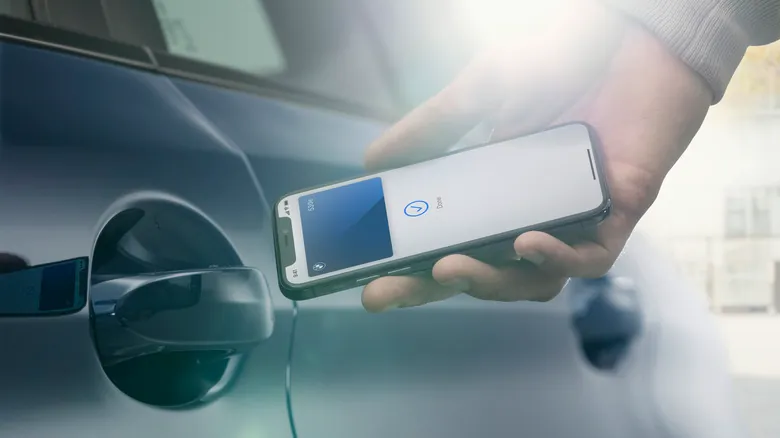
You walk up to your vehicle, and the doors unlock. You sit down, press the brake, and the engine starts. Your smartphone never left your pocket. That sequence relies on a highly coordinated handshake between your device and your car, driven by a combination of Bluetooth Low Energy (BLE), Near-Field Communication (NFC), and Ultra-Wideband (UWB) technologies.
Digital car keys pull cryptographic certificates directly from your phone to act as a secure access token. Making a phone act like a physical fob requires tight hardware integration to stop sophisticated thieves and ensure you aren’t stranded by a dead battery.
The Radio Waves Replacing Your Key Fob
Most modern digital key architectures use a three-tier radio system to handle different ranges of interaction. BLE acts as the scout. As you walk toward your vehicle, BLE establishes the initial low-power connection from several dozen feet away, waking up the car’s security systems.
UWB completely changes the physical interaction. This high-bandwidth wireless protocol takes over from BLE as you get closer. UWB measures distance with extreme, centimeter-level accuracy using time-of-flight calculations. This enables true passive entry. The vehicle recognizes the authenticated device in your pocket and unlocks automatically as you step up to the door. No tapping is required.
NFC sits at the core of the system as the reliable backup and the primary method for specific actions. NFC requires intentional, close-range proximity. To use it, a driver physically taps their device against an exterior NFC reader, which is usually built directly into the door handle. Once inside, they place the phone on an interior wireless charging pad to authenticate the ignition.
Stopping Relay Attacks with Time-of-Flight
Traditional radio frequency fobs have a widely exploited security flaw. Car thieves routinely execute “relay attacks” by using signal amplifiers. A thief stands outside your house, grabs the fob’s idle signal from your kitchen counter, and amplifies it to a partner standing next to your car. The car thinks the key is right there and unlocks the doors. UWB technology outright breaks this theft method.
Because UWB calculates physical distance based on the exact time a radio signal takes to travel back and forth, it relies purely on time-of-flight measurements rather than raw signal strength. Any artificial latency introduced by a relay hacker’s amplifier immediately adds time to that signal’s trip. The car detects the fractional delay, realizes the key is not physically nearby, and remains firmly locked.
Protecting Credentials in the Secure Element
Digital keys do not float loosely in your phone’s storage. Automakers tie these digital certificates directly into the smartphone’s Secure Element. This is a dedicated, hardware-based security module that operates completely isolated from the main processor and the primary operating system. If your phone downloads malware or gets hacked, the malicious software physically cannot access the partition holding your car keys.
For high-security actions, the system ties into the phone’s hardware biometrics. The digital key platform can demand a face ID or fingerprint scan before it sends the final authorization code to start the engine.
Cross-Platform Standardization
Nobody wants a digital key that only works on a single brand of phone. The Car Connectivity Consortium (CCC) handles the global standardization for this hardware. Their standard—currently up to Digital Key Release 4.0—defines the exact hybrid architecture that allows BLE, UWB, and NFC to hand off duties smoothly.
This universal framework allows major automakers like BMW, Volkswagen, Audi, BYD, Genesis, and Tesla to build systems that work universally across iOS and Android wallets. The NFC Forum heavily emphasized this cross-platform push in its 2026 Technology Roadmap. The focus is on establishing strict cross-platform interoperability standards so features like battery-less access work perfectly regardless of which phone you buy.
The Dead Battery Backup Plan
The most common fear regarding digital keys is getting locked out when your phone dies. Fortunately, the hardware accounts for this using NFC power harvesting.
An NFC chip can physically draw minute amounts of power directly from the car’s door lock reader during a tap. This energy harvesting allows the digital key to function perfectly well, according to official documentation from Samsung, for several hours after your device battery hits zero and the screen goes black. You just tap the dead phone to the handle, and the door opens.
Remote Access and Valet Restrictions
That constant digital connection completely changes how owners lend out their vehicles. Digital keys support granular, remote access controls. You can text a temporary digital key to a valet, a mechanic, or a teenager.
Based on the Car Connectivity Consortium guidelines, an owner can restrict that specific shared token. You can configure it so the valet key only opens the driver’s door and limits the car’s top speed. You can restrict a teenager’s key so the car simply will not start after a specific hour at night. And because modern digital keys store distinct user profiles, the car knows exactly who is opening the door. When a specific key unlocks the vehicle, the onboard computer instantly adjusts the climate controls, seat positioning, and even in-car payment accounts to match that specific driver.