
SpaceX will list on the Nasdaq on June 12 under the ticker symbol SPCX, targeting a $75 billion raise at a fixed price of $135 per share. The public offering comes as technology firms increasingly look to bypass strained terrestrial power grids by building data processing infrastructure in low Earth orbit.
The offering of roughly 555.56 million Class A shares gives the aerospace manufacturer an initial market capitalization of $1.75 trillion. The funds will support the company’s operational shift from a launch service provider to an operator of an “orbital economy.” This infrastructure strategy focuses on expanding Starlink broadband, establishing space-based solar power arrays, and constructing extraterrestrial data centers.
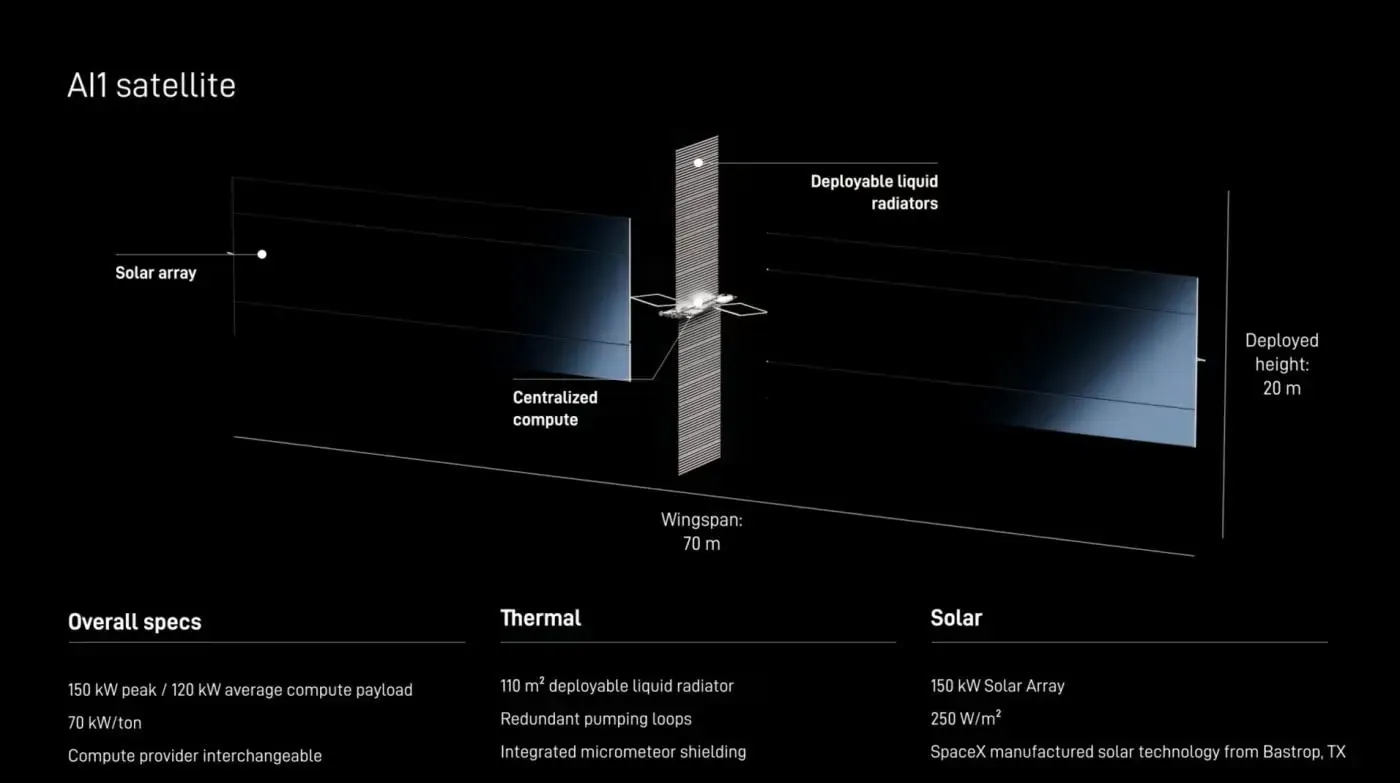
Ahead of the public listing, the company released specifications for the hardware driving this expansion. SpaceX detailed its first-generation “AI1” orbital compute satellite. The hardware utilizes a 150 kW peak compute payload, an advanced liquid radiator thermal management system, and a 150 kW solar array. The space computing initiative integrates technical resources from the company’s February all-stock merger with the artificial intelligence firm xAI.
How Starcloud and Kepler Communications Complicate the Orbital Compute Market
The World Economic Forum projects the global space economy will grow from $630 billion to $1.8 trillion by 2035. SpaceX enters this specific data infrastructure sector against active competition. Rival aerospace and technology firms are currently deploying their own orbital hardware networks to capture the off-planet computing market.
Y Combinator-backed competitor Starcloud deployed a NVIDIA H100 GPU into space late last year. The firm recently filed an active FCC application for an 88,000-satellite data-processing constellation, operating alongside established network hardware from Kepler Communications and Starcloud. The influx of IPO capital provides SpaceX with immediate liquidity to accelerate its AI1 manufacturing output and secure an early physical presence in the emerging orbital server market.