
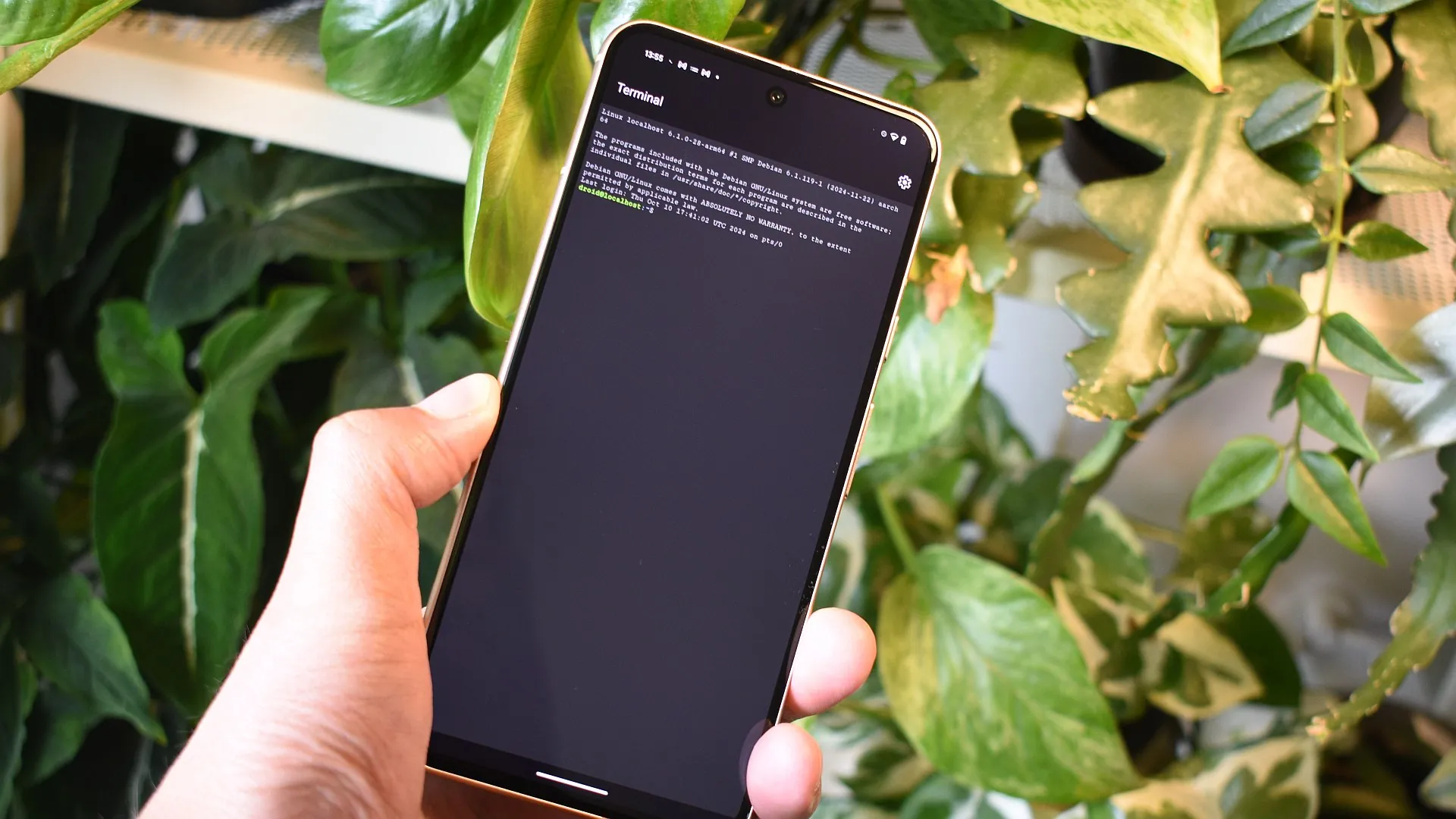
Android hardware routinely outpaces the demands of daily mobile tasks. Unlocking that raw compute to run desktop-grade software usually requires voiding warranties and rooting the device. Adam Conway at XDA Developers bypassed those hard restrictions, successfully booting a full Debian Linux working environment directly on an unrooted Android smartphone.
The setup relies entirely on Termux and PRoot Distro. This combination punches through the standard Android application sandbox and the operating system’s restricted Bionic C library. Instead of spinning up a sluggish virtual machine, PRoot acts as a translation layer for system calls and filesystem paths.
The result? A conventional GNU/Linux userspace running natively on the phone’s own kernel.
Once the environment boots, users get full access to the familiar Debian filesystem structure. Conway used standard apt commands to pull down ARM64 Linux packages. The phone handled terminal multiplexers like tmux and text editors like Neovim directly. He also installed Git, Python, Node.js, and even Claude Code straight to the mobile hardware.
Getting these tools functional requires some terminal maneuvering, which Conway documented in a hands-on experiment tracking the setup constraints.
Conway noted the daily user experience remains “rough around the edges” when dealing with mobile touchscreens and external peripherals. But he concluded this specific Debian configuration brings a standard Android handset dangerously close to fully replacing a traditional laptop for developers.
ARM64 Architecture Blurs the Line Between Mobile and Desktop
Running native Linux environments on unrooted phones highlights a massive hardware shift. Apple’s M-series chips already proved that ARM-based silicon can dominate the desktop market. Android processors from Qualcomm and MediaTek now share that same underlying ARM64 instruction set.
When developers use tools like PRoot to strip away the mobile UI sandbox, they aren’t emulating a desktop. They are executing code exactly as it would run on an ARM-based Linux laptop. This pathway allows software engineers to compile code, manage servers, and test APIs from a pocket-sized device during travel or hardware failures.