
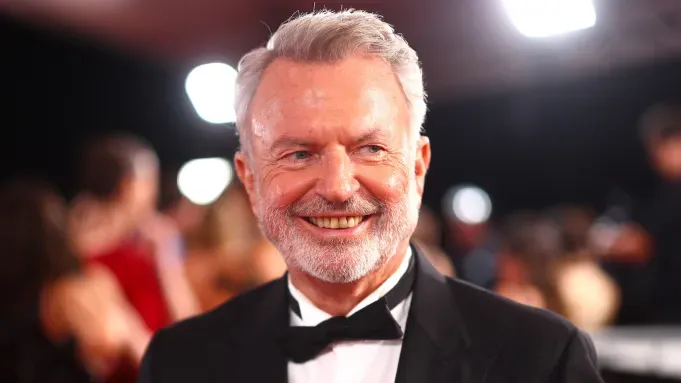
Sam Neill’s sudden passing in Sydney on Monday hit Hollywood hard. The 78-year-old actor was universally beloved, pulling off the rare career feat of anchoring a blockbuster franchise like Jurassic Park while effortlessly slipping into gritty prestige television like Peaky Blinders. And almost immediately after the news broke, his peers flooded social media to share memories of a deeply generous collaborator.
British actor Richard E. Grant led the public memorials on Instagram. Grant wrote that Neill was “An officer and a gentleman in the truest sense,” adding that Neill had “Guided and helped me through a very difficult time in my life… Sail on, kind Sir.” Pop icon Kylie Minogue kept her reaction brief, posting “vale Sam,” while actress Daisy Ridley also shared a heartfelt remembrance, according to a roundup published by The Independent.
Behind the camera, the affection was just as obvious. Jurassic World Dominion director Colin Trevorrow remembered Neill as a “deeply soulful and beautiful man.” Trevorrow specifically highlighted the actor’s natural “tranquillity” and “calm assuredness” on set.
The loss also resonated at the highest levels of government in the region. New Zealand Prime Minister Christopher Luxon publicly called Neill “one of our greatest cultural exports.” Australian Prime Minister Anthony Albanese quickly echoed that sentiment, noting the actor had “earned a special place in Australian hearts.”
While his death was a shock, his family offered a crucial clarification regarding his health. Neill had previously been diagnosed with stage three angioimmunoblastic T-cell lymphoma, a rare blood cancer, in 2022. But he rigorously treated the disease and publicly announced he was cancer-free in April 2026. A family spokesperson confirmed the actor was still cancer-free at the time of his death, detailing the circumstances in an official statement published by the Evening Standard.
That brutal battle with cancer heavily influenced his final years. Neill credited his 2023 memoir, Did I Ever Tell You This?, with giving him “a reason to live” during his initial treatment phases. He leaves behind an industry that clearly adored him and a filmography that defined an entire generation of cinema.