
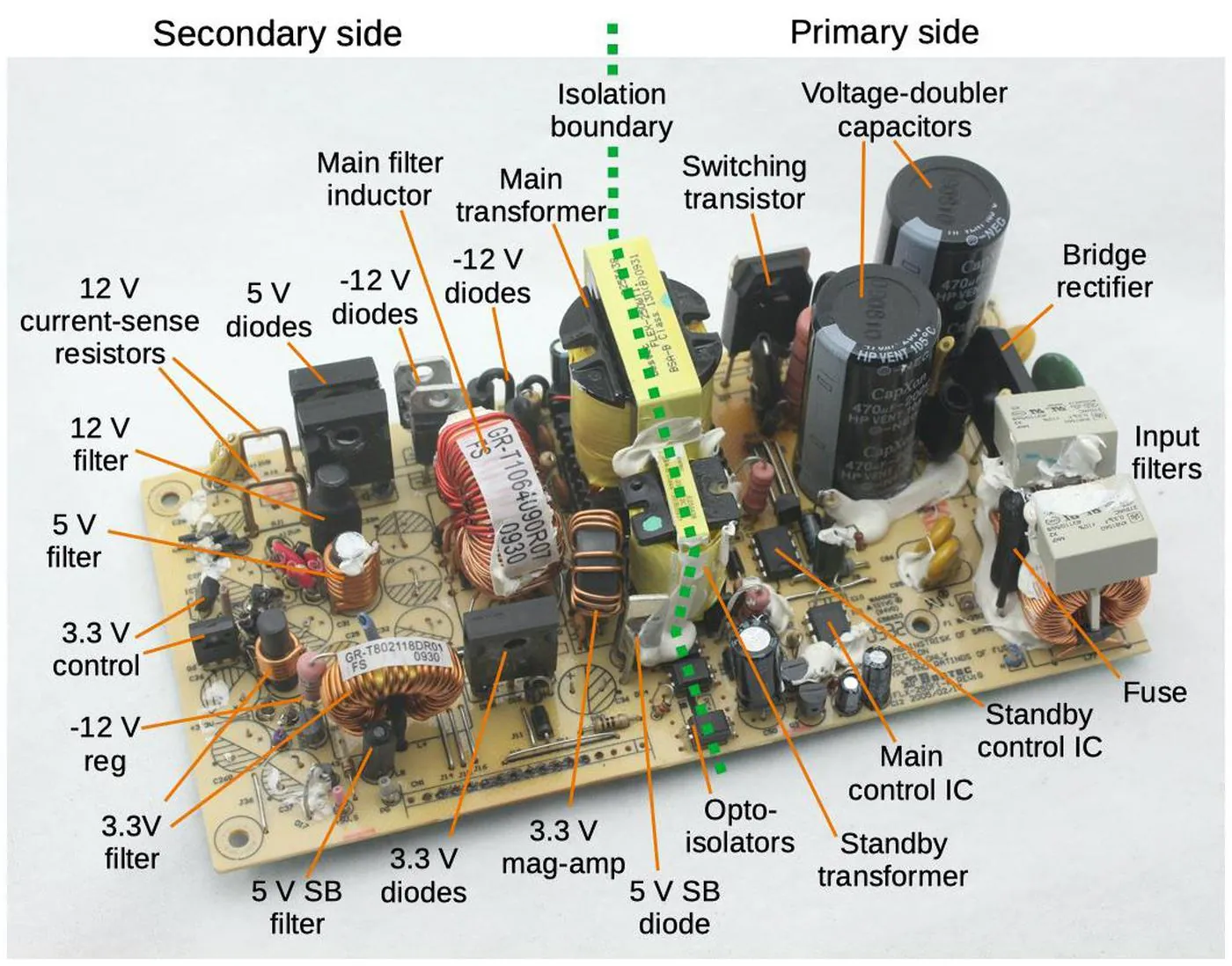
The DIY home lab community is seeing rapid growth as tech enthusiasts build self-hosted AI inference nodes and local cloud storage. This trend frequently relies on recycling decommissioned desktop hardware to bypass upfront costs.
Repurposing an old gaming PC into a 24/7 server places continuous, extreme stress on aging Power Supply Units (PSUs). When older budget power supplies fail under this relentless load, they push out-of-spec voltage downstream, frying the motherboard, CPU, and storage drives instantly.
Key Details
- Capacitor degradation is driven by heat and time, with component lifespan roughly halving for every 10-degree Celsius increase in operating temperature.
- A single year of constant 24/7 home lab operation inflicts the exact same thermal wear on a power supply as a full decade of casual daily gaming.
- Older consumer units run highly inefficiently at the low idle loads typical of home servers, spiking electricity costs and generating excess chassis heat.
The primary mechanism of hardware death is capacitor degradation, governed strictly by heat and time. A standard engineering rule dictates that capacitor life halves for every 10-degree Celsius increase in operating temperature. A power supply that easily handled two hours of gaming a day for years degrades rapidly when forced to run 8,760 hours straight. The sustained thermal stress quickly exhausts the remaining lifespan of the internal components.
The drive to build a power-efficient home server is frequently undercut by these older units. They operate inefficiently at the low idle loads where home servers spend the majority of their time, dumping excess heat into the chassis and driving up electricity costs.
Why Budget PSUs Take The Entire System Down With Them
Enterprise-grade server power supplies use independent protection circuits to ensure a clean shutdown. When a high-quality unit reaches the end of its life, it simply turns off. Repurposed consumer units lack this specific hardware safety net.
Hardware diagnostics attribute many of these secondary failures to broken Multilayer Ceramic Capacitors (MLCCs) and sustained thermal stress. Without robust Over Voltage Protection (OVP) and Over Current Protection (OCP) circuits, a dying consumer PSU shoots unregulated voltage straight into the motherboard. According to documentation verifying physical component failure, the absence of independent OVP is the primary reason an old power supply destroys the equipment it powers.