
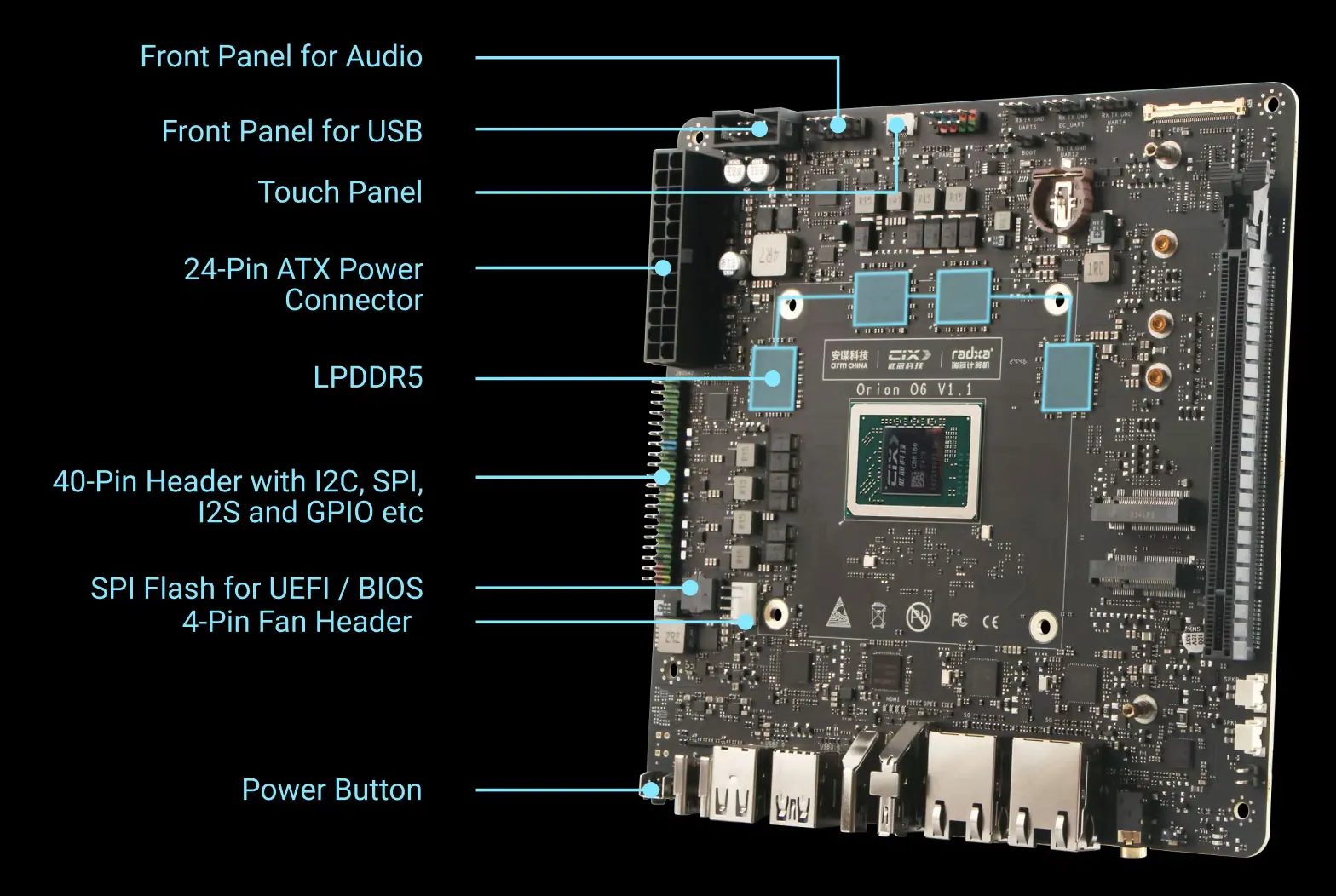
For decades, the custom PC building scene has been completely locked to the x86 architecture dominated by Intel and AMD. That monopoly is fracturing in 2026 as the Radxa Orion O6 hits the market. This new Mini-ITX motherboard allows enthusiasts to build a standard, modular desktop powered entirely by an open-source Armv9 processor.
It runs on the Chinese-developed CIX P1 System-on-Chip, built using a highly efficient 6nm TSMC process. You get a 12-core CPU setup combining Arm Cortex-A720 and A520 cores, paired with up to 64GB of LPDDR5 memory. It is an absolute dream for hardware tinkerers looking to step up from low-power boards into actual desktop workstations.
The hardware easily leaps past mainstream hobbyist boards. In synthetic single-core and multi-core benchmarks, the CIX P1 outpaces older favorites, completely outclassing the Raspberry Pi 5 at a $212 starting price. You even get dual 5GbE network ports and an Arm Immortalis G720 GPU equipped with hardware ray-tracing.
There is a dedicated Neural Processing Unit on board pushing 30 TOPS for local edge AI tasks. But the platform is still bleeding-edge, meaning you have to be ready to troubleshoot. Software support remains the immediate bottleneck, with only a handful of Linux distributions like Debian and Fedora officially supported right now. Trying to get a dedicated PCIe graphics card running smoothly on the physical Gen4 x16 slot is currently a sloppy, inconsistent experience.
How the Standard 24-Pin ATX Connector Changes the Hardware Market
Single-board computers usually rely on proprietary power bricks or simple USB-C adapters, completely isolating them from the standard PC component market. The Orion O6 changes this equation by integrating a traditional 24-pin ATX power connector alongside standard USB-C PD support.
This physical design choice signals a deliberate industry movement. ARM processors are no longer strictly for closed-box laptops, tablets, or industrial servers. Hardware manufacturers are actively designing pathways to drop them directly into the standard desktop PC chassis enthusiasts have used for twenty years.