
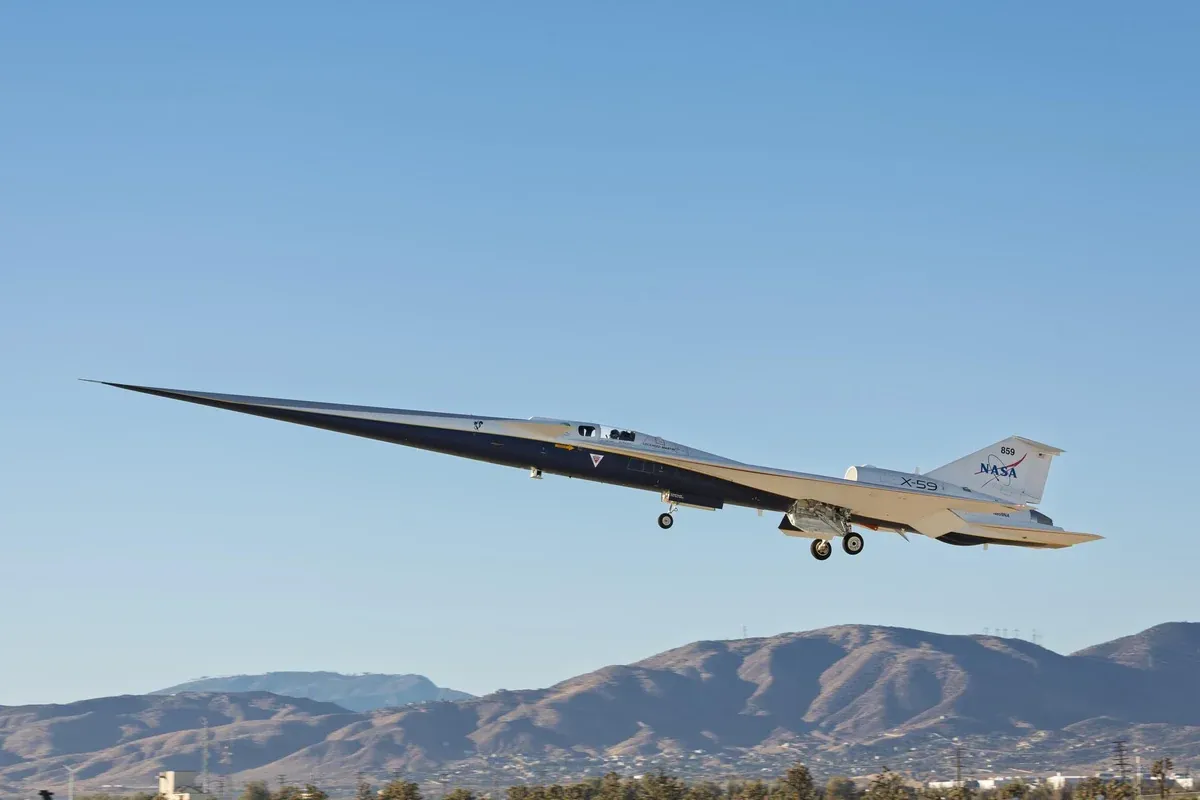
For over 50 years, commercial supersonic flight over U.S. land has been strictly outlawed due to the ear-shattering noise of sonic booms. On Friday, June 12, NASA took a major step toward overturning that ban. The experimental X-59 research aircraft successfully reached Mach 1.4—about 924 mph—at an altitude of 55,000 feet over Edwards Air Force Base in California, according to Engadget.
The flight marks a clear progression for the Quesst mission, a joint project with Lockheed Martin’s Skunk Works. The goal is to prove that an aircraft can break the sound barrier without rattling windows on the ground. The X-59 features an elongated, spear-like nose designed to physically separate shock waves, preventing them from merging into an explosive sonic boom and reducing the sound to a gentle “sonic thump.”
The Envelope Expansion Phase
The June 12 test comes just one week after the aircraft initially breached the sound barrier. The jet hit Mach 1.1 at 43,400 feet on June 5. Engineers are currently pushing the plane through its envelope expansion phase to test structural limits at increasing speeds.
Right now, the X-59 does not fly alone. An F-15 chase plane accompanies the experimental jet during these high-speed runs. The loud, traditional sonic booms generated by the F-15 intentionally obscure the X-59’s experimental noise profile. This setup will remain until the dedicated acoustic validation phase officially begins.
How the Quesst Mission Moves Forward
NASA engineers follow a strict roadmap before the aircraft interacts with civilian populations:
- Envelope Expansion: Pushing the aircraft to its maximum speed and altitude limits alongside standard chase planes.
- Acoustic Validation: Measuring the actual ground-level sound generated by the elongated nose design over unpopulated testing ranges.
- Community Response: Flying the X-59 over select U.S. cities to gather direct human feedback on the perceived noise levels.
How the X-59 Tests Threaten the 1973 Overland Speed Ban
The 1973 U.S. ban on civilian supersonic flights over land defined the commercial aviation industry for half a century. It was a primary factor in the eventual retirement of the Concorde in 2003, as airlines simply could not justify the operating costs of supersonic jets if they were restricted strictly to transoceanic routes. The success of the X-59 directly challenges this regulatory framework.
NASA intends to present the final acoustic data from these community flights directly to U.S. and international regulators. If the agency proves the airframe geometry successfully mitigates shock wave convergence, it gives the Federal Aviation Administration a data-driven basis to establish new, acceptable noise thresholds. This specific policy shift is the required first step before any modern aerospace company can viably launch a commercial supersonic fleet.