
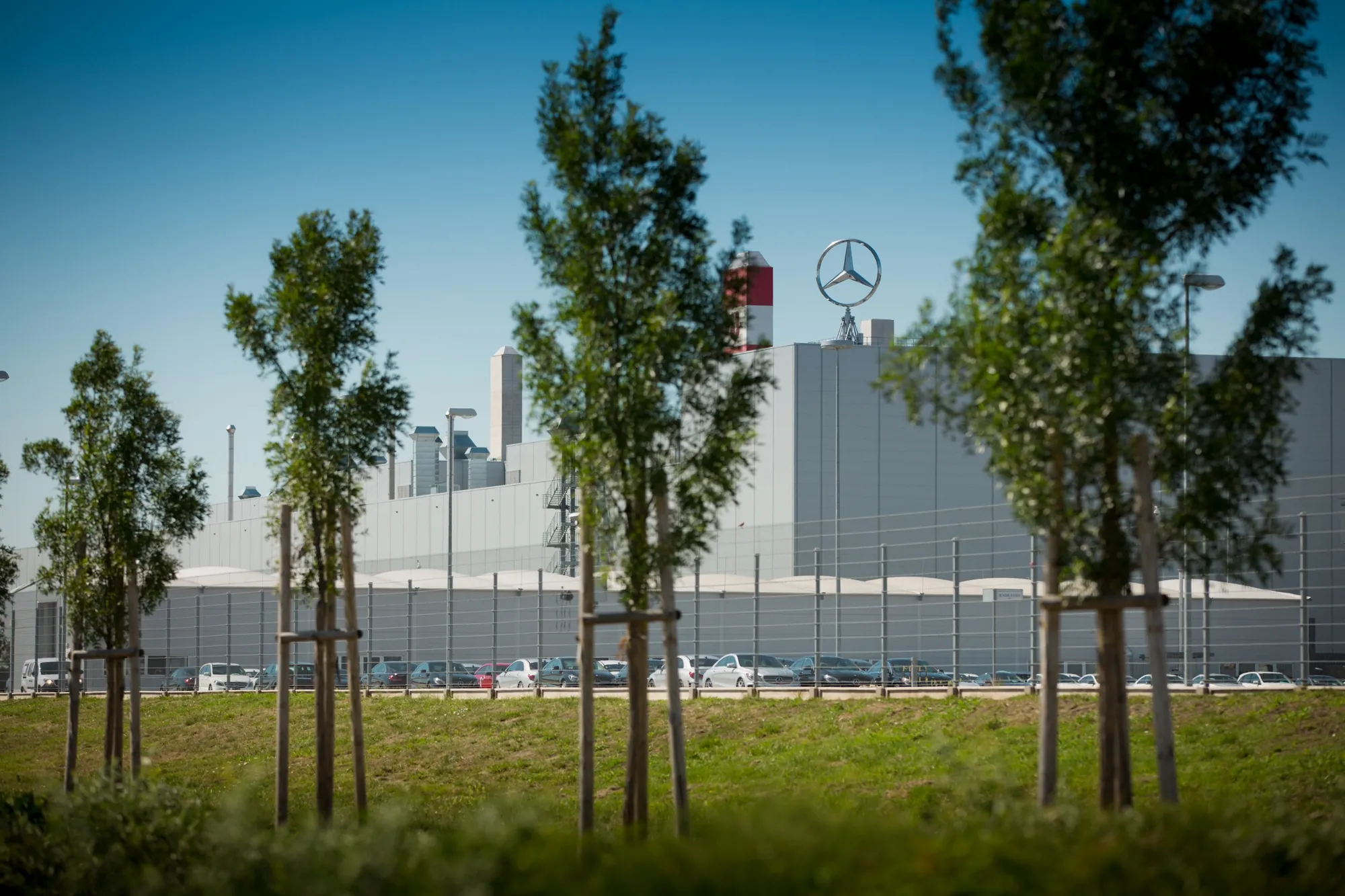
Mercedes-Benz is moving the assembly of its upcoming compact G-Class SUV out of Germany. The automaker plans to build the model at its Kecskemét, Hungary facility, prioritizing lower labor and production costs over domestic manufacturing. The compact SUV is scheduled for an official debut on July 13, aligning with a formal corporate announcement regarding the European supply chain.
The decision redirects significant volume away from the Rastatt assembly lines. German manufacturing plants in Sindelfingen, Bremen, and Rastatt are now projected to lose roughly 100,000 vehicles in combined annual output. Mercedes is reallocating those resources eastward.
To support the new vehicle, the Kecskemét plant is undergoing an expansion that will position it as the automaker’s largest factory in Europe. The production shift completely bypasses the lineage of the traditional G-Wagen, which historically rolls off the Magna Steyr assembly lines in Graz, Austria. Instead, the automaker is proceeding with a €1 billion Hungarian investment that will grow the facility’s workforce from 3,000 to approximately 7,500 employees.
Key Details
- Capacity upgrades: The Kecskemét facility will increase its maximum annual output from 300,000 to 400,000 vehicles.
- Market timeline: The compact SUV, often referred to internally as the “Little G,” is projected to hit the market in 2027 or 2028.
- Strategic reversal: Executive boards originally envisioned the vehicle as an EV-only product before revising the blueprint.
That strict electric-vehicle mandate is dead. Faced with cooling consumer adoption rates and immediate legislative changes in key markets, Mercedes abruptly changed course on the powertrain engineering. The company recently approved a 1.5-liter hybrid internal combustion engine to sell directly alongside the electric variant, adjusting its global strategy to account for the loss of federal incentives in the United States.
Why Automakers Are Cutting German Assembly Lines
European automakers are aggressively attempting to rein in assembly costs. Global economic uncertainty, combined with elevated German labor rates, makes domestic EV production difficult to balance on a spreadsheet. The compact G-Class was designed to be a high-margin prestige product. By moving assembly to a lower-cost European jurisdiction and pivoting to a mixed-powertrain model, Mercedes is financially insulating the vehicle from volatile electric vehicle demand across North America and Europe.