
The new mobile processor MediaTek Dimension 9200 it’s official! It is one of the most promising SoC (System on Chip) in recent years and will compete, throughout 2023, with Qualcomm’s next Snapdragon 8 Gen 2.
It stands out for the higher energy efficiency of up to 25%, which means a much lower energy consumption. Also, compared to the previous flagshipthe Dimensity 9000, the new Dimensity 9200 brings general performance improvements.
This is MediaTek’s new high-end chipset, the Dimensity 9200
As expected, MediaTek has just introduced its latest high-end processor for mobile devices. The new Dimensity 9200 stands out for incorporating several innovations in the industry mobile with better performance and excellent efficiency.
First of all, MediaTek Dimensity 9200 is based on 2nd generation TSMC 4nm lithography process. Thus, according to the company, at peak performance the energy efficiency consumed is reduced by up to 25% for greater autonomy.
Therefore, compared to its predecessor, this chipset will not only be faster, but will preserve battery life better.
It is based on TSCM’s second generation 4nm process.

The MediaTek Dimensity 9200 is also the first chipset to integrate a core (major) ARM Cortex-X3 with a maximum frequency of 3.05GHzbased on ARMv9 architecture.
In addition, we also have three core ARM Cortex-A715 with a maximum frequency of 2.85GHzas well as quad core Cortex-A510 with a maximum frequency of 1.8GHz.
In summary, we have the following nucleic configuration:
- 1x Cortex-X3 up to 3.05GHz
- 3 x Cortex-A715 up to 2.85GHz
- 4 x Cortex-A510 up to 1.8GH
The new processor also includes the ARM Immortalis – G715 graphics card (GPU) as engine of ray tracing hardware based and variable rate representation. In addition, the new MediaTek chipset achieved a total of 1.26 million points in the reference point antutu.
The MediaTek chipset integrates ARM Immortalis graphics – G715 with ray tracing
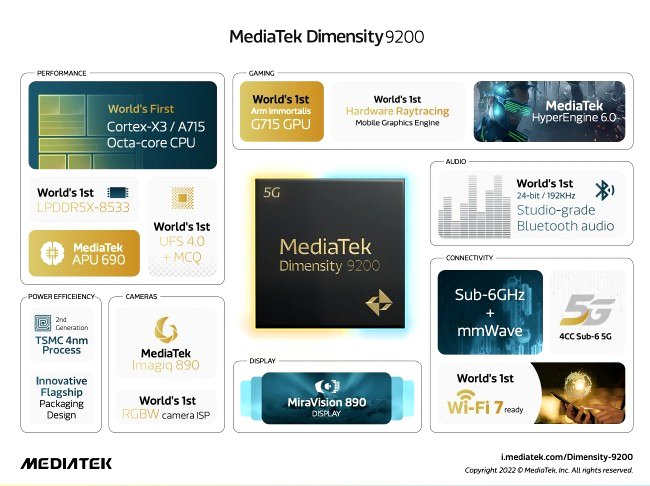
Its technical features also include support for LPDDR5 RAM, as well as UFS 4.0 internal storage, the fastest read and write standards for memory.
In addition, it supports displays with a maximum resolution of 5K and a refresh rate of 60 Hz. It supports a WHQD display of up to 144 Hz or, at most, a Full-HD display with a refresh rate of up to 240 Hz.
At the same time, MediaTek claims that the new on-screen image processing engine will make content stand out thanks to the Miravision 980 system.
We also have a new AI NPU (APU 900), a 6th generation artificial intelligence engine. In fact, this AI system promises to reduce energy consumption very substantially in various usage scenarios.
More powerful, more efficient and with more than 1.26 million points in AnTuTu
The MediaTek Dimensity 9200 chipset also has the Image Signal Processor, also known as ISP Image 890. According to the manufacturer, it has native support for RGWB (red, green, white and blue) image sensors, capable of processing RAW files natively and capturing up to 30% more light in images.
In addition, it also promises to improve video capture, with more detail and detail preserved in recordings, as well as being able to capture more light in videos.
Wi-Fi 7 is already supported by MediaTek Dimensity 9200
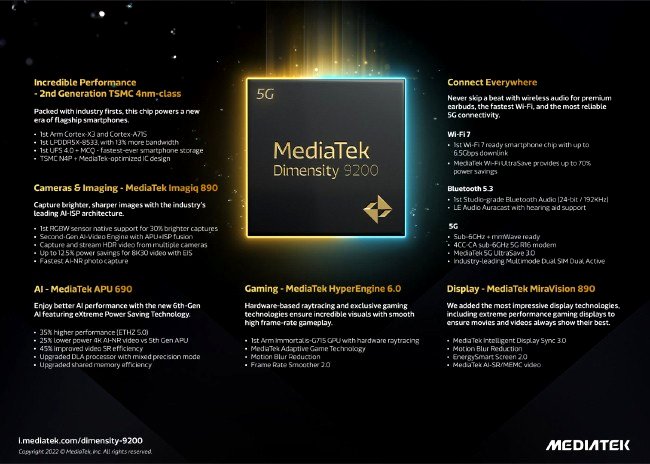
Connectivity is also assured in MediaTek Dimensity 9200 with the SoC that integrates a new modem capable of guaranteeing a stable connection in 5G for sub-6 GHz and mmWave frequencies.
In addition, compatibility with the upcoming wireless network standard, Wi-Fi, is guaranteed. In fact, we have native support for the upcoming Wi-Fi 7 standard, making it the first chipset to support this connectivity.
Vivo has already announced that it will use the new MediaTek chipset

Finally, the first smartphones to integrate the MediaTek Dimensity 9200 processor will be from Vivo, arriving on the market in 2022. In addition, we also trust OPPO and use this chipset in some versions of its next Find X.
In addition, several executives from Xiaomi, Honor and ASUS ROG have also shown interest in the capabilities of this processor, so we have smartphones from these manufacturers to integrate the MediaTek Dimensity 9200.