
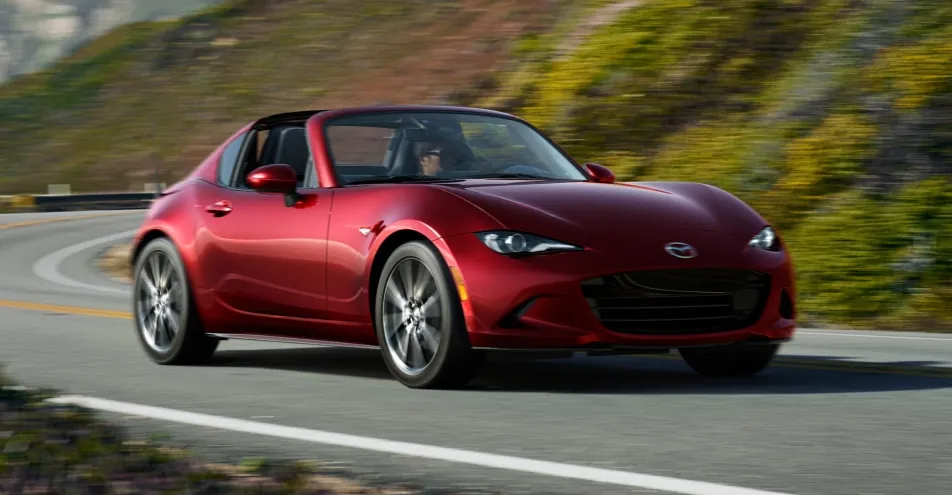
The biggest threat to the Mazda MX-5 Miata has always been battery bloat. Electrification adds crippling weight and physically ruins the perfect balance of a small roadster. A recently published patent filed with the USPTO (US-12673545-B2) shows Mazda engineers have devised a mechanical workaround to shrink the physical footprint of hybrid powertrains. By re-engineering the bulky power converter and inverter into a flattened, L-shaped housing, the hardware now slides directly into the dead space next to the transmission.
This keeps the heavy electrical components entirely out of the engine bay. The design protects the hardware during a front-end collision while freeing up critical space in the small chassis. It proves that engineers are actively fighting to preserve the nimble driving dynamics of the upcoming “NE” generation vehicle.
Key Details
- The US-12673545-B2 patent relocates the high-voltage AC busbars lower down in the chassis to improve crash safety.
- Engineers flattened internal components like the smoothing capacitor and DC busbar to fit neatly behind the engine.
- The architecture directly responds to stringent incoming emissions standards forcing lightweight vehicles into hybridization.
Integrating high-voltage systems into a compact rear-wheel-drive platform usually ruins the handling dynamics. The USPTO patent details how the L-shaped housing wraps around the transmission tunnel, keeping the center of gravity incredibly low. This is part of a wider engineering push to keep the vehicle compliant with environmental laws. Other documents outline weight distribution goals using tunnel-mounted batteries and rotary hybrids.
How Euro 7 Standards Force Compact Innovation
The transition to this architecture is a direct response to strict incoming emissions rules. Euro 7 policies demand higher efficiency across all internal combustion engines. This puts low-volume, high-performance vehicles in a tight spot. Mazda is not the only manufacturer executing this aggressive packaging race. Toyota is actively stripping down and shrinking its hybrid components to fit inside smaller vehicle platforms.
The engineering challenge is maintaining the strict lightweight ethos the Miata has championed for over 30 years without failing regional compliance checks. Shrinking the inverter is a critical step in keeping the roadster legal on global roads.
The Bottom Line
Sports car purists worried about a heavy, bloated hybrid Miata can breathe slightly easier. Mazda’s mechanical creativity proves that electrification does not automatically require a bulky crossover platform. If this L-shaped inverter makes it to the final production NE model, the MX-5 will likely retain the nimble, lightweight driving character that defined its legacy.