
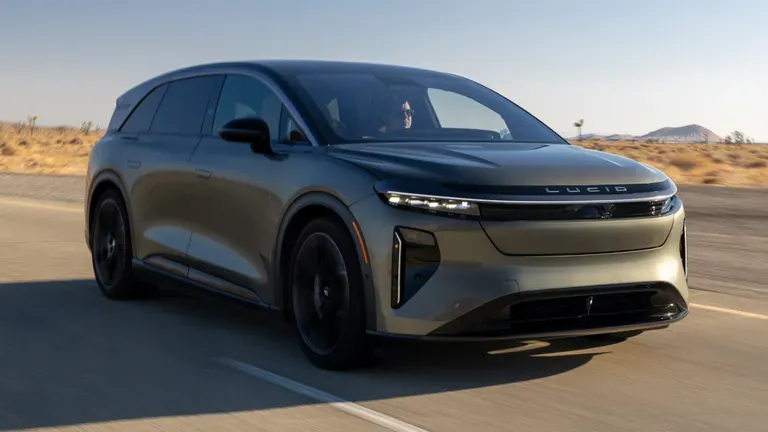
The highly anticipated 2026 Lucid Gravity Grand Touring just went through a rigorous 547-mile real-world test. Electric SUVs often struggle with highway efficiency, but Lucid is trying to change the math in a highly competitive market. The three-row luxury vehicle boasts 828 horsepower and shoots from 0 to 60 mph in just 3.4 seconds. Raw speed is just the beginning of the hardware story.
The true standout is the electrical efficiency. In mixed driving across highways, city streets, and backroads, the Gravity achieved an average of 2.93 mi/kWh, yielding an actual range of 354 miles. When drivers used a more conservative approach, that number climbed to 3.12 mi/kWh. The official EPA estimate pushes the maximum potential up to 450 miles. The vehicle runs on a 924V electrical architecture, which means it charges from 0 to 80 percent in only 25 minutes. That brief pit stop adds roughly 360 miles of driving range.
Buyers stepping into the Gravity lineup will find the base Touring trim starting at just under $80,000. For the high-performance Grand Touring model tested here, the price sits around $125,000, which closely tracks with the figures laid out in a detailed Edmunds analysis. Inside, the SUV offers 120 cubic feet of total cargo space and a power-sliding second row. It also includes lifestyle-focused additions like rear-seat tray tables and multiple 120V outlets for powering devices on the go.
Despite earning high marks for its sedan-like driving dynamics, excellent third-row comfort, and a lack of body roll, the vehicle has a few early bugs. Testers explicitly noted that the early build of the Gravity is currently “plagued with some software issues.” Lucid will need to push over-the-air updates to match the physical polish of its hardware.
How the Gravity Challenges Rivian and Cadillac
The release of the Gravity officially pushes Lucid into the highly profitable three-row SUV segment, moving the company beyond its flagship Air sedan. They are now competing directly against the Rivian R1S, the Volvo EX90, and the Cadillac Escalade IQ. Lucid holds a unique engineering advantage in this specific fight.
The company explicitly states that the advanced powertrain technologies driving the Gravity are derived directly from their historic experience engineering cars for the Formula E racing series. That motorsport background explains how an SUV of this size manages to corner flatly while maintaining incredibly high electrical efficiency. Competitors relying on older 400V architectures and heavier battery packs will have to adapt quickly to match these charging speeds and weight-management metrics.