
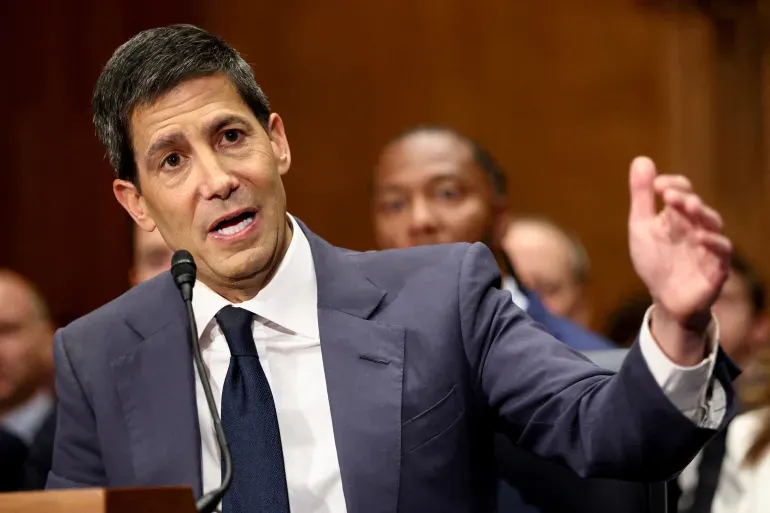
Newly appointed Federal Reserve Chair Kevin Warsh is presiding over his first Federal Open Market Committee meeting, where the central bank is widely expected to hold interest rates steady at their current target range of 3.50% to 3.75%. The decision to pause comes directly from a recent surge in global energy prices triggered by the US-Iran war. Although a preliminary peace deal recently lowered oil costs, the preceding energy crunch drove US inflation back up to 4.2% in May, forcing the Fed into a cautious holding pattern.
Instead of immediate rate adjustments, Warsh is using the June 16-17 meeting to implement a major shift in the central bank’s communication strategy. Warsh took office on May 22, and his immediate priority is shifting away from predictive signaling while maintaining current rates. He favors a policy of “strategic ambiguity,” intending to reduce the Fed’s reliance on forward guidance and potentially eliminate the easing bias entirely from the FOMC statement.
The End of Predictable Guidance
Warsh is actively questioning the long-standing communication tools utilized by his predecessors. He has expressed skepticism regarding the value of regular post-meeting press conferences and the institutional “dot plot” projections that map out future rate expectations. Wall Street traders are closely monitoring his press conference tone, according to live Fed updates, to see exactly how much transparency he plans to strip from the central bank’s public posture.
The Fed’s decision to hold rates contrasts sharply with the actions of other global central banks reacting to the exact same energy-driven inflation pressures. The European Central Bank recently hiked its key rate to 2.25%. Simultaneously, the Bank of Japan raised its rates to 1%, hitting a 31-year high. Warsh is the 17th chair of the Federal Reserve since 1913 and the 11th since the modern FOMC structure was established in 1936, and his initial policy divergence places the US on a distinct path from its primary economic allies.
Why the Fed is Abandoning the Ample Reserves Framework
Beyond public messaging, Warsh is preparing to fundamentally alter the mechanics of US monetary policy. He intends to formally transition the Fed’s primary policy lever away from the “ample reserves” balance sheet framework. This system, heavily relied upon over the last decade, will be replaced with a return to strict federal-funds rate targeting.
This operational shift forces financial markets to abandon their reliance on telegraphed central bank moves. By scaling back the balance sheet and removing predictable forward guidance, Warsh is requiring institutional investors to react to immediate economic data rather than trading on the Fed’s projected intentions.