
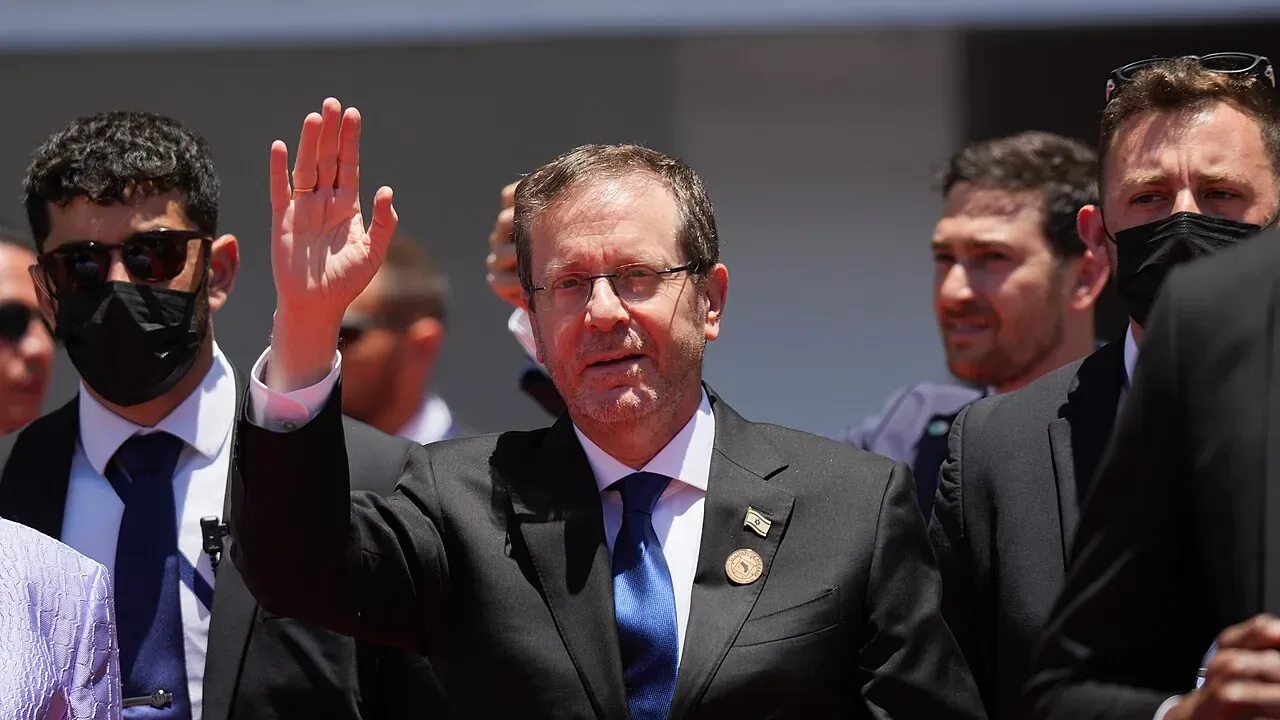
Israeli President Isaac Herzog announced on Saturday night, Nov. 7, that opposition leader Gadi Eisenkot will receive the first opportunity to build a governing coalition following Israel’s Oct. 27 general election. The decision puts Eisenkot, a former military chief and leader of the Yashar party, in position to potentially unseat Prime Minister Benjamin Netanyahu, Israel’s longest-serving premier.
In formal consultations with Herzog this week, parliamentary factions representing 67 of the Knesset’s 120 members endorsed Eisenkot, according to an official tally reported by Dawn and Reuters. Factions representing 46 lawmakers backed Netanyahu, whose Likud party remains the single largest faction in parliament, while seven members made no recommendation.
“President Herzog has invited Gadi Eisenkot to the President’s Residence, where he will be tasked with forming the government tomorrow,” Herzog’s spokesperson said in a statement on Saturday evening. Immediately after the announcement, Eisenkot wrote on X: “This is the time to establish a national emergency government. I will do anything possible to prove us worthy,” according to the Associated Press.
The Coalition Math in the 120-Seat Knesset
Turning those 67 endorsements into a seated 61-member majority will require difficult compromises. Neither Netanyahu’s religious-nationalist bloc nor Eisenkot’s opposition bloc won an outright parliamentary majority in the Oct. 27 vote.
Arab-led parties made historic gains in the election and recommended Eisenkot to Herzog to prevent Netanyahu and his far-right allies from returning to power. However, an Arab party has formally joined an Israeli governing coalition only once in the country’s history, and building such an alliance carries major political obstacles after more than three years of war in Gaza.
Reporting differs on how far Eisenkot will go in working with Arab lawmakers. The Associated Press reported that Eisenkot “has indicated a willingness to partner with them under certain conditions, including calling Hamas a terrorist group that needs to be destroyed,” and noted he could also pursue a minority government supported externally by Arab parties outside the formal coalition, though other factions in his bloc have said they would reject that arrangement. Reuters and Dawn reported that Eisenkot and his bloc have “declined to join forces with Arab parties” despite receiving their endorsement.
According to Al Jazeera and Reuters, Eisenkot could reach a 61-seat majority without Arab-led parties if he persuades the two ultra-Orthodox factions, Shas and United Torah Judaism, to join his coalition. Another option is a broad unity government with major Jewish parties, including Likud, though deep policy divisions stand in the way. Netanyahu relies on ultra-Orthodox parties that demand military draft exemptions for religious seminary students and opposes a formal state investigation into the security failures surrounding the Oct. 7, 2023 Hamas-led attacks. Eisenkot has set baseline coalition conditions requiring mandatory military, national, or civilian service for all citizens, adherence to the Declaration of Independence, recognition of Israel as a Jewish, democratic, liberal, and equal state, and the dismantling of Hamas’s military and governing power in Gaza, The Indian Express reported.
Clashes Between Netanyahu and Yashar
Shortly before Herzog announced his pick on Saturday, Netanyahu released a video statement calling for a “national unity government” and warning against “hastily swearing in a government with terrorist supporters,” a phrase he uses to describe the Arab-led parties. Netanyahu has campaigned against any partnership between Eisenkot and Arab lawmakers and previously made unsubstantiated claims that Arab parties “stole” the Oct. 27 election.
Eisenkot’s Yashar party—whose name translates to “Straight”—rejected Netanyahu’s video in a statement on X. The party called on Likud lawmakers to break their alliance with “radical parties,” referring to far-right coalition partners Itamar Ben-Gvir and Bezalel Smotrich, and reiterated that Eisenkot will only include lawmakers who back his party’s principles and recognize Hamas as a terrorist organization.
Eisenkot served as Chief of Staff of the Israel Defense Forces from 2015 to 2019 and entered politics in 2022, according to Al-Monitor. Following the Oct. 7, 2023 attacks, he joined Netanyahu’s wartime cabinet as an observer for eight months before resigning and returning to the opposition. During the Gaza conflict, Eisenkot’s son and two of his nephews were killed in combat.
Eisenkot is scheduled to formally receive the mandate from Herzog at a ceremony at the President’s Residence on Sunday, Nov. 8. Once tasked, he starts an initialfour-week window of 28 days, as reported by Al Jazeera, and has “up to six weeks to form a coalition,” including extensions, according to the Associated Press.