
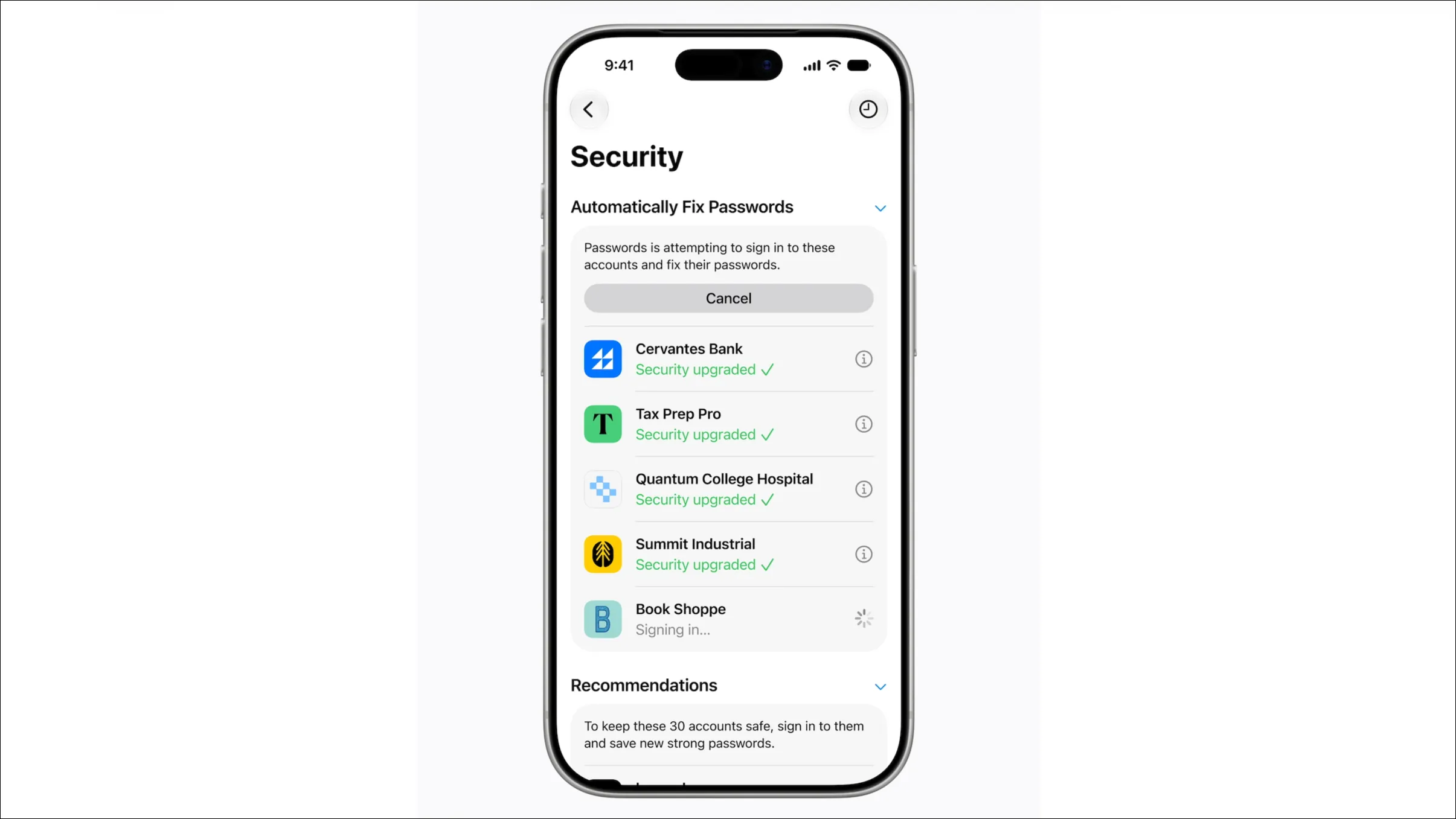
Apple just took a big step toward autonomous software. Buried inside the newly released iOS 27 developer beta is an AI feature for the Passwords app. With a single tap, this AI will automatically go to websites in the background and change your weak, reused, or compromised passwords for you.
You don’t have to visit the websites yourself anymore. The system uses a combination of Safari and Apple Intelligence to execute the password updates quietly in the background, as confirmed by BleepingComputer. As the AI goes to work, you see real-time status updates on your screen shifting from “Signing in” to “Saving strong password.”
If a site requires two-factor authentication, the AI simply asks for temporary permission to grab the one-time verification code from your Messages or Mail app. Once the new credential is created, it saves directly to your iCloud Keychain so it can autofill across your other devices. But there is a catch. The automation currently only works on eligible, supported platforms, according to AndroidHeadlines. It cannot visit every single website on the internet just yet.
The convenience is great for everyday users, but it is causing immediate concern for IT departments. Author Arin Waichulis at 9to5Mac pointed out a compliance issue in the current beta build. There is no Mobile Device Management (MDM) toggle to turn this agentic AI off on company-owned hardware. If an employee taps “fix” on a personal iPhone, the AI could attempt to alter enterprise accounts. This risks triggering failed password updates or system lockouts for work accounts that require dedicated authenticator apps.
How Autonomous Agents Shift the Burden of Account Security
This update is a fundamental shift in how tech companies approach personal security hygiene. For years, the burden of fixing a data breach vulnerability fell entirely on the user. You had to log in, check the account settings, and generate a new code yourself. Now, Apple is transferring that friction to an autonomous on-device agent.
They are actually matching a competitor in this specific cybersecurity niche. Google rolled out a similar automated password-changing feature for its Chrome browser last year, noted by PCMag. The transition from AI as a chatbot to AI as an active, executing agent is officially underway on the two most popular mobile operating systems.