
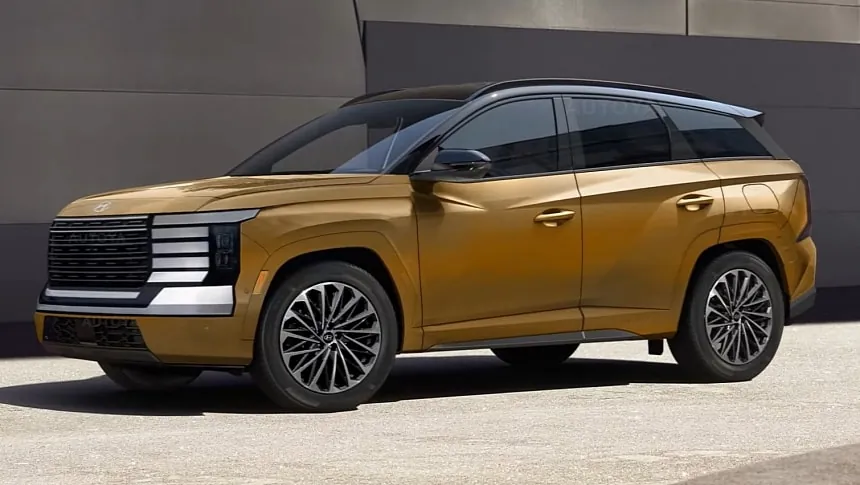
Hyundai is completely rewriting the design language for its top-selling vehicle. Newly released renderings indicate the next-generation Tucson crossover is abandoning its familiar curves for a rugged, heavily squared-off exterior. The upcoming model heavily borrows from the blocky architecture recently introduced on the midsize Santa Fe.
The strategy represents a calculated corporate risk. Automakers typically iterate cautiously on their primary revenue drivers. But Hyundai is instead pivoting the Tucson sharply to capitalize on a lucrative consumer shift toward utilitarian, off-road aesthetics.
Key Details
- Longer hoods and prominent wheel arches will replace the current urban-focused profile.
- A flat, upright rear end maximizes interior cargo volume while altering the vehicle’s footprint.
- The cabin is expected to integrate a larger, Android Automotive-powered touchscreen infotainment system.
- Standard powertrains will likely receive hybrid-focused upgrades to maintain segment competitiveness.
Design chief Simon Loasby previously signaled this directional pivot. He noted the corporate mandate was to “turn the volume up on the capability and SUV-ness” across the lineup. The newly dropped renderings confirm that directive applies even to the brand’s primary volume driver. Test mules show an unapologetically flat rear end and widened wheel arches. The vehicle essentially presents as a scaled-down Santa Fe.
The compact crossover class long ago replaced the traditional sedan as the default American commuter vehicle. Fending off segment leaders like the Toyota RAV4 and Honda CR-V requires distinct product differentiation. By adopting a rugged profile, Hyundai is specifically targeting buyers who typically gravitate toward the outdoor-lifestyle aesthetics of the Subaru Forester and Mazda CX-50.
The Calculated Risk of Altering a Volume Leader
Automakers rarely subject their best-selling products to polarizing design overhauls. A misstep in the compact crossover segment instantly erodes market share and quarterly revenue. Hyundai’s aggressive styling bet indicates a structural corporate belief that the sleek, urban-crossover aesthetic has peaked.
Consumers are consistently rewarding brands that project durability and outdoor capability, even if the vehicle never leaves paved roads. Transitioning the Tucson to this upright, truck-like silhouette is an overt attempt to command premium pricing. The brand is betting it can attract a demographic willing to pay for off-road styling without cannibalizing its traditional commuter base.