
High-rise physical security screening relies on overlapping layers of technology, personnel, and structural design to manage foot traffic and block unauthorized entry. Protecting a commercial tower requires far more than locking the front doors. According to research authored by Geoff Craighead at the Council on Tall Buildings and Urban Habitat (CTBUH) and Dennis Challinger at ASIS International, modern screening demands a unified ecosystem. That means combining perimeter physical barriers with strict digital identity verification.
Background: How We Got Here
The screening process actually begins outside the lobby. Strong exterior doors, reinforced windows, and retractable bollards at loading docks are the foundational physical barriers. They deter unauthorized entry before anyone reaches a security desk. And that is just the start. The transition away from traditional lock-and-key systems brought in digital access control. Keycards, biometric scanners, and mobile apps allow building managers to track movement electronically. They can instantly revoke permissions if a credential gets lost. The result? A tighter grip on exactly who enters the building.
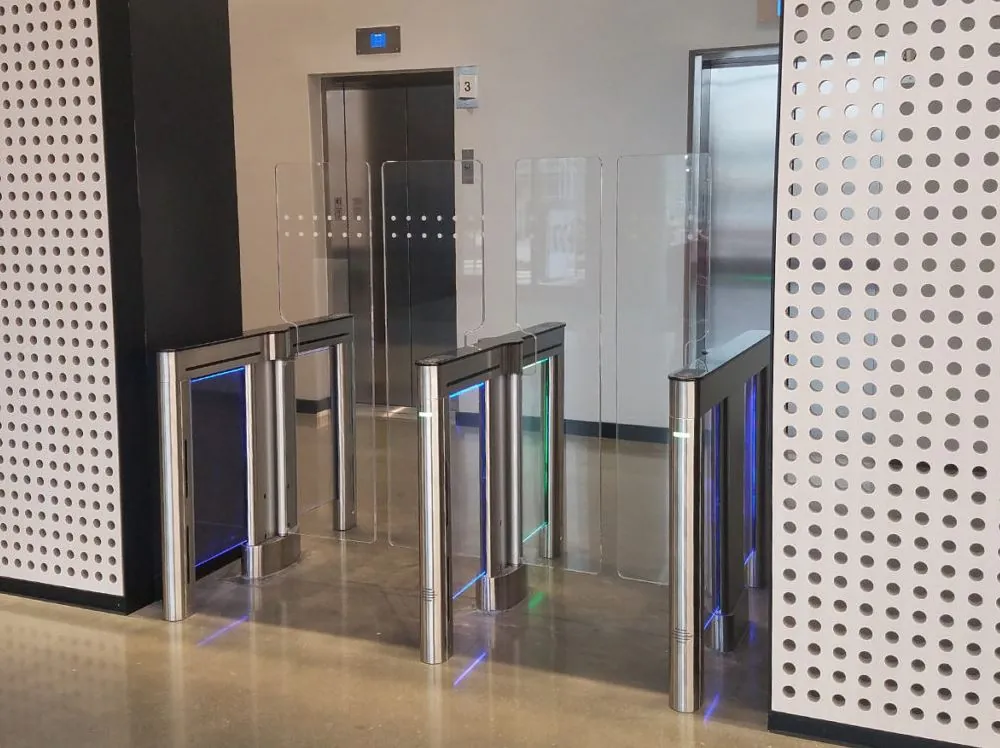
To handle high volumes of foot traffic quickly, corporate lobbies use optical turnstiles. These entrance barriers use infrared sensors to process authorized users. They also detect, delay, and trigger physical alarms against “tailgating” or “piggybacking.” Tall buildings have unique physical vulnerabilities simply because movement is artificially constrained to specific choke points like elevators and stairways. The sheer volume of people moving through lobbies creates an anonymous mass. This gives offenders a populated environment to blend in easily and exploit small errors, like a propped side door.
Key Players and Stakeholders
The people enforcing these systems matter just as much as the hardware. Relying purely on a receptionist’s visual recognition is an outdated method. In large buildings with high turnover, visual verification often lets unauthorized individuals slip right through. Modern screening relies on strict authorization documents and pre-registration software instead. Visitors must present government-issued photo identification. Security personnel then check this against an authorized daily manifest before handing over a temporary access badge.
Delivery trucks are verified against scheduled manifests at the loading docks. Drivers stay restricted to designated zones. For high-value tenants, couriers must be explicitly authorized by the tenant before proceeding, and contractors must be escorted in sensitive areas. But human error still causes problems. The National Institutes of Health (NIH) documented a specific incident where building security failed to verify the date on an access memorandum for a pest control company. The company was improperly admitted on a Monday evening instead of the preceding Friday. The following morning, several tenant employees became ill due to residual pesticide exposure that had not been given the required two days to dissipate. A well-meaning employee holding a secure door open for a stranger bypasses millions of dollars in security infrastructure without breaking a sweat. Technology only works when the humans involved follow the rules.
What’s at Stake
Building managers are constantly evaluating the likelihood of various threats and planning emergency preparedness strategies. Elevators are now an active screening layer. By integrating access control with destination dispatch software, visitors must swipe their credentials in the lobby. The system then directs them to a specific elevator car programmed to stop only at their authorized floor. In a standard elevator, anyone who slips into the cab can press a button and access multiple floors. Destination dispatch eliminates the buttons inside the car entirely. You tell the system where you are going in the lobby, and it groups passengers by floor. This stops wandering entirely.
For high-profile facilities, security teams are replacing traditional metal detectors with high-resolution millimeter-wave (mmWave) and AI-powered screening systems, like those from Rohde & Schwarz. These scanners safely detect both metallic and non-metallic concealed items without the need for invasive physical pat-downs. Unlike airport X-ray machines that require people to empty their pockets and place bags on a belt, modern mmWave scanners allow visitors to walk through at a normal pace. This keeps lobby traffic moving while still detecting hidden objects.
The boundary between physical security and cybersecurity is gone. With networked cameras and access control systems acting as potential entry points for hackers, physical security is a core component of Enterprise Risk Management. Video surveillance cameras use AI-powered analytics and edge computing to do more than passively record. They autonomously identify behavioral anomalies, flag loitering in restricted zones, and recognize crowd formations in real-time. Disparate, siloed systems are a vulnerability. In modern buildings, video surveillance, intrusion detection, and Building Management Systems operate on a unified platform. If occupancy sensors detect anomalies in a space that access control shows as empty, the system instantly flags a potential breach. That integration is what keeps towers secure today.
Key Takeaways
- High-rise screening relies on strict digital identity verification rather than visual recognition, ensuring visitors only access floors they are explicitly approved to visit.
- Optical turnstiles and destination dispatch elevators physically enforce access rules, preventing common bypass methods like tailgating and unauthorized floor selection.
- Human error remains a primary vulnerability in building access, requiring strict adherence to digital manifests to prevent accidental or malicious breaches.