
In a technical tutorial published by the WeVideo Film School at WeVideo, and a practical assessment conducted by cinematographer Neil Oseman at Neil Oseman Cinematography, the underlying mechanics of forced perspective are exposed as a strict science of geometry, optics, and extreme lighting. Forced perspective is an in-camera optical illusion that manipulates human depth perception, forcing objects to appear significantly larger, smaller, closer, or further away than their physical reality. The technique requires zero digital alteration, relying entirely on how the brain interprets relative scale when monocular depth cues are intentionally corrupted.
The practice traces its psychological roots back to the Ames Room, a distorted trapezoidal space developed by Adelbert Ames Jr. in 1946. Inside an Ames Room, a person walking from one corner to another appears to grow or shrink drastically. Filmmakers co-opted this concept to trick the camera lens. By placing one actor close to the camera and another actor far away along the Z-axis (depth), a director can make a normal-sized human look like a towering giant next to a tiny companion.
To maximize the visual distortion, cinematographers frequently manipulate foreground and background proportions with wide-angle lenses. Wide lenses inherently exaggerate the size of objects positioned close to the glass while simultaneously pushing background elements further away, making them appear diminutive. This optical characteristic naturally enhances the illusion of extreme scale disparity before the crew even turns on the studio lights.
The Physics of Deep Focus and Intense Illumination
The entire illusion shatters the second the audience spots a blurry background. If the giant in the foreground is sharp but the tiny character in the background is slightly out of focus, the human brain instantly recognizes that the two subjects are not standing next to each other on the same physical plane. To maintain the trick, the camera must capture a deep depth of field, keeping both subjects perfectly sharp.
Achieving deep focus requires the camera assistant to “stop down” the lens aperture. By closing the iris to a very small opening—often an f/16 f-stop or tighter—the camera increases the range of distance that appears acceptably sharp. However, this creates a massive logistical headache for the lighting department. A heavily restricted aperture allows very little light to hit the film plane or digital sensor, forcing the crew to achieve deep focus without blurring the background by flooding the set with an unnatural amount of illumination.
Lighting a forced perspective set is governed by the inverse square law of light. If a light source is moved twice as far away from a subject, it must be four times as bright to yield the same level of illuminance. Because actors and props are staggered dozens of feet apart along the Z-axis to fake the size difference, balancing the exposure across that vast depth requires exceptionally powerful incandescent studio fixtures. The resulting heat generated by these massive light arrays becomes a physical hazard on set. When filmmakers use foreground miniatures to simulate massive castles or spaceships, the crew must constantly monitor the props to ensure the intense heat does not melt or degrade the detailed paintwork during a long shooting day.
Solving the Camera Movement Problem
For decades, forced perspective shots were strictly locked off on a tripod. Moving the camera left or right introduces parallax—the optical effect where objects closer to the lens appear to move across the frame faster than distant objects. The moment parallax occurs, the spatial distance between the near and far actors is revealed, destroying the scale illusion. Modern filmmakers rely on three specific techniques to bypass this limitation.
- The Nodal Point Pivot: If a director wants to pan the camera across a forced perspective scene without exposing the trick, the camera cannot just swivel on a standard tripod head. It must rotate perfectly around its nodal point. This specific optical center is the exact axis where light rays cross inside the lens. By calibrating the rig to maintain the zero-parallax-point during a pan, the foreground and background elements remain locked in their artificial relationship.
- Synchronized Moving Platforms: To achieve dynamic tracking shots, the production crew must build moving sets. If the camera tracks right, the optical alignment between the near actor and the far actor will shift. To compensate, the platform holding one of the actors (or a section of the set itself) must mechanically slide in the opposite direction at a mathematically precise speed. This counters the parallax effect in real-time, allowing the camera to move freely while the scale illusion holds firm.
- The Proxy Eyeline Trick: Because the actors are actually standing 15 to 20 feet apart to fake their size difference, they cannot look directly at each other. If they make actual eye contact, their sightlines will converge at the wrong angle, making them look cross-eyed or disconnected on screen. Instead, the crew places proxy markers—often brightly colored tennis balls mounted on C-stands—at specific heights off-camera. The actors deliver their emotional performances to the tennis balls, ensuring their eyelines match perfectly when the two separate depths are compressed into a single 2D image.
Famous Case Studies in Hollywood Illusion
Practical scale manipulation has driven some of the most iconic imagery in cinema history, functioning as a staple of visual storytelling long before digital compositing existed. In 1941, cinematographer Gregg Toland weaponized deep-focus lenses and scale tricks for Citizen Kane. By manipulating the physical distance between props and characters, Toland repeatedly dwarfed Charles Foster Kane against massive background windows, visually encoding the character’s isolation and suffocating power dynamics directly into the framing.
Just a year later, the production of Casablanca (1942) faced a severe space constraint. The script called for a deep, sprawling airport runway at night, but the crew was confined to a cramped Hollywood soundstage. To simulate the vast distance, the production built miniature painted airplanes and placed them at the back of the stage. To sell the illusion of scale, they hired dwarf actors to walk around the planes dressed as mechanics. By utilizing miniature planes and dwarf actors in the Casablanca background, and spraying down the set with a fake rainstorm to obscure the visual trickery, the crew manufactured an expansive tarmac entirely indoors.
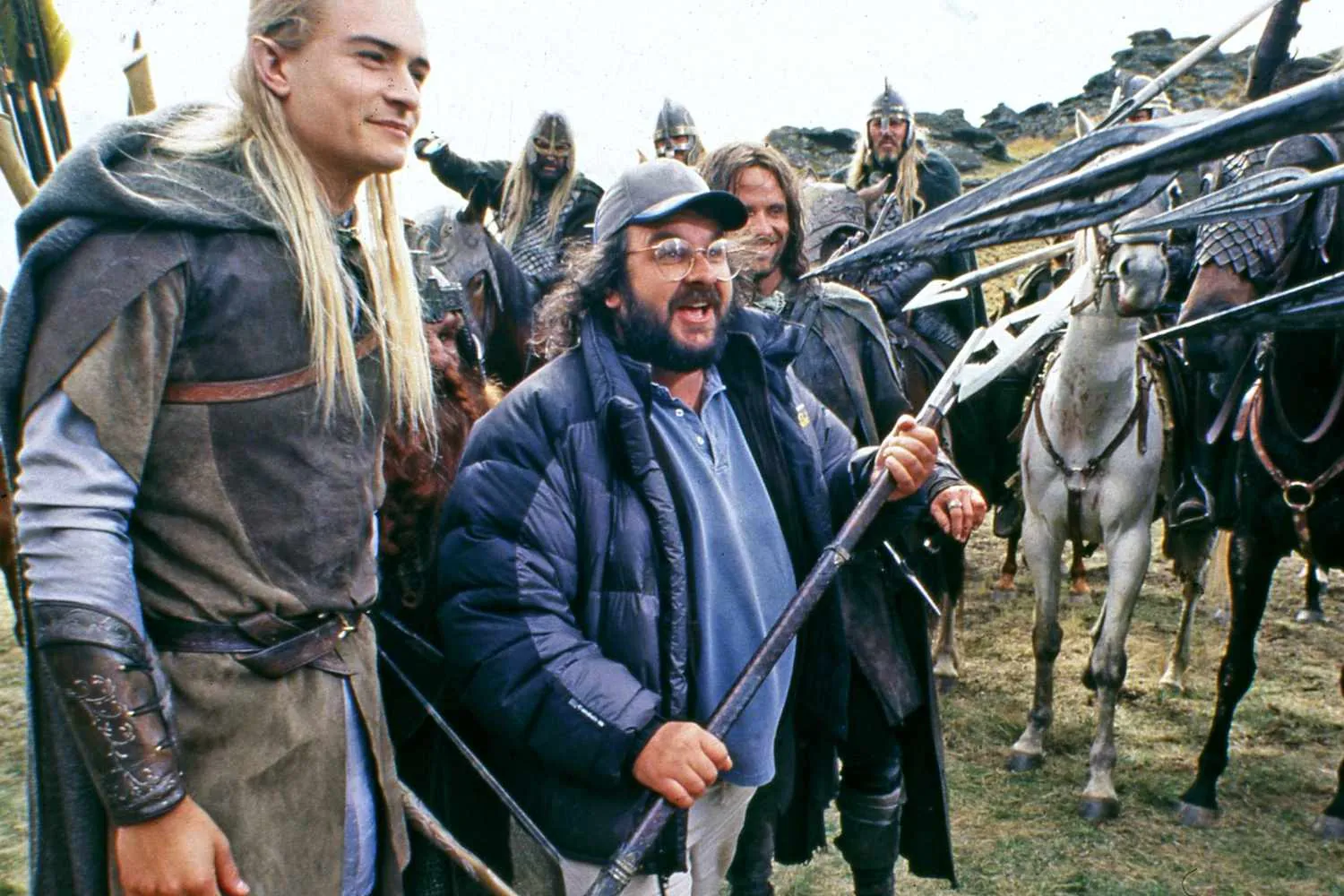
The technique reached its modern zenith during the production of The Lord of the Rings trilogy (2001-2003). Director Peter Jackson and his crew engineered highly advanced, motion-controlled moving platforms to keep Hobbits and Dwarves scaled down next to human characters. This allowed the camera to push, pull, and track through the environments while the set pieces shifted automatically to cancel out the parallax effect, resulting in some of the most convincing practical scale work ever captured on film.
Comedy directors also rely on the technique for its immediate timing benefits. For the 2003 Christmas comedy Elf, director Jon Favreau explicitly chose practical in-camera tricks over CGI to turn Will Ferrell into a giant. By using raised platforms and staggered positioning, Favreau allowed the actors to perform their scenes together in real-time. This kept the comedic rhythm and improvisational riffing intact, something that is often lost when actors are forced to perform alone against green screens for later digital compositing.
Even modern, effects-heavy blockbusters return to the technique for grounded realism. During the production of Star Wars Episode IX: The Rise of Skywalker in 2019, the crew dragged a 5-foot miniature sand-crawler prop into the Jordan desert. They placed the model on a raised table close to the camera lens, while Jawa extras were positioned a calculated distance away in the background desert. The resulting shot required no digital scaling, proving that optical geometry remains a viable tool for massive studio tentpoles.
The Direct Advantages of In-Camera Optical Tricks
The primary draw for cinematographers executing these demanding setups is the immediate feedback loop. Because the trick happens entirely in front of the lens, it requires no optical printing or digital post-production work. A director can look at the field monitor and see the final, scaled image instantly. The crew can review the daily rushes the very next morning knowing exactly what they captured, rather than waiting months for a visual effects vendor to composite green screen plates.
The tradeoff for this immediacy is the extreme physical footprint required to pull it off. Faking a major size difference demands pushing actors far away from the lens. A shot that appears to take place in a tight, intimate dining room might actually require a soundstage that is 80 feet deep just to accommodate the necessary Z-axis separation. When the production can secure the required space and handle the intense lighting demands, the resulting illusion locks the audience into a tactile, physical reality that digital manipulation rarely replicates.