
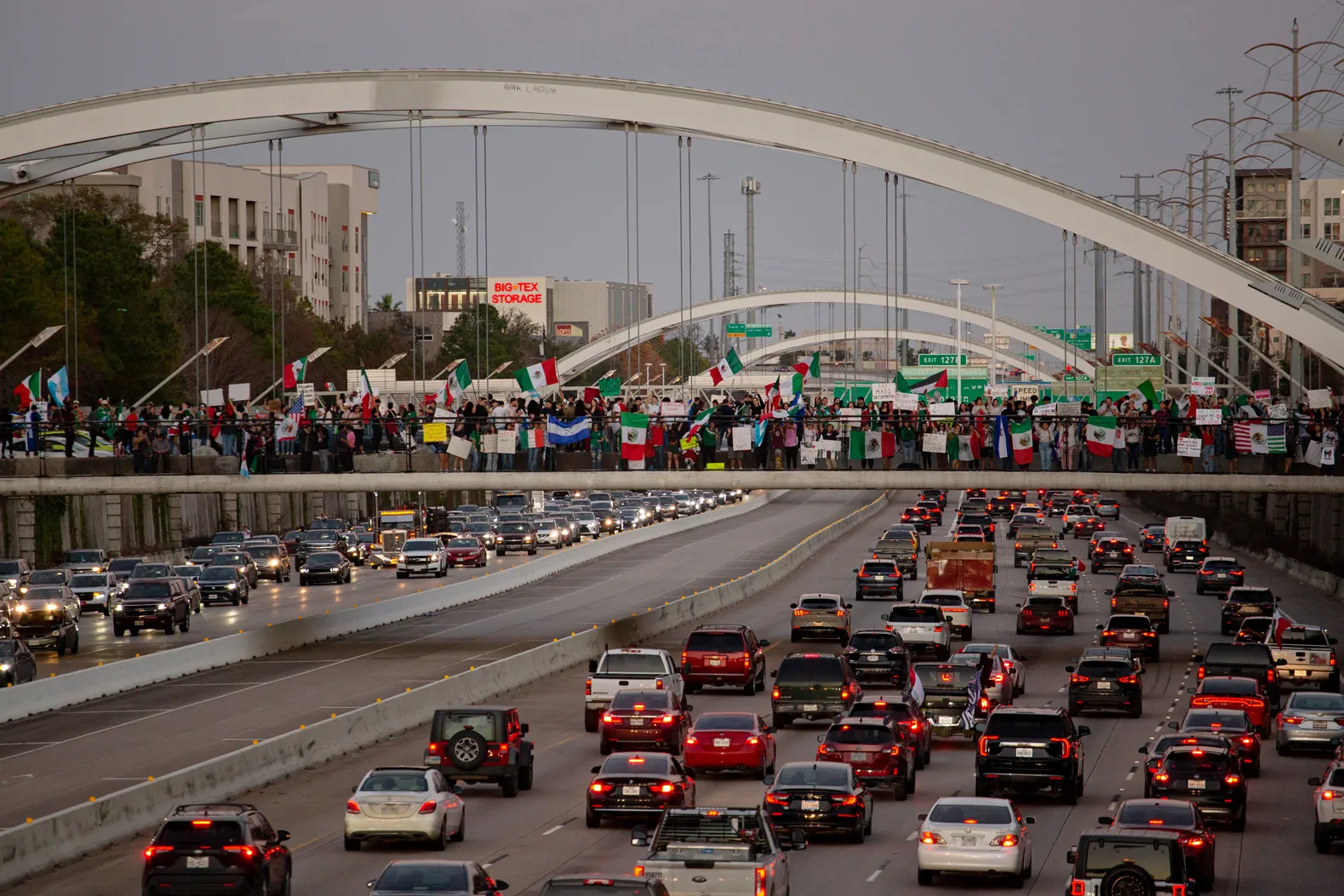
The Trump administration’s second-term immigration crackdown is facing intense local and international scrutiny following a fatal confrontation in Texas. Hundreds of demonstrators marched through Houston on Sunday, temporarily shutting down traffic on the Dunlavy Street bridge to demand a criminal investigation into the killing of Lorenzo Salgado Araujo.
Salgado Araujo, a 52-year-old Mexican national, was shot and killed by an Immigration and Customs Enforcement agent on July 7 while driving his construction crew to a job site. ICE stated the agent fired in self-defense after Salgado Araujo attempted to ram them with his vehicle. A subsequent statement from the US Attorney for the Southern District of Texas omitted any mention of a collision.
Protesters gathered at Ervan Chew Park before blocking the overpass with banners calling for the abolition of the federal agency. Activists are organizing a larger demonstration scheduled for Friday, July 24, aiming to disrupt standard municipal operations across Houston.
The incident has sparked severe diplomatic friction. Mexican President Claudia Sheinbaum and Foreign Minister Roberto Velasco formally petitioned the United Nations and requested criminal investigations from US state attorneys general regarding the deaths of Mexican migrants during recent enforcement operations.
According to the Associated Press, ICE encounters have resulted in at least 10 deaths since the beginning of the current administration. The Mexican government cited a total of 17 migrant deaths during this period.
Salgado Araujo operated a small construction business and lived in the United States for more than 35 years with no criminal record, leaving behind a wife and three US-born children. During the July 7 traffic stop, three of his co-workers, including his brother, were arrested by federal agents.
A subsequent FBI search warrant indicated agents found a “crystal-like substance” inside the work van. Attorneys representing the Salgado Araujo family stated the substance was tested and identified as salt.
Domestic civil rights groups are challenging the official federal narrative. The League of United Latin American Citizens issued a statement pointing to a documented history of federal agents using alleged vehicle rammings as justification for lethal force. US Rep. Bennie Thompson publicly called for a comprehensive review of ICE training and operational vetting.
In response to the escalating protests, border czar Tom Homan instituted a temporary pause on targeted traffic operations and introduced a mandate requiring ICE body cameras to be active during all vehicle stops.