
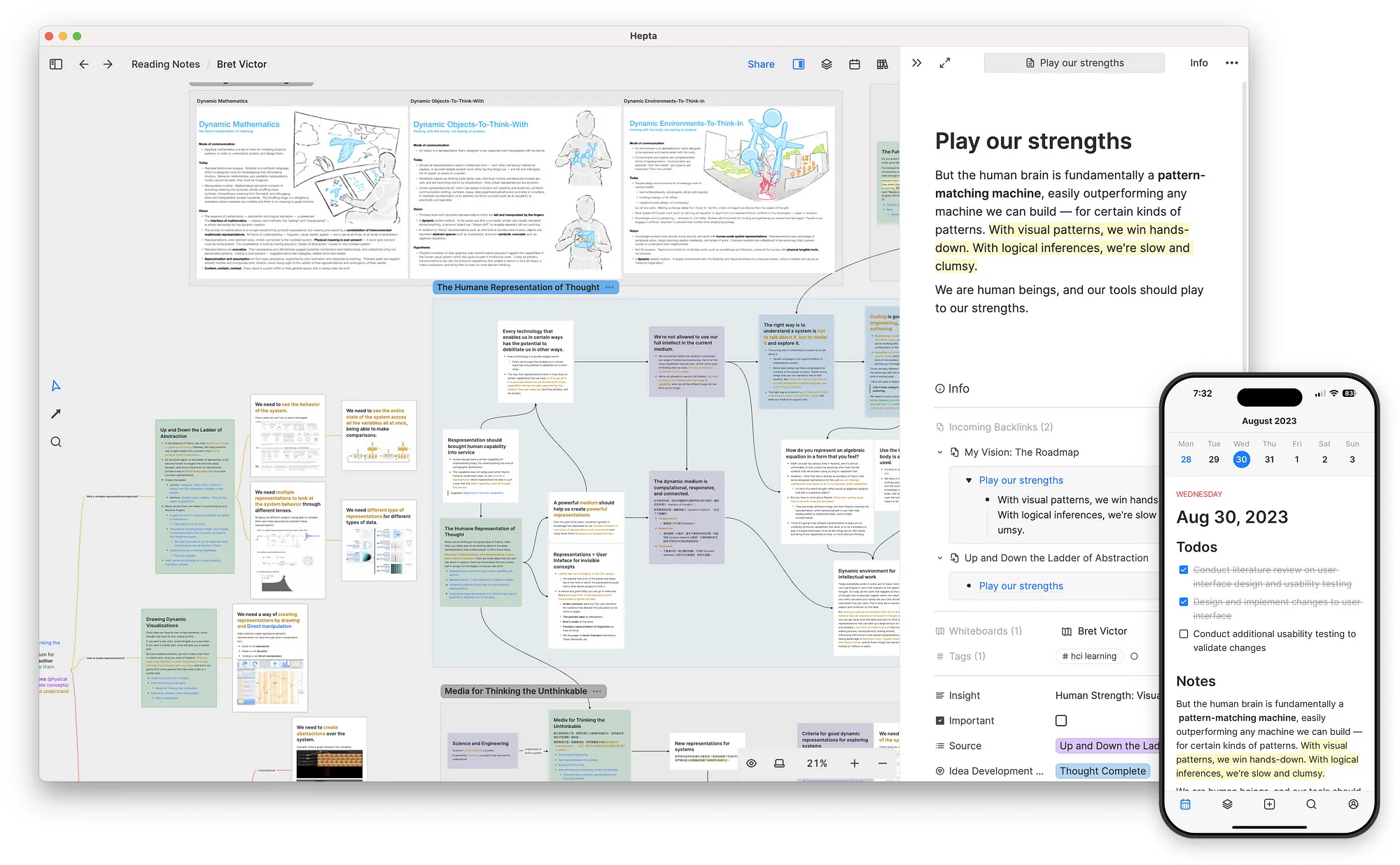
In a benchmark test conducted by XDA Developers, the visual knowledge management platform Heptabase is positioning itself as a cure for algorithmic brain rot. The software operates as an infinitely scrolling virtual whiteboard designed specifically to force critical thinking rather than spitting out automated, ready-made answers.
The productivity software market is currently migrating away from traditional folder-based note-taking toward spatial mapping. Instead of relying on third-party plugins, Heptabase built a native read-annotate-arrange loop. That structure heavily targets researchers, academics, and developers trying to organize massive amounts of unstructured data.
The interface relies on a card-based system. Users can tear apart PDFs and journal entries, dropping them directly onto a visual canvas. In a practical application, XDA Developers used the platform’s AI Tutor to manage details for a fantasy novel world-building project. The system digested the raw text and spit back a customized lesson plan. It broke down the undeveloped chunks of the story into a manageable syllabus that forced the user to manually fill in the blanks.
That spatial approach is heating up. Software companies are racing to build visual workspaces. According to a recent market breakdown, these spatial canvas competitors are pulling users away from Scrintal and Logseq Whiteboards. But Heptabase is taking the concept further for power users.
Recent patches spanning versions 1.94.0 through 1.98.4 activated a local Command Line Interface. That CLI allows external AI coding agents to dive directly into a user’s tag database. They can modify PDF cards directly within a secure local environment.
The Obsidian Threat and the End of Plain-Text Dominance
For years, power users swore by plain-text systems. Apps built around Markdown files dominated the personal knowledge management space. But the sheer volume of data modern professionals ingest has broken that linear model. By running a visual-first canvas that operates like Obsidian on AI-powered steroids, Heptabase attacks a very specific bottleneck.
It bridges the gap between raw data storage and actual comprehension. When looking at a direct visual research model comparison against a standard Obsidian Markdown vault, the speed of retrieving complex relationships changes drastically. Developers and academics do not just need a place to dump text anymore. They need a workspace that actively organizes the chaos.
The Verdict
XDA Developers concluded that Heptabase successfully avoids the trap of most generative tools. Instead of doing the thinking for the user, the platform provides a structured framework that demands active human learning and retention.