
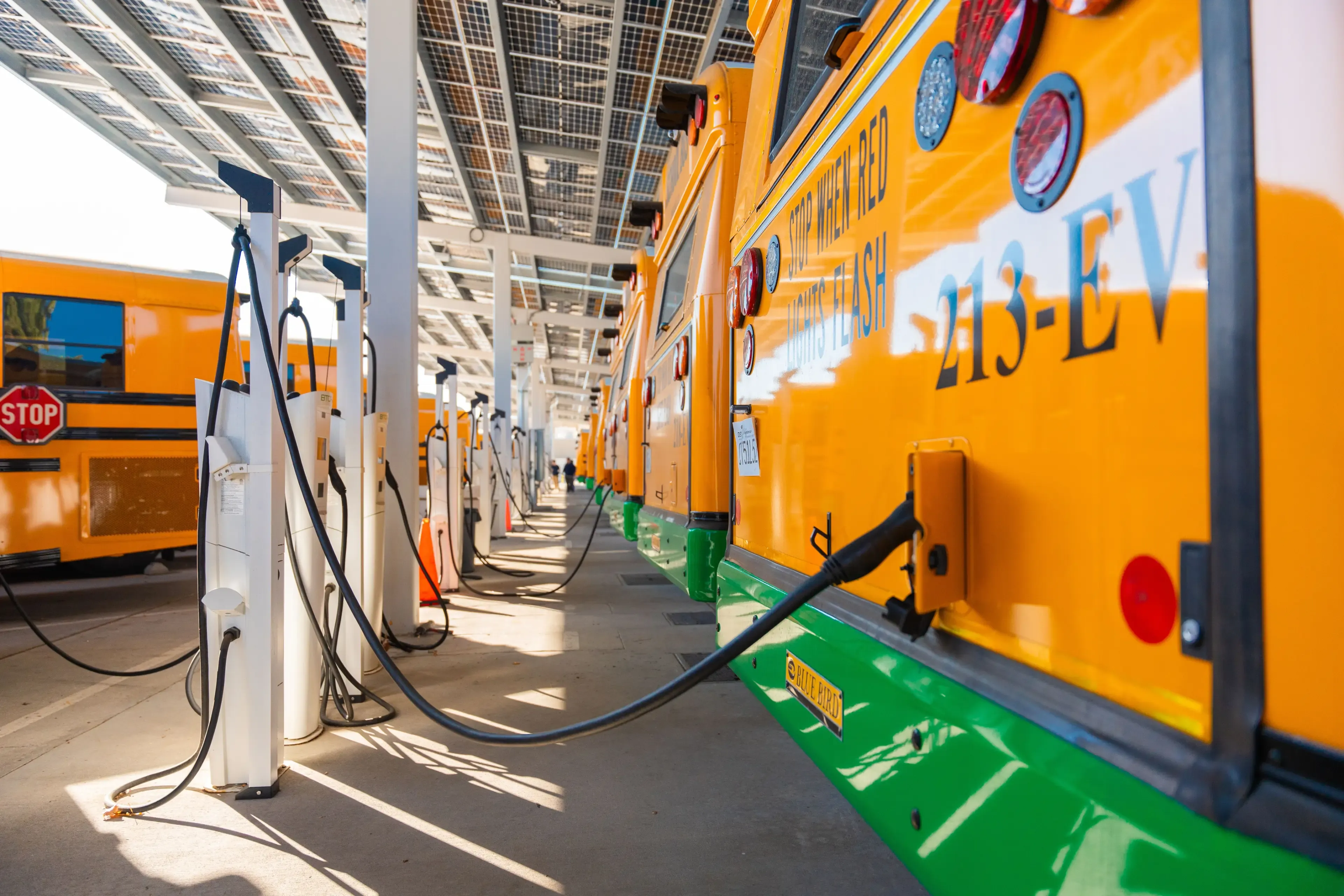
Last week’s blistering heat waves pushed the United States power infrastructure to the absolute brink. Utilities braced for rolling blackouts across several states as air conditioning usage shattered historical records. And then, help arrived from the most unlikely source: empty school buses.
Electric school buses equipped with vehicle-to-grid (V2G) technology actively pumped electricity back into local grids exactly when demand spiked. Instead of just draining power to charge, these heavy-duty vehicles reversed the flow to act as giant, rolling batteries. The hardware successfully stabilized vulnerable circuits and literally kept the lights on for thousands of residents.
What We Know
- Around 230 V2G-capable electric school buses are currently deployed across the US.
- The active fleet can supply 8 megawatt-hours of power on demand.
- That 8 MWh reserve is enough to power roughly 1,600 typical homes during a peak crisis.
- Oakland Unified operates 74 of these buses, injecting an estimated 2.1 GWh of clean energy back into the grid annually.
The World Resources Institute tracks these deployments closely. This 8 MWh capacity is just a fraction of the technology’s true potential, as detailed in an Electrek energy report released Sunday. Experts calculate that scaling this bidirectional hardware to just half of the 6,700 electric school buses currently on US roads would unlock over 100 MWh of flexible off-peak energy. Utilities save money by avoiding emergency generation costs, and ratepayers dodge peak wholesale energy pricing.
California is doubling down on the concept. The San Francisco Unified School District kicks off an aggressive expansion next month in August 2026. Transportation platform Zum will manage the rollout of 104 new buses in the first phase. That fleet will return about 3 GWh of energy annually to the local infrastructure.
The program scales up to 238 buses by the 2027-2028 school year. Utility company PG&E and the California Energy Commission are financially backing the project, creating the largest bidirectional fleet ever deployed in the US market. A coalition including the EPA Region 9 and the Bay Area Air Quality Management District is heavily monitoring the results to replicate the system in other cities.
Why Utilities Are Banking on Bidirectional Charging
The success of these V2G school buses fundamentally alters how utility companies plan for extreme weather. Solar and wind energy are inherently intermittent. When the sun sets and the wind stops during a 100-degree evening, grid operators usually scramble to fire up expensive natural gas peaker plants to cover the sudden drop in renewable generation.
Heavy-duty EVs erase that logistical headache. School buses sit idle exactly when grid stress peaks—late afternoons and evenings in the summer. By treating these dormant vehicle fleets as distributed municipal battery networks, state governments can stabilize their power supply without spending billions of dollars constructing standalone lithium-ion grid storage facilities.