
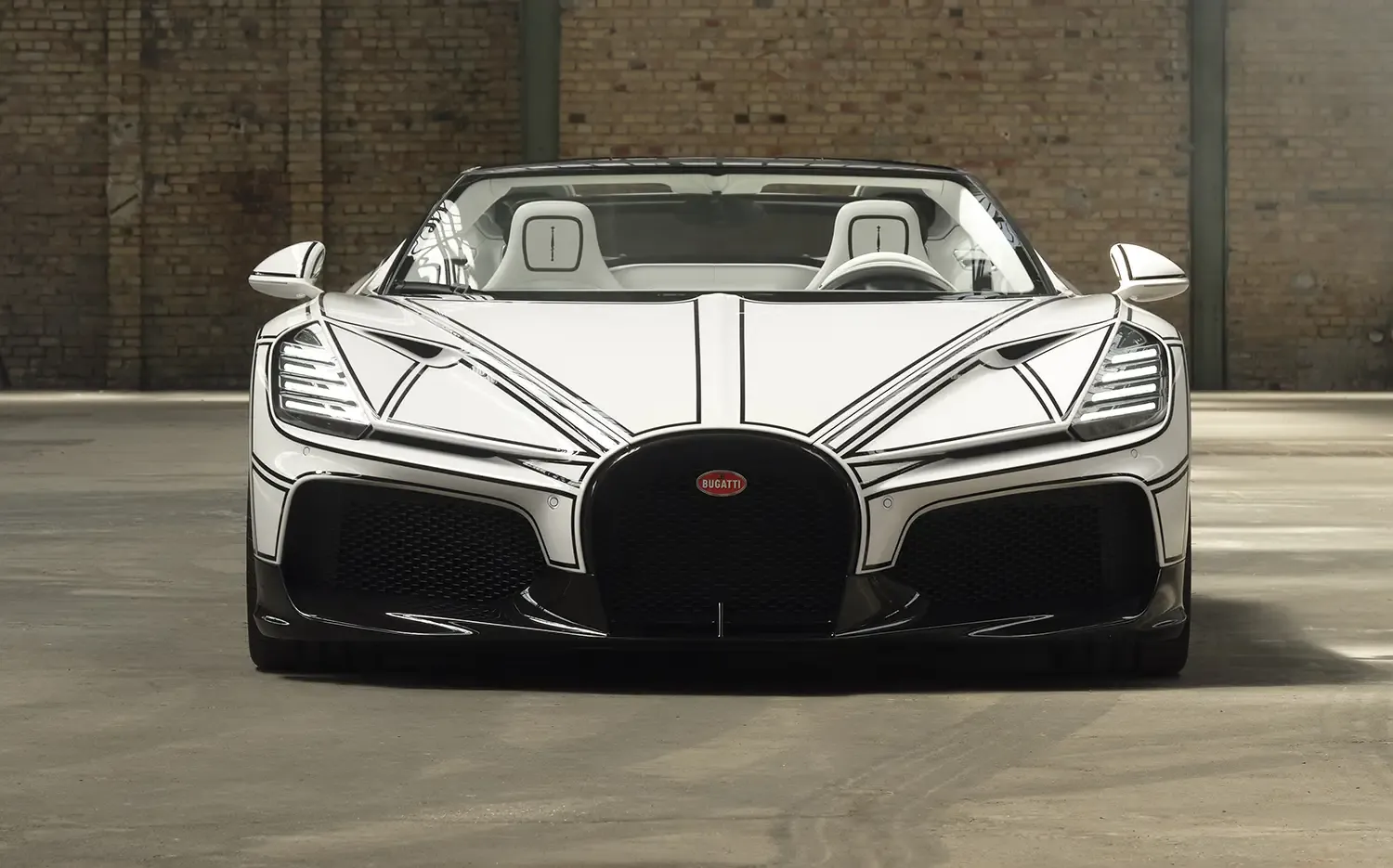
Bugatti just finished building the 99th and final W16 Mistral hypercar at its Molsheim Atelier. This specific completion closes the book on the quad-turbocharged 8.0-liter W16 engine’s series production.
The Mistral leaves the factory holding a highly specific crown. It is the fastest open-top production car in the world, carrying a speed record of 453.91 km/h (282 mph) set previously at the Papenburg proving ground.
A Custom Exit for a Middle Eastern Client
Bugatti did not build the final unit as a standard spec. The company handed the project to its Sur Mesure bespoke division to fulfill a commission for a Middle Eastern client. The exterior features a two-tone “Pearl” and “Sparkle” finish, while the interior uses a “Magnolia” and “Grey Carbon Matt” layout.
The most unique detail sits right in the center console. Bugatti removed its traditional dancing elephant motif on the gear selector and replaced it with a custom aluminum falcon head gear shifter to honor the owner’s heritage.
And the car explicitly acknowledges its own history. A dedication plate reading “The last of its kind” sits beneath a silhouette of the vehicle. Ettore Bugatti’s signature is also stitched into the headrests and engraved on the door sills.
Transitioning to the V16 Hybrid Era
The retirement of the W16 engine concludes a 21-year lineage. It all started under the late Volkswagen Group Chairman Ferdinand Piëch. In the early 2000s, Piëch issued a strict engineering mandate: build a civilized road car capable of breaching 1,000 metric horsepower and 400 kph (249 mph). The 2005 Veyron met that standard, and the final iterations in the Mistral and Chiron Super Sport pushed that output to 1,578 horsepower.
Bugatti is already preparing the physical space for what comes next. The conclusion of the Mistral program lines up with the opening of a new purpose-built La Manufacture facility in Molsheim to house next-generation production.
While standard series production is completely finished, Bugatti’s Programme Solitaire coachbuilding arm is still finishing a handful of bespoke one-off chassis commissions using existing W16 stock.
How the W16 Retirement Highlights an Industry Pivot
The end of Bugatti’s purely internal combustion W16 engine highlights a sharp divide at the top of the automotive industry. Most legacy supercar brands are fighting to keep combustion alive for as long as possible. Competitors like Aston Martin are currently finding regulatory loopholes to extend the lifespan of their traditional V12 engines.
Bugatti is taking a completely different route. The company is pivoting entirely to electrification for its incoming Tourbillon successor. That vehicle will use a naturally aspirated 8.3-liter V16 co-developed with Cosworth, paired directly with three Rimac-engineered electric motors. Instead of fighting emissions standards with smaller turbocharged engines, Bugatti is using hybrid power to justify an even larger displacement block.