
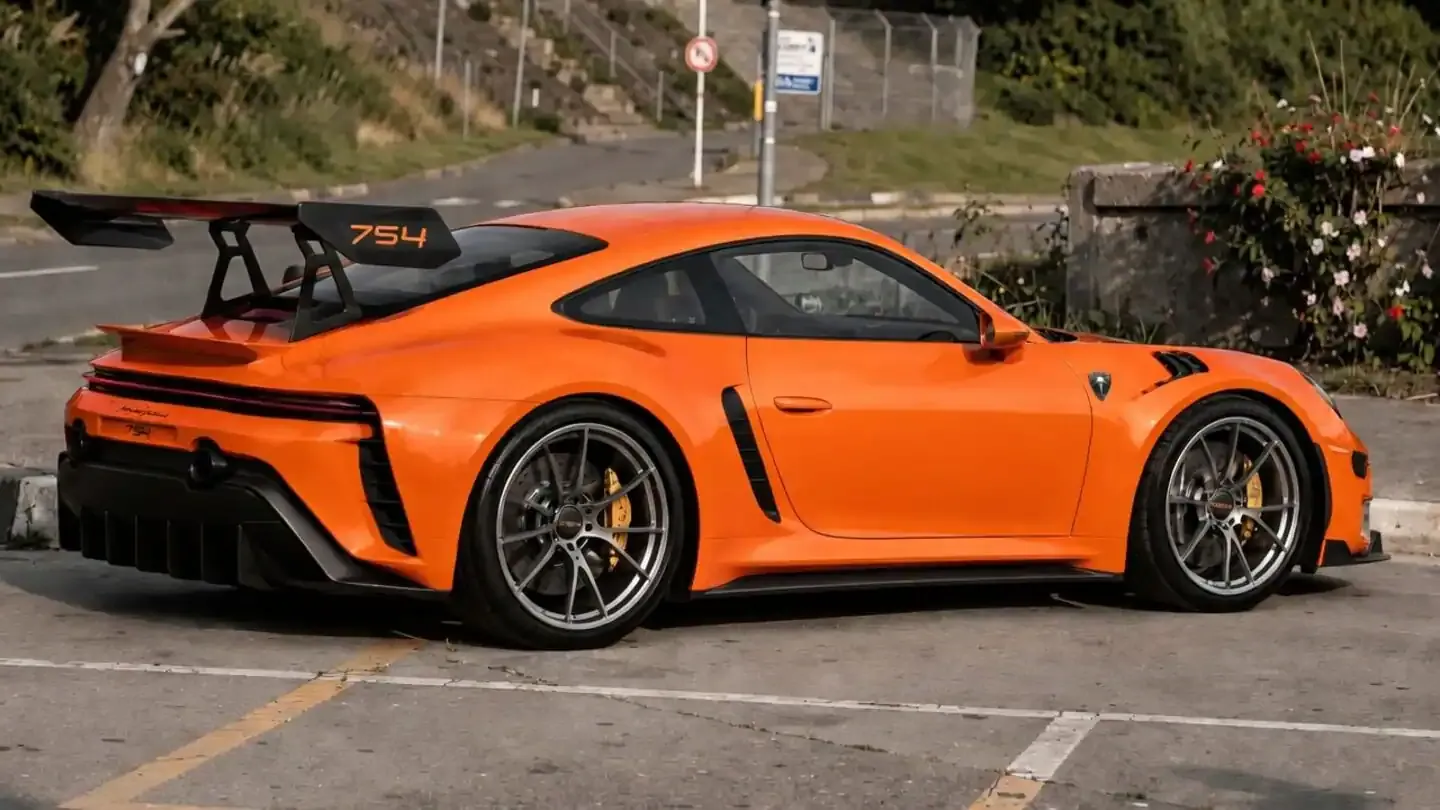
Angelelli Automobili has officially unveiled Project 754, a coachbuilt exotic that strips the Porsche 911 down to its bones and rebuilds it into a bespoke Italian supercar. The new machine utilizes the structural foundation of the 991 and 992 generation 911s. But the final product looks absolutely nothing like a vehicle from Stuttgart.
This is extreme low-volume manufacturing. The company plans a strictly limited production run of just 50 units for the global market. To ensure buyers understand the legal boundaries, Angelelli explicitly confirmed they have no commercial or industrial relationship with Porsche.
The engineering team threw out standard production constraints. Project 754 relies heavily on advanced manufacturing techniques to shed weight, combining extensive carbon fiber bodywork with cutting-edge 3D-printed titanium structural components.
Buyers can choose between two completely different driving dynamics:
- The 754 R: This configuration keeps the traditional rear-engine layout. It maximizes traction off the line and delivers the aggressive acceleration characteristics you expect from a highly tuned 911 chassis.
- The 754 M: This version physically shifts the powertrain into a mid-engine setup. Moving that mass forward optimizes weight distribution and sharpens handling precision for track use.
Both configurations generate between 700 and 800 horsepower. Managing that thrust requires serious aerodynamic hardware. The car features a custom active aerodynamic system, integrating adjustable front spoilers and an active rear wing. Angelelli refined these elements through extensive wind tunnel testing to lock in high-speed stability and generate massive downforce, as outlined in the Project 754 reveal.
The Engineering Cost of Mid-Engine Conversions
Taking a rear-engine platform and re-engineering it into a mid-engine supercar is notoriously difficult. Porsche itself only executes that specific layout shift for extreme endurance racers like the 911 RSR. By offering the 754 M, Angelelli is effectively tearing out the rear firewall and completely redesigning the cooling, suspension geometry, and exhaust routing of the 992 chassis.
This approach highlights a growing shift in the boutique supercar market. Instead of building bespoke carbon tubs from scratch—a process that costs hundreds of millions in R&D—independent builders are acquiring world-class platforms and modifying the physical layout to achieve hypercar performance metrics.