
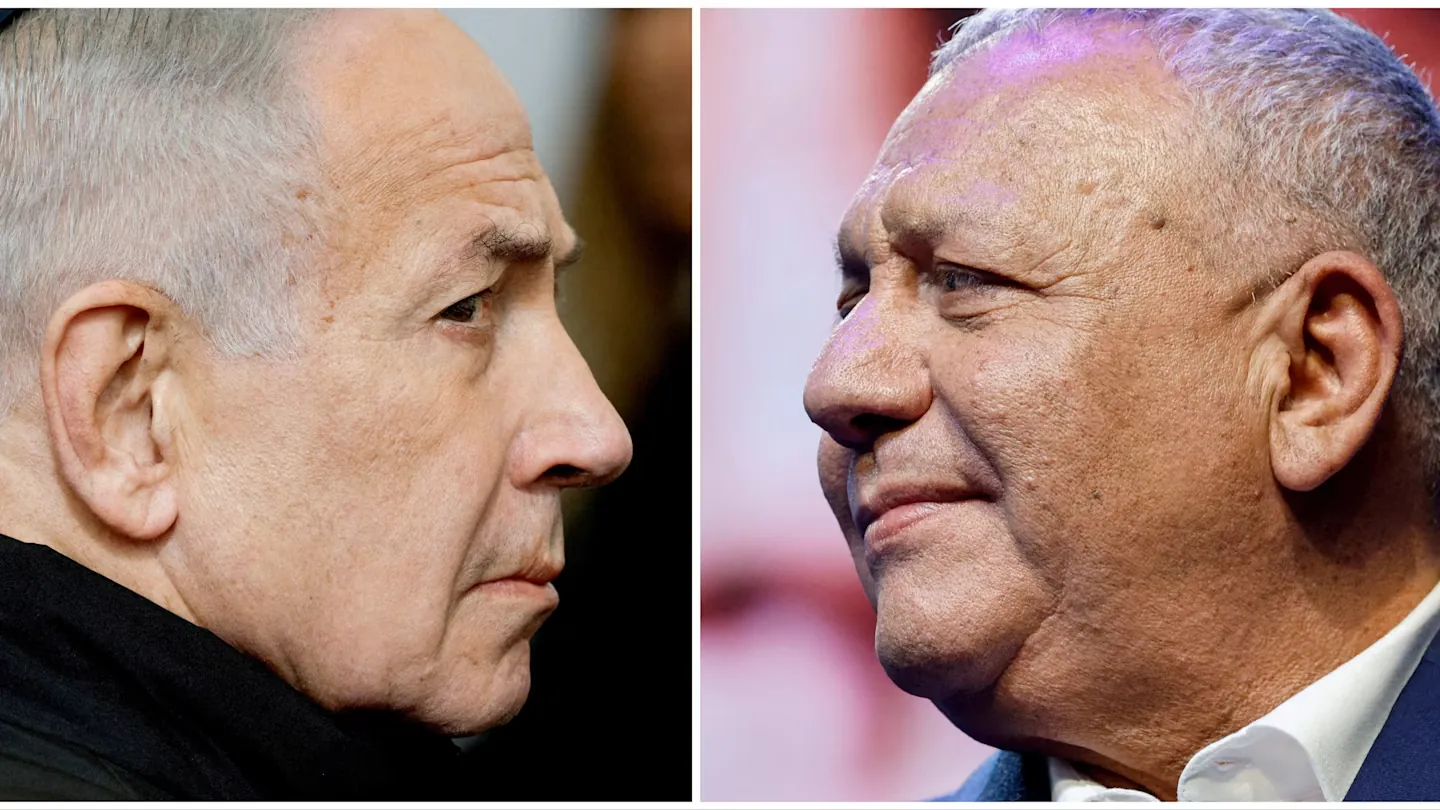
Israeli caretaker Prime Minister Benjamin Netanyahu and opposition leader Gadi Eisenkot met on Sunday morning, Nov. 29, 2026, at the Kirya, Israel’s military headquarters in Tel Aviv, to begin national unity coalition talks. The meeting followed Netanyahu’s Saturday proposal for a rotating premiership that would put Eisenkot in office first.
The sit-down was the first known meeting between the two rivals since Israel’s Oct. 27 general election and began with a security briefing, representatives for both leaders told The Washington Post. Likud had announced late Saturday that the 10 a.m. meeting would take place at a hotel in Herzliya before talks convened at the defense headquarters in Tel Aviv.
Separate negotiating teams from Netanyahu’s right-wing Likud party and Eisenkot’s centrist Yashar party met at the same time on Sunday morning. Yashar negotiators also held parallel discussions with Naftali Bennett’s B’Yachad party.
Terms of the rotation offer
Netanyahu put the unity proposal on X on Saturday, writing that “my responsibility as a leader obligates me to put everything aside, including the principle of the largest party”. He wrote that he would agree to Eisenkot taking office “first as prime minister, while I will serve as alternate prime minister at the beginning of the term”.
In the same post, Netanyahu pointed to “the magnitude of the existential danger and the possibility that a government will be formed that does not have the capacity to deal with this danger”. Neither Netanyahu nor Eisenkot has publicly disclosed how long each rotation term would last or which additional parties would join a unity cabinet.
Eisenkot, a former Israeli army chief, responded on Saturday by inviting Netanyahu to direct negotiations. “If Likud is ready for genuine unity, I am ready to assess the seriousness of its intentions over the next 24 hours,” Eisenkot said.
Eisenkot added that discussions would be based on a detailed proposal Yashar sent to Netanyahu on Nov. 22, which he said Likud had left unanswered. On Friday, Eisenkot had accused Likud of stalling coalition negotiations to push the country toward new elections.
How the Knesset seat math looks
Neither political camp won the 61 seats required to command a majority in the 120-seat Knesset, Israel’s parliament. Turnout in the Oct. 27 election reached 78.0%, the highest since 1999, according to final results compiled by the Israel Democracy Institute.
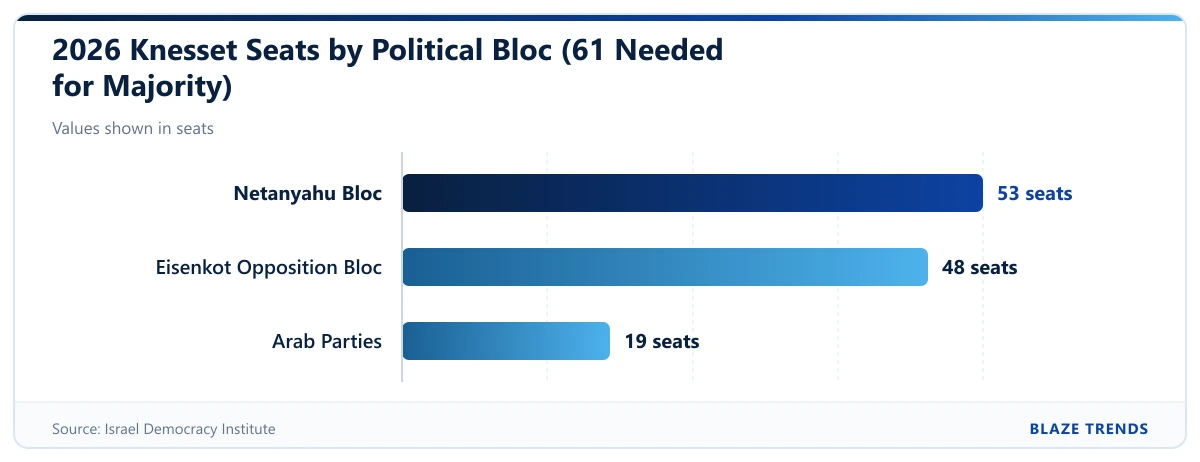
Netanyahu’s five-party bloc won 53 seats, while Eisenkot’s four-party opposition bloc took 48. Two Arab-led alliances, the Joint List and the United Arab List (Ra’am), won a combined 19 seats after a surge in Arab voter turnout, the highest total for Arab parties in Israeli history.
| Political Bloc | Parties and Seats | Bloc Total |
|---|---|---|
| Netanyahu Bloc | Likud (27), UTJ (7), Otzma Yehudit (7), Shas (6), Religious Zionist (6) | 53 |
| Eisenkot Opposition Bloc | Yashar (21), B’Yachad (12), Democrats (8), Yisrael Beiteinu (7) | 48 |
| Arab Parties | Joint List (11), United Arab List / Ra’am (8) | 19 |
After consulting all Knesset factions following the October vote, President Isaac Herzog bypassed Likud despite its 27-seat plurality and gave Eisenkot a 28-day mandate to form a government. Eisenkot has already signed coalition deals with Avigdor Liberman’s Yisrael Beiteinu and Yair Golan’s Democrats, according to The Times of Israel, while Bennett’s B’Yachad has not signed an agreement.
Eisenkot’s effort to assemble 61 seats without Likud has been slowed by difficulties reaching terms with ultra-Orthodox parties. All but one Jewish party also pledged before the election not to govern with Arab parties.
Opposition leaders split over talking to Likud
Netanyahu’s Saturday proposal exposed open divisions inside the opposition bloc. Bennett urged cautious unity negotiations with Likud, viewing a unity government as preferable to a coalition reliant on ultra-Orthodox and Arab parties.
B’Yachad number two Yair Lapid broke with Bennett on X, rejecting Netanyahu’s offer as untrustworthy and arguing that an Eisenkot-led government should take office without Likud before any talks on expanding it. Democrats chairman Yair Golan also dismissed Netanyahu’s rotation offer on X and called on opposition parties to form a government without him.
What happens before December 6
No single party in Israel has ever won an outright parliamentary majority, requiring coalition agreements after every election. Between 2019 and 2022, repeated coalition impasses between Netanyahu and rival parties forced five separate national elections.
Eisenkot’s 24-hour window to gauge Likud’s intentions runs through Sunday, and his formal presidential mandate expires on Sunday, Dec. 6. If talks fail to produce a 61-seat majority by that deadline, Israel risks sliding toward another election with Netanyahu remaining caretaker prime minister.