

Extended holiday return policies temporarily replace a store’s standard 14- to 30-day return limit with a fixed January deadline for gifts bought during a fall-and-winter window. Most major chains run cutoffs between January 8 and January 31, though Apple gear, carrier phones, holiday decor, and marketplace orders often follow shorter clocks or carry fees.
ContentsToggle
How do extended holiday return policies set deadlines?
Every extended return policy relies on two dates: a qualifying purchase window that usually opens in October or November, and a fixed cutoff in January. If you buy an eligible item inside that window, the store pauses its normal return limit so gift recipients have time to make exchanges after the holidays.
Most retailers judge eligibility by the purchase date on your receipt, though some tie the clock to delivery instead. Apple Store Online, for example, covers eligible items received between November 6 and December 25, 2026 through January 8, 2027, and reverts to standard country limits for purchases made after December 25.
A few chains restart their normal countdown the day after Christmas instead of naming one blanket date. Under Target’s extended holiday return policy for items bought November 1 through December 24, 2026, the return clock starts on December 26, giving you 30 days on most electronics and 14 days on Apple products.
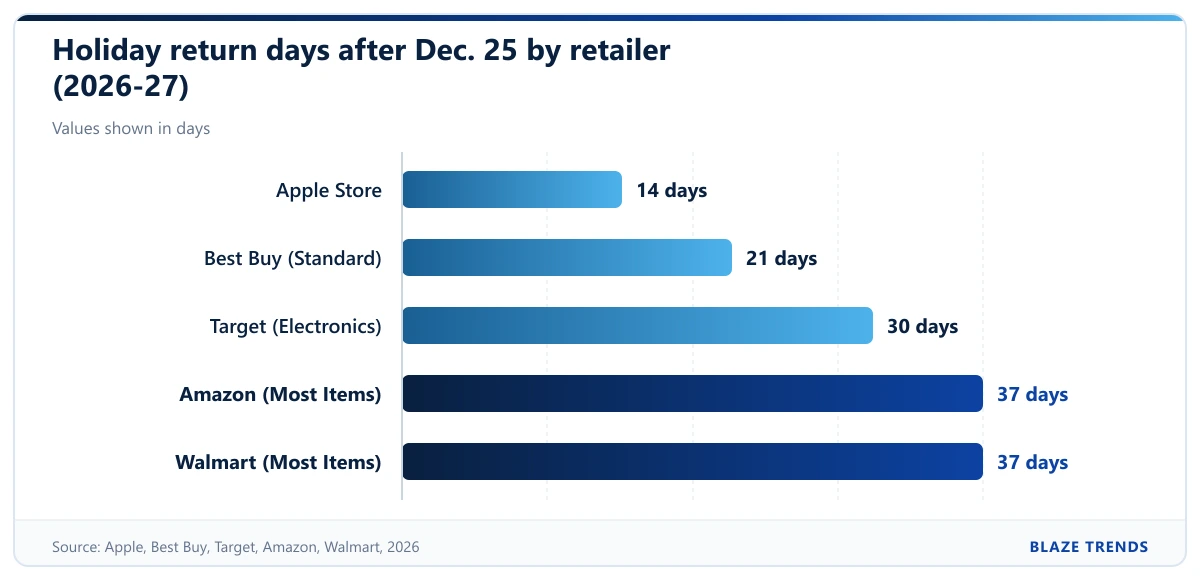
Because exact dates shift by a day or two each season, check the retailer’s support page each fall before placing early orders. As of the 2026-2027 holiday season, five of the largest U.S. retailers set their standard holiday windows as follows.
| Retailer | Qualifying window (2026) | Return deadline (2027) | Notable catches |
|---|---|---|---|
| Amazon | Nov. 1 to Dec. 31 | Jan. 31 | Apple-branded products close Jan. 15 |
| Walmart | Oct. 1 to Dec. 31 | Jan. 31 | Marketplace seller participation varies; wireless phones keep a 14-day standard clock |
| Target | Nov. 1 to Dec. 24 | Jan. 24 (electronics and Target Plus) | Apple, Beats, and unlocked or prepaid phones close Jan. 8; seasonal holiday decor excluded on Target Plus |
| Best Buy | Oct. 30 to Dec. 31 | Jan. 15 | Excludes carrier-contracted phones, AppleCare+ plans, and holiday decorations |
| Apple Store Online | Received Nov. 6 to Dec. 25 | Jan. 8 | Purchases after Dec. 25 revert to standard limits; UK consumer financing orders excluded |
Keep in mind that everyday general merchandise at Target and Walmart already carries a 90-day return window year-round. Holiday extensions mainly protect shorter-window categories like consumer electronics, small appliances, and third-party items.
Which items carry shorter deadlines, exclusions, or fees?
High-value electronics and seasonal items are the most common traps during holiday returns. Retailers carve out Apple hardware, Beats audio, and mobile phones because open-box resale losses climb quickly, leaving many of those products with a January 8 or January 15 cutoff instead of January 31.
Cell phones tied to third-party wireless carrier contracts usually stay on their normal 14-day window, or 30 days for Verizon activatable devices under Best Buy’s holiday return policy. Returning a contracted phone to the store doesn’t automatically cancel your wireless plan, so you still have to contact the carrier directly.
Holiday decorations and specialty goods often skip the January extension altogether. Best Buy keeps Christmas and Halloween decorations on a 15-day window for every shopper, while personalized goods, gift cards, opened software, and final-sale items are generally nonreturnable across major chains.
An extended calendar deadline doesn’t waive restocking or return shipping fees. At Best Buy, opened activatable devices (excluding prepaid phones) carry a $45 restocking fee, and opened cameras, lenses, camcorders, drones, projectors, projector screens, and mobility scooters incur a 15% restocking fee unless you bought them in Alabama, Colorado, Hawaii, Iowa, Mississippi, Ohio, Oklahoma, South Carolina, or another state where law prohibits it.
Apparel and department stores also deduct prepaid return shipping charges when you mail an order back. According to CBS News reporting in December 2025, mail-in return labels cost $4.95 per request at Zara, $7.50 at J.Crew, and $9.95 at Dillard’s, making free in-store drop-offs the budget-friendly choice.
Retailers have tightened these rules because processing returns is expensive. According to the National Retail Federation’s 2025 report, U.S. retailers projected $849.9 billion in total returns in 2025, with 19.3% of online sales returned and 9% of returns classified as fraudulent. Industry analysts quoted by TODAY in 2025 noted that shipping a single return costs a retailer at least $12, while NRF winter holiday data projects 17% of holiday sales come back and 82% of shoppers return unwanted gifts within a month.
How do gift receipts and in-store returns protect your refund?
How you hand an item back determines both who receives the money and whether the gift giver finds out. A standard receipt refunds the original payment card, while a gift receipt hides the purchase price and gives you store credit or an even exchange at the counter.
Mailing a gift back can ruin that privacy. Best Buy’s policy states that gifts returned in person issue store credit to the recipient, whereas gifts returned by mail or bought from third-party Marketplace sellers refund the original buyer and send them an email notification.
If you lose the receipt, many large stores still process an in-store return when you show a valid government-issued photo ID. Walmart logs no-receipt returns with photo ID and limits payouts to store credit or an exchange, and some chains may deny the return or withhold sales tax if the purchase can’t be verified. For eligible Walmart refunds, payouts typically take up to seven days to a card, bank account, or PayPal, compared with three hours to a Walmart Gift Card or account balance.
Before heading to the counter or printing a label, run through four quick checks so you don’t lose money on fees or missing parts.
- Check the receipt date and the seller name to confirm whether the retailer or a third-party marketplace vendor handled the order.
- Leave factory seals intact on cameras, drones, software, and phones until you’re sure you want to keep them, since breaking the seal can trigger a 15% or $45 restocking fee.
- Pack every original box, cable, charger, and manual, because missing accessories can lead to a partial deduction or a rejected return.
- Choose in-store drop-off when returning gifts or clothing to skip mail-in label fees and keep refund emails from reaching the gift giver.
Don’t confuse a return with a price adjustment if an item drops in price after you buy it. Keeping the product and asking for the difference falls under holiday price match guarantees, which follow separate rules and often exclude major sale weekends.
How do return laws differ in the US, UK, and EU?
Stores offer extended holiday return windows voluntarily, so your legal backup depends on where you live and whether you shopped online or in person. If a retailer refuses a change-of-mind return after a cutoff passes, local consumer law sets the actual floor.
- In the United States, federal law doesn’t require stores to accept change-of-mind returns, so store policies and state disclosure laws govern. Under California Civil Code section 1723, for instance, a store that fails to conspicuously post a limited or no-return policy must accept returned merchandise, and several states restrict restocking fees.
- In the United Kingdom, UK government return rules state that shops don’t have to refund in-person purchases just because you changed your mind, and legally they only have to accept returns from the original buyer unless store gift policy allows otherwise. Online, mail, and phone buyers get a statutory 14-day cancellation window from delivery plus 14 days to ship the item back, with refunds including standard shipping due within 14 days of return receipt.
- In the European Union, European Union shopping rights give online and off-premises buyers a 14-day statutory right to withdraw without giving a reason, excluding personalized goods, unsealed software or hygiene items, and private sales. EU law also provides a minimum two-year free legal guarantee on faulty items bought online or in physical stores, regardless of holiday return deadlines.
Frequently asked questions
Can you return an opened electronic gift during the holiday window?
Most major retailers accept opened electronics inside the holiday window as long as all original parts are included, though select gear like cameras, drones, projectors, and carrier phones can carry $45 or 15% restocking fees once unsealed. Before returning a phone, tablet, or laptop, sign out of cloud accounts and erase your personal data so the store can inspect and process the device.
Does a paid store membership give you more time to return holiday gifts?
At some chains, yes. Best Buy gives standard shoppers until January 15, 2027 on October 30 through December 31, 2026 purchases, while paid My Best Buy Plus and My Best Buy Total members get until January 31, 2027 on October 30 through December 3 orders and a 60-day return window on purchases from December 4 onward.
What happens if you only return one item from a holiday bundle?
Breaking up a promotional bundle usually voids the bundle discount or free bonus item. Retailers like Best Buy subtract the discount or the value of any unreturned promotional item from your refund unless you bring back the entire bundle together.