
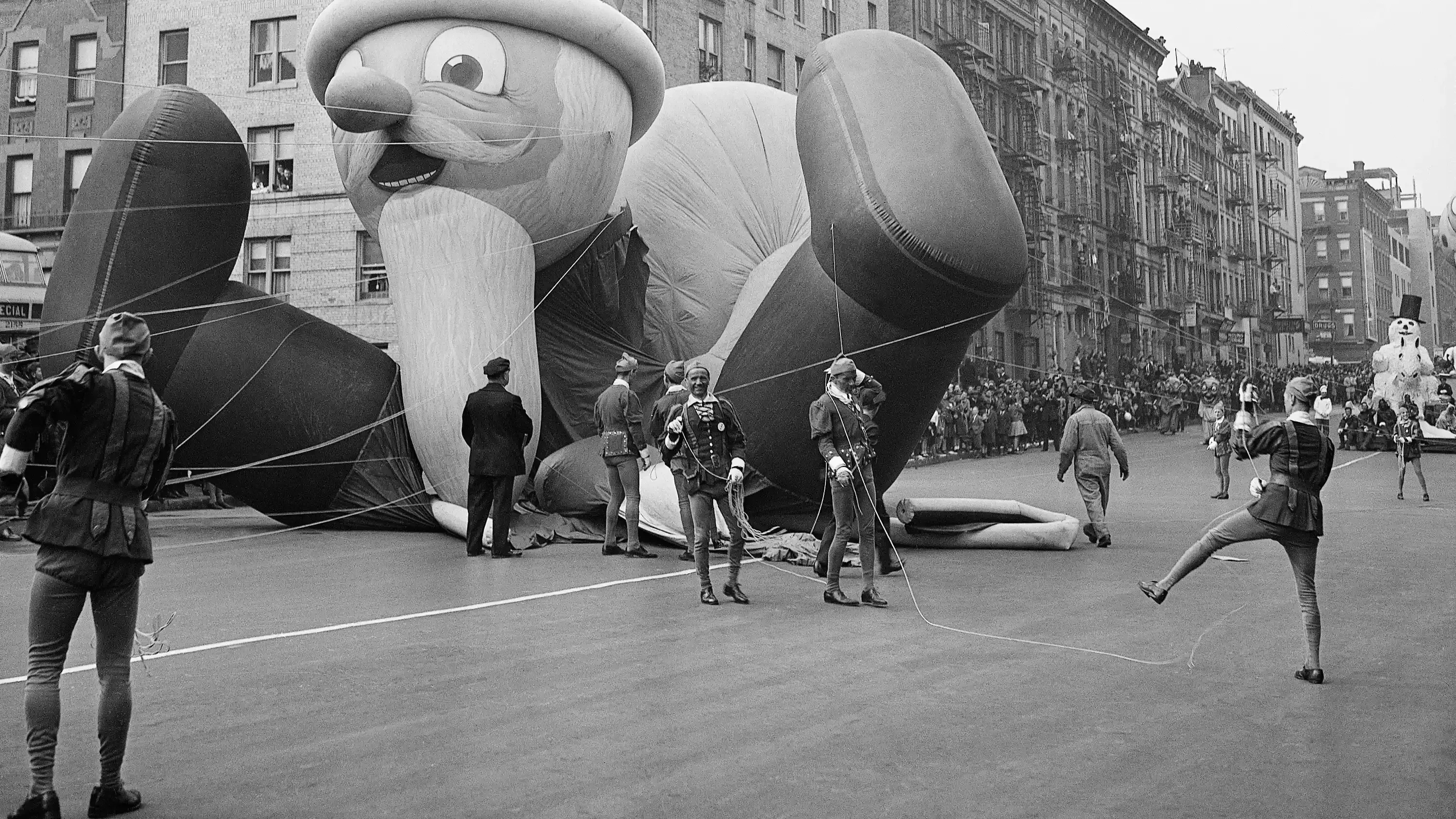
Giant parade balloons are built from multi-chamber, polyurethane-coated fabric and inflated with roughly 12,000 cubic feet of helium under weighted nets before launch. When flown in gusty wind, trained crews and anchor vehicles reel characters lower block by block, while New York City rules ground them above 23 mph sustained winds or 34 mph gusts.
ContentsToggle
How are giant parade balloons built and inflated?
Early parade balloons were heavy rubber shells, which tore easily and took serious effort to patch. Modern versions use flexible, leak-resistant polyurethane-coated fabric panels cut to shape and heat-sealed together, according to Popular Science.
Designers start by sculpting clay scale models and submerging them in water to calculate how much helium the full-size character will need. Teams then map the shape digitally for wind-flow modeling, paint the fabric while the balloon is fully inflated so the finish flexes cleanly, and run both indoor and outdoor test flights, production leaders told the National Air and Space Museum.
Inside, a large character is never a single hollow pocket. A Charlie Brown balloon, for example, splits into 16 sealed chambers, placing lift chambers along the top and ballast chambers near the bottom so the figure stays upright in the air.
Crews fill these chambers with helium because the gas is inert and non-flammable, unlike hydrogen, while still giving steady lift over packed sidewalks. On average, one giant balloon takes about 12,000 cubic feet of helium, generating enough buoyancy to lift nearly 750 pounds.
Inflation usually starts the afternoon before a parade and takes around 90 minutes per balloon. Technicians stake each character under heavy nets and weights overnight, leaving the chambers slightly under-inflated so morning sunlight and warmer daytime air can expand the helium without stressing the seams.
Early on parade morning, crews top off the helium and unhook the nets just before step-off. When the route ends, deflation takes only about 15 minutes as handlers unzip side vents or rip panels, press out the remaining gas, and roll the shell back up for storage.
How do crews steer a multi-story balloon through city streets?
Keeping a floating five-story character centered over an avenue takes a strict command structure. Under New York City safety rules adopted in 1998, every large balloon moves with a captain, two assistant captains, a pilot, two assistant pilots, and an assigned police officer.
The pilot walks backward down the street, watching both the balloon’s pitch and the handlers’ spacing. Behind them, 50 to 90 trained volunteers walk the guide lines; for Macy’s parades, handlers must weigh at least 120 pounds and have no heart, back, or knee issues.
Each handler holds a waist-level bar called a bone tied directly to a tether line. When the pilot signals a turn or height change, everyone winds or unwinds rope around their bone in unison to pivot the character smoothly around corners.
People alone do not anchor the biggest balloons. New York City’s 1998 rules require two support vehicles weighing 1,379 pounds each per large balloon, with one vehicle guiding from the front and the second acting as a rolling anchor.
How are balloons flown in wind and when do they get grounded?
Wind behaves differently at street level than it does at an airport weather station. Tall downtown skyscrapers funnel air down narrow avenues, creating a wind tunnel effect that slams crosswinds into a balloon’s broad sides the moment it crosses an open intersection, as PBS NewsHour reported.
Modern urban wind rules trace back to a 1997 accident in New York City, when gusts near 40 mph drove a Cat in the Hat balloon into a lamppost near Central Park and critically injured a spectator. The city responded in 1998 with hard limits on both wind and hardware.
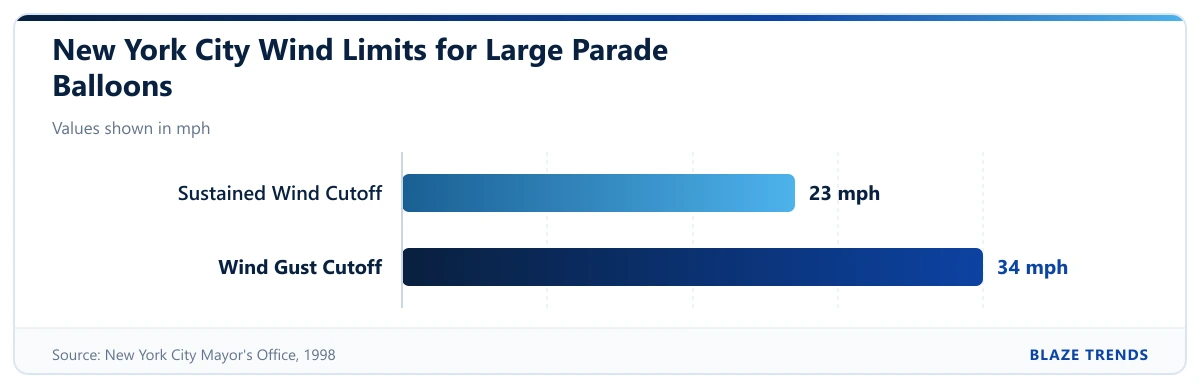
Under those New York City rules, large parade balloons cannot fly if sustained winds top 23 mph (37 kph) or gusts exceed 34 mph (55 kph). The city also capped dimensions at 78 feet long, 40 feet wide, and 70 feet high, required Department of Transportation design approval, modified lampposts so arms run parallel to the street or can be removed, and gave the NYPD final authority to lower or pull any balloon.
Weather calls happen live along the avenue. Organizers consult the National Weather Service beforehand, station a licensed meteorologist at the starting line, hang windsocks down the route, and hand an assistant pilot on every balloon a handheld wind meter to check speeds at each intersection.
Before grounding a lineup, crews adjust flight altitude. Large balloons normally float roughly 10 to 50 feet off the street, and each character carries its own risk profile and height chart based on its weight and sail area.
You could see that system working during windy stretches of the 2019 Macy’s Thanksgiving Day Parade, when ground winds stayed under 10 mph while gusts climbed to 29 mph. According to live NYPD anemometer updates cited by CBS News, crews lowered the SpongeBob SquarePants balloon from its usual 50 to 55 feet down to 15 to 20 feet, while balloons in earlier windy years flew as low as 10 feet.
How do parade balloon rules vary by city and inflatable type?
New York City’s written thresholds apply only within its own jurisdiction, so other major US parades set weather cutoffs alongside local police and balloon manufacturers. In the United Kingdom, parade organizers commonly use a similar 23 mph maximum wind limit for helium inflatables, though each unit’s exact cap depends on its manufacturer rating.
Not every oversized character rolling down a parade route relies on helium. Many productions mix in cold-air inflatables powered by continuous electric fans on wheeled frames or motorized bases, including hybrid floats called falloons and vehicle-mounted balloonicles that stay grounded and handle brisk winds far more easily.
| Inflatable Type | Lift System | Typical Crew Size | Wind Sensitivity and Cutoff |
|---|---|---|---|
| Giant helium balloon (NYC standard) | About 12,000 cu ft of helium | 50 to 90 handlers plus two 1,379-lb support vehicles | High sensitivity; NYC caps flight at 23 mph sustained winds or 34 mph gusts |
| Standard commercial helium balloon | Helium in sealed chambers | 20 or more handlers | High sensitivity; UK parades commonly cap flight around 23 mph per manufacturer rating |
| Cold-air parade inflatable (wheeled or vehicle-mounted) | Continuous electric air fans | 4 to 6 handlers for mid-sized wheeled units | Lower sensitivity; anchored to wheeled frames or vehicles with no helium lift |
Frequently asked questions
Why do giant parade balloons need up to 90 handlers for 750 pounds of lift?
Upward buoyancy is only a small piece of the load. Once a crosswind pushes against a 70-foot-tall balloon, it acts like a massive vertical sail, so dozens of handlers and two heavy support vehicles are needed to absorb sudden horizontal tugs and keep the ropes clear of lampposts.
What happens if a parade balloon gets punctured mid-route?
A modern giant balloon will not burst like a latex party balloon. Because the polyurethane-coated fabric is tough and divided into separate internal chambers, a puncture causes slow, localized deflation, and crews can open built-in emergency zippers or rip panels to bring it safely down on the street.
Why did parades stop releasing balloons into the sky?
Early parades let helium balloons drift away at the finish line as a spectacle. Organizers permanently ended the practice after a stray balloon tangled with an airplane over Queens in 1932 and sent the aircraft into a tailspin.
Can parade balloons fly with regular air instead of helium?
Regular air gives no upward lift on its own, so air-filled characters either ride on wheeled frames with electric blowers or need heavy rigging. During a 1958 helium shortage, crews filled giant parade balloons with air and carried them along the route suspended from cranes.