
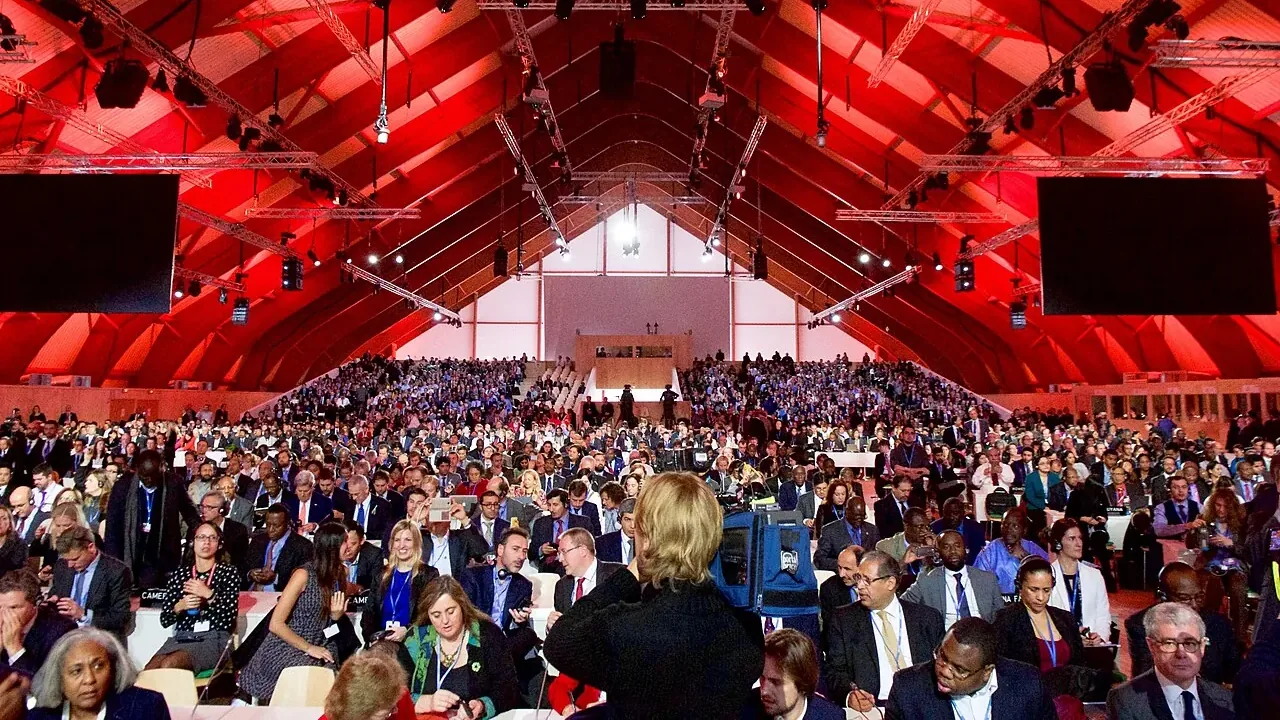
At COP climate summits, 198 Parties (197 countries plus the European Union) adopt deals by consensus rather than majority vote. Because governments left their draft voting rule unadopted in 1995, any formal objection in the closing plenary can block an agreement. That setup drives marathon overtime sessions and occasional collapses when major blocs refuse to yield.
ContentsToggle
Why do COP climate summits use consensus instead of voting?
COP stands for Conference of the Parties, the supreme decision-making body of the 1992 United Nations Framework Convention on Climate Change (UNFCCC). When governments met for the first summit in Berlin in 1995, they were meant to adopt formal Rules of Procedure under Article 7 of the treaty. Oil-producing nations including Saudi Arabia and Kuwait opposed majority voting for protocols, so delegates applied the draft rules provisionally and deferred Rule 42 on voting.
Parties have postponed Rule 42 at every annual summit for more than 30 years. Without an adopted voting clause, decisions default to UN consensus practice, which official UNFCCC procedural guidance defines as adoption “by general agreement” and “absent any formal objection.” Under draft Rule 31, at least one-third of Parties must be present to open a session and two-thirds to adopt decisions.
Consensus does not require every country to cast an enthusiastic yes vote. Governments with doubts can stay quiet during adoption and enter reservations into the official record, provided nobody lodges a formal objection from the floor. In a 2024 Carbon Brief analysis, UNFCCC Executive Secretary Simon Stiell summed up that threshold by noting that “all Parties must agree on every word, every comma, every full stop.”
Voting is not completely absent from the UN climate system. Procedural appeals of a presiding officer’s ruling on a point of order go to an immediate simple majority vote under Rule 34, and formal treaty amendments under Article 15 of the Convention can pass by a three-fourths majority vote as a last resort.
| Type of action | How it passes | Legal effect |
|---|---|---|
| Routine COP or CMA decision | Consensus with two-thirds quorum | Political commitment unless a treaty authorizes binding rules |
| Procedural appeal (Rule 34) | Simple majority of Parties present and voting | Upheld or overturned procedural ruling by the chair |
| Treaty amendment (Article 15) | Consensus first, or three-fourths majority vote as a last resort | Binding once three-fourths of Parties formally accept it |
| Action Agenda pledge | Voluntary sign-on by countries, cities, or companies | Non-binding sideline pledge outside formal UN decisions |
How do negotiators build a COP text before the final gavel?
The two-week annual summit is only the final stage of a year-long calendar. Technical negotiators meet mid-year in Bonn, Germany, under two subsidiary bodies: SBSTA covers science, emissions accounting, and reporting, while SBI handles climate finance, transparency, and implementation. Draft texts produced in Bonn feed straight into the November or December conference.
At the summit, three governing bodies meet side by side inside the UN-managed Blue Zone: the COP for the 1992 Convention, the CMP for the Kyoto Protocol, and the CMA for the 2015 Paris Agreement. Opening plenaries first adopt the formal agenda, a step that can stall talks before substantive bargaining begins. Delegates then split into smaller contact groups and informal consultations.
When you read a draft compilation text from a climate summit, you will sometimes see 7 to 15 competing options for a single clause. Disputed words sit inside square brackets until governments agree to drop or rewrite them, and every verb signals a different level of commitment:
- “Shall” signals a legally binding obligation.
- “Should” states a formal recommendation.
- “May” leaves the action optional.
Who holds influence in the negotiating rooms?
Few countries negotiate alone in a hall of 198 Parties. Governments pool their voices inside formal UNFCCC party groupings that agree on shared red lines before entering closed rooms. Major blocs include the G77 and China (134 developing nations), the African Group (54 nations), the Coalition for Rainforest Nations (52 countries), the Like-Minded Developing Countries (around 24 developing nations), and the Alliance of Small Island States (AOSIS).
Non-EU developed nations coordinate through the Umbrella Group, which includes the United States, Canada, Japan, Australia, and (since 2023) the United Kingdom. Delegation size shapes what happens across parallel rooms. Wealthier governments can assign specialist teams to dozens of simultaneous talks, while smaller countries may send only two or three negotiators to cover every track.
Hosting duties rotate annually across five UN regional groups, and the host country nominates the COP President. That officer mediates disputes, drafts overarching cover decisions, and enforces meeting rules. Under draft Rule 22.3, the COP President cannot act as a national delegate while presiding.
Why do summits run into overtime or collapse without a deal?
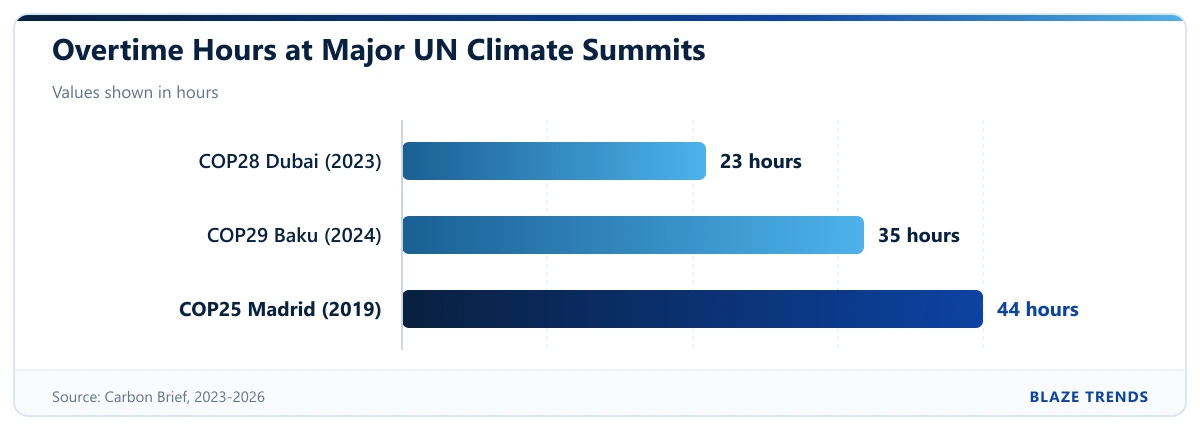
Because any formal objection can halt adoption, delegations hold back final concessions until the closing hours. According to Carbon Brief’s tracking, no COP has finished on schedule since 2003. At the COP28 talks in Dubai in 2023, negotiators worked 23 hours past deadline to adopt the first UN text calling to “transition away from fossil fuels,” while COP29 in Baku ran 35 hours overtime in 2024 and COP25 in Madrid set a 44-hour overtime record in 2019.
When talks deadlock on specific technical tracks, negotiators often invoke Rule 16 to defer unresolved items to the next session. Governments used Rule 16 on 12 unfinished agenda items at both COP25 and COP28, according to Carbon Brief’s review of COP28 Dubai outcomes. In rare cases, presiding officers have also struck the gavel over isolated protests, as Mexico did despite Bolivia’s objection at COP16 in Cancún in 2010 and Qatar did without recognizing Russia’s floor request at COP18 in Doha in 2012.
Overruling an isolated holdout is very different from overriding a major coalition. When large blocs refuse to drop formal objections, the summit fails to adopt a central agreement. At COP15 in Copenhagen in 2009, objections left the plenary able only to “take note of” the Copenhagen Accord rather than formally adopt it.
A similar breakdown occurred at COP31 in Antalya, Türkiye, in November 2026. After surpassing COP25’s 44-hour overtime record, Russia and Saudi Arabia opposed fossil-fuel transition language while the European Union, the United Kingdom, and developing nations formally objected to a draft that omitted fossil fuels. With consensus out of reach, COP31 President Murat Kurum closed the summit without an overarching cover decision.
Frequently asked questions
Why don’t UN climate summits switch to majority voting?
Adopting Rule 42 to introduce majority voting would itself require consensus among the 198 Parties. Countries concerned about being outvoted on energy policy or climate finance have withheld consent since 1995, keeping the voting rule frozen.
Are COP agreements legally binding on participating countries?
Most annual COP decisions function as political commitments and recommendations rather than enforceable international law, unless a treaty explicitly authorizes binding operational rules. Formal treaties adopted at COP, such as the 2015 Paris Agreement, create legally binding procedural duties like submitting five-year national climate plans while letting each government set its own emissions targets.
What happens to existing climate treaties if a COP fails to reach a deal?
A collapse over an annual cover decision does not cancel existing treaties like the 1992 UNFCCC or the 2015 Paris Agreement. Unfinished technical items roll forward under Rule 16 to mid-year talks in Bonn and the next annual summit, while existing reporting cycles stay in force.