

CinemaScore is a Las Vegas research firm that grades wide theatrical releases from A+ to F by polling opening-night moviegoers in North American lobbies. Movie exit polling surveys verified ticket buyers right after the credits roll to forecast box office staying power. Because Friday crowds already want to like the film, a B or C usually signals trouble.
ContentsToggle
How CinemaScore collects opening-night grades
Ed Mintz founded CinemaScore in 1978 in Los Angeles before moving operations to Las Vegas, running the family business with his son Harold until his death in February 2024 at age 83. Today, the company automatically polls and publicly grades wide releases opening on 1,500 or more screens across North America.

Every Friday, pollsters head to five randomly selected cities drawn from 25 major North American markets, including Los Angeles, New York, Chicago, Dallas, Atlanta, and Philadelphia. Studios cannot pick or influence which theaters get polled, because letting a distributor stack the room would skew the results.
Pollsters start around 6:30 p.m. and hand out physical six-question ballot cards before collecting them as audiences leave the auditorium. Each card asks for six pieces of data:
- An overall letter grade from A to F
- The moviegoer’s age bracket and gender
- Interest in buying or renting the movie later at home
- The main reason the viewer chose to attend
- Whether the film matched its marketing
Roughly 65% of approached moviegoers fill out a card, according to a 2014 Deadline interview with Ed Mintz. That produces about 400 completed ballots per film with an estimated 6% margin of error.
Once the screening lets out, pollsters type the tally into an iPad in roughly 10 minutes, wrapping up about 1.5 hours of active work. CinemaScore averages the responses into a single grade from A+ to F, with plus and minus modifiers on every letter except F, and delivers full age and gender splits to studio subscribers around 11 p.m. Pacific Time before posting the headline letter publicly.
Why a B or C CinemaScore worries Hollywood studios
If you read CinemaScore like a high school report card, the industry’s reaction looks bizarre. Opening-night crowds are not a random cross-section of the public; they are the fans who bought tickets first and walked in hoping for a great night out.
“A’s generally are good, B’s generally are shaky, and C’s are terrible”
Mintz’s famous rule of thumb holds up in ticket sales. Historical industry data from 2004 to 2014 showed A+ releases earned an average domestic total of 4.8 times their opening weekend, while A-graded movies averaged 3.6 times and C-rated releases dropped to 2.5 times.
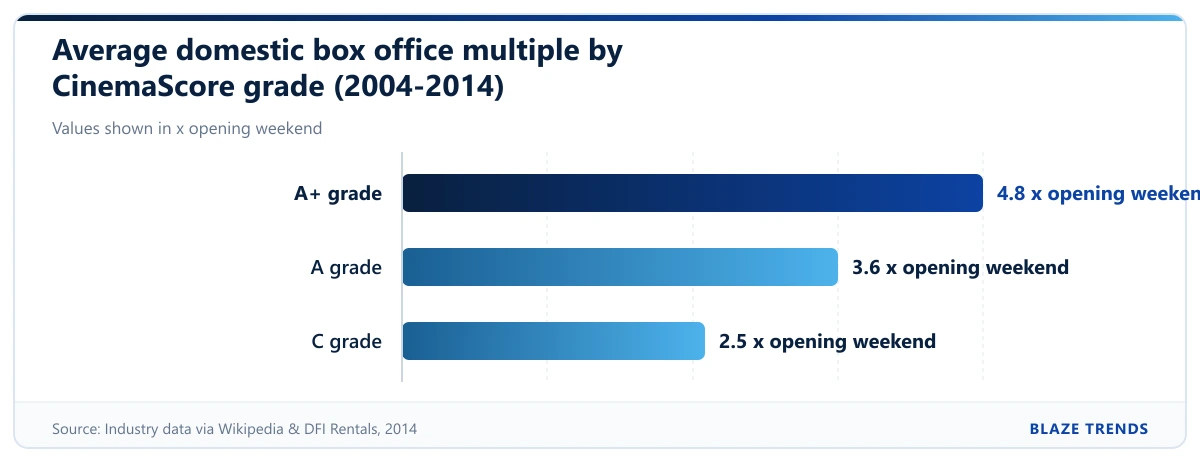
That predictive power survived the pandemic era. A 2025 study in the Journal of Applied Marketing Theory found that higher CinemaScore grades significantly reduced second-weekend box office drops both before and after COVID-19, whereas Rotten Tomatoes’ Top Critics score lost statistical significance after the pandemic.
Extreme grades remain rare on both ends of the scale. As of November 2026, only 136 films have earned an A+, while just 22 movies had received an F as of 2020.
CinemaScore vs. PostTrak and Rotten Tomatoes
CinemaScore still dominates weekend headlines because its letter grade is public and easy to read, yet Hollywood studios rely on two other major audience metrics right beside it. Each service samples moviegoers differently and answers a slightly different question.
| Metric | Operator | How data is collected | Main output | Public availability |
|---|---|---|---|---|
| CinemaScore | CinemaScore | Six-question paper cards in five random cities on opening night | Single letter grade (A+ to F) plus studio age/gender splits | Overall letter grade is public for 1,500+ screen releases |
| PostTrak | Comscore and Screen Engine/ASI | 17- to 20-question tablet surveys across opening weekend and week two | Overall positive %, definite recommend %, granular demographics | Proprietary studio dashboards; select numbers appear in trade press |
| Verified Audience Score | Rotten Tomatoes | Online ratings tied to Fandango ticket purchases after showtime | Percentage positive score; Verified Hot badge at 90%+ with 500+ ratings | Public online in real time |
Screen Engine/ASI launched PostTrak in 2012 as a syndicated in-theater exit-polling joint venture now run with Comscore across the US, Canada, and Puerto Rico. According to The Ankler’s 2026 report on lobby polling, PostTrak hires freelance pollsters on 6- to 10-hour shifts to gather 17- to 20-question tablet surveys that take under five minutes and track both overall positivity and how strongly viewers would recommend the film through week two.
Rotten Tomatoes added its Verified Audience Score in May 2019 to curb online review bombing by verifying completed ticket transactions through Fandango. Under Rotten Tomatoes’ official criteria, wide releases earn a Verified Hot badge once they hit at least 90% with 500 or more verified ratings.
The biggest methodological gap comes down to who answers. CinemaScore and PostTrak actively intercept moviegoers in the lobby, while Rotten Tomatoes relies on self-selected viewers who choose to go online and rate the movie later. Even so, some studio executives interviewed by The Ankler in 2026 said they now weigh PostTrak and Rotten Tomatoes’ verified scores more heavily than CinemaScore’s single letter.
When genre curves and demographics bend the rules
A CinemaScore measures whether a movie satisfied opening-night expectations created by its trailers, not whether critics think it belongs in a museum. When an auteur-driven or genre-bending film gets marketed like a straightforward thriller or blockbuster, blindsided Friday crowds often punish it with a D or F.
Horror movies operate on an even tougher curve because scare fans split sharply over bleak or ambiguous endings. The Conjuring in 2013 became the first horror release to score higher than a B+ when it landed an A-, and Harold Mintz once likened an F for a horror title to a B- for a comedy.
Headline letters can also hide massive generational divides inside the theater. In August 2014, Teenage Mutant Ninja Turtles finished with an overall B, yet viewers under 18 graded it an A while adults aged 25 to 35 gave it a C+.
Star power and older ticket buyers can also outrun a lukewarm grade. Tammy earned a C+ in 2014 yet held well at the box office because 50% of its crowd was over 35 and 24% was over 50. Earlier releases like Shutter Island (C+, 3.1x multiple) and Vanilla Sky (D-, 4x multiple) also defied their opening-night scores.
Frequently asked questions
Can you take a CinemaScore survey online?
No. CinemaScore collects ballots exclusively in person using physical cards at randomly selected theaters on opening night. Keeping the survey offline prevents internet campaigns from brigading a film’s grade.
Why don’t smaller or limited releases have a public CinemaScore?
CinemaScore only polls and publishes grades automatically for wide releases opening on 1,500 or more screens. Distributors of smaller films can pay CinemaScore to run a private poll using the identical methodology, and those results remain confidential unless the client chooses to share them.
Does CinemaScore operate outside North America?
CinemaScore focuses on North American wide releases in the US and Canada. Markets like the UK have no direct public equivalent, though Comscore’s PostTrak tracks the US, Canada, and Puerto Rico domestically and operates in select international territories.