
Under the two-legged aggregate score rule in soccer, two clubs play each other twice, once at each team’s home stadium, and add the goals from both matches together into a single combined score. The team that scores more total goals across those two 90-minute games wins the tie and advances to the next round, regardless of whether it won, lost, or drew either individual match. If both teams have the exact same aggregate score after 180 minutes of regulation play, tournament tiebreakers such as extra time, a penalty shoot-out, or the away goals rule decide the winner.
When you watch a knockout tournament like the UEFA Champions League or the CONCACAF Champions Cup, the broadcast scoreboard displays the abbreviation Agg in parentheses next to the match score, according to Alicante Football Academy’s 2026 explainer. That figure tracks the running two-game total across the first leg and the second leg. Rather than settling a knockout round in a single 90-minute game at one venue, a home-and-away series gives every club equal time in front of its own supporters and on the road.
How do you calculate the aggregate score across two legs?
Calculating the winner of a two-legged tie requires adding each team’s goals across both matches rather than counting wins, losses, or league points. Under UEFA Champions League Article 20 of the 2026/27 competition regulations, knockout ties prior to the final are played in home and away matches, and the team that scores the greater aggregate of goals across the two games qualifies for the next stage.
- Record the regulation score at the end of 90 minutes plus stoppage time in the first leg hosted by Team A.
- Add the goals scored during the 90-minute second leg hosted by Team B to each club’s first-leg total to produce the 180-minute aggregate score.
- Compare the two combined totals at the final whistle of the second leg, where the club with more total goals advances immediately.
- Apply the tournament’s tiebreaking procedure if both teams finish the second leg with the exact same aggregate total.
A common mistake among casual fans is treating a two-legged tie like a best-of-three series where winning one game apiece forces a decider. Standard match points (three points for a win and one for a draw) do not exist in knockout aggregate play, as noted by Alicante Football Academy and Calc Engines in 2026. If Team A wins the first leg 3-0 at home and Team B wins the second leg 1-0 in the return match, Team A wins the series 3-1 on aggregate and advances as soon as the second leg ends.
What happens when the aggregate score is tied after 180 minutes?
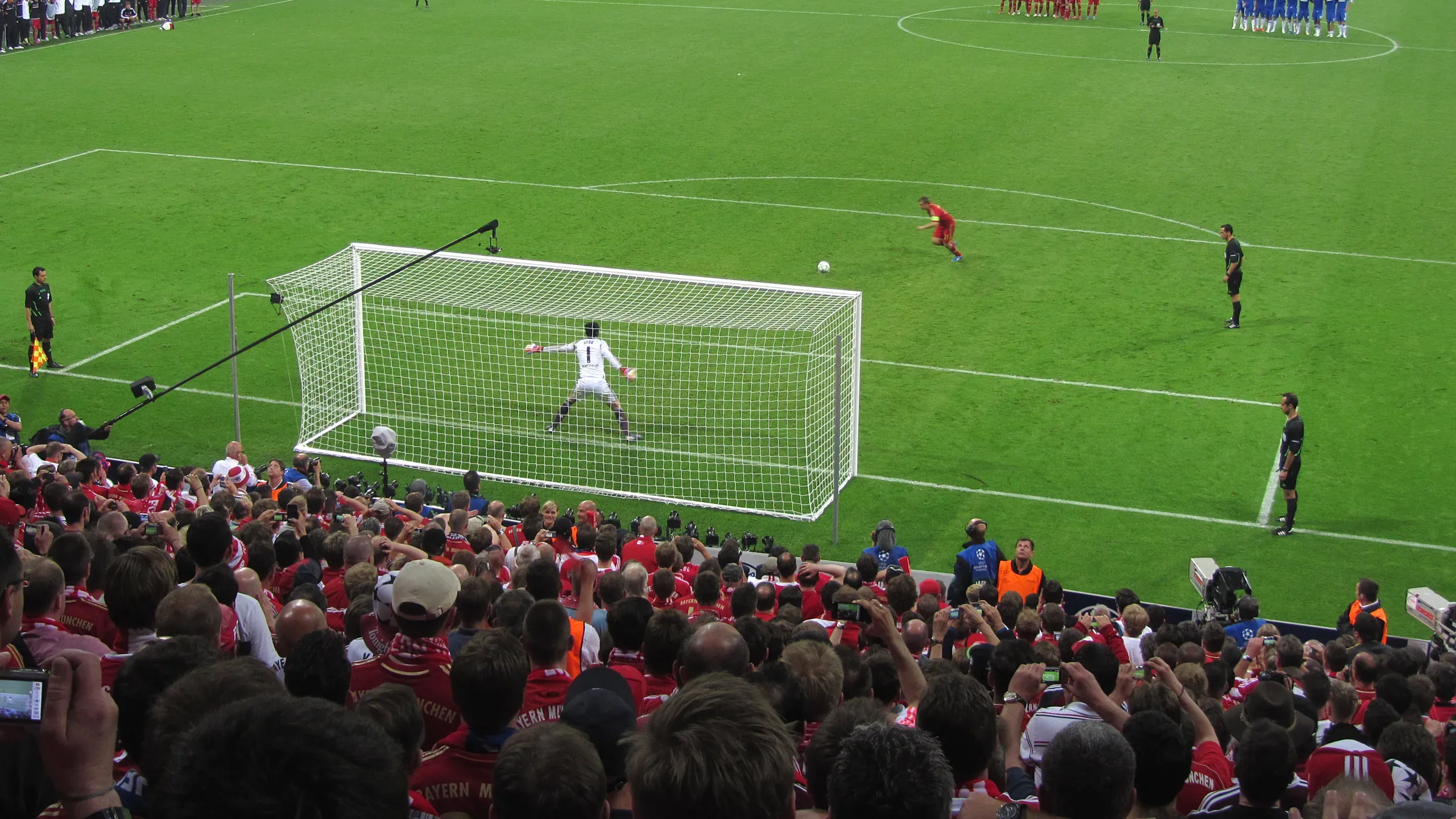
When two clubs score the exact same number of combined goals across both legs, the match cannot end in a draw because only one team can advance. Under IFAB Law 10 of the 2026/27 Laws of the Game, published by the International Football Association Board and The Football Association, competition organizers may only determine the winner of a drawn home-and-away tie using three approved procedures or a combination of them: the away goals rule, two equal periods of extra time not exceeding 15 minutes each, and a penalty shoot-out.
In European club tournaments governed by UEFA’s 2026/27 Article 21 knockout regulations, a level aggregate score after 180 minutes triggers the same extra-time format used in single-match knockout tiebreakers. Under Articles 21.01 and 21.02, the players remain on the field for a five-minute break after the second leg’s regulation whistle, then play two 15-minute periods of extra time. Teams switch ends at the halfway mark of extra time without a rest break. If neither team scores during those 30 extra minutes, or if both teams score an equal number of goals in extra time, Article 21.03 sends the tie to a penalty shoot-out.
Why did UEFA and other confederations drop the away goals rule?
For more than five decades, most two-legged ties never reached extra time unless both matches ended with the exact same scoreline in each stadium. Under the traditional away goals rule, if the aggregate score was tied after 180 minutes, whichever club scored more goals at the opponent’s stadium won the tie immediately. Casual viewers often hear that an away goal counts double, which is a misconception: as Calc Engines explains in its 2026 guide, an away goal never adds two goals to the scoreboard and acts strictly as a tiebreaker when the combined aggregate score is level.
The 2020-21 UEFA Champions League quarter-final between Bayern Munich and Paris Saint-Germain showed how decisive that tiebreaker could be, according to Wikipedia’s 2026 tournament records. Paris Saint-Germain won the first leg 3-2 away in Munich, and Bayern Munich won the second leg 1-0 away in Paris. Those results left the series deadlocked at 3-3 on aggregate after 180 minutes, and Paris Saint-Germain advanced to the semi-finals because they had scored three away goals to Bayern’s one. Under UEFA’s 2026/27 regulations, that exact same 3-3 aggregate draw would go straight to 30 minutes of extra time and, if still tied, a penalty shoot-out.
That quarter-final took place during the final season in which European club competitions used away goals to break knockout ties. On June 24, 2021, UEFA’s 2021 rule change abolished the away goals rule across all men’s, women’s, and youth club competitions starting with the 2021/22 season. In its official release, the governing body noted that “The away goals rule has been an intrinsic part of UEFA competitions since it was introduced in 1965.”
UEFA dropped the rule after statistical tracking from the mid-1970s to 2021 showed that the gap between playing at home and playing away had narrowed across Europe. According to the UEFA figures cited by Alicante Football Academy and Calc Engines in 2026, home wins in UEFA matches dropped from 61% in the mid-1970s to 47%, while away wins climbed from 19% to 30%. Average goals per game over that span also converged from 2.02 for home teams and 0.95 for away teams to 1.58 for home teams and 1.15 for away teams. Instead of encouraging visiting clubs to attack, the rule was deterring home teams in the first leg from pushing forward out of fear of conceding a tiebreaking away goal.
Two other continental governing bodies soon followed UEFA’s change. The South American Football Confederation (CONMEBOL) abolished the away goals rule in its club tournaments, including the Copa Libertadores and Copa Sudamericana, starting in the 2022 season, and the Asian Football Confederation (AFC) removed it from AFC club competitions starting in the 2023-24 season, according to Wikipedia’s 2026 rule summary.
Which soccer tournaments still use away goals in a two-legged tie?
Removing away goals in Europe, South America, and Asia did not eliminate the rule from global soccer. Because IFAB Law 10 still authorizes away goals as a valid tiebreaker as of the 2026/27 Laws of the Game, major tournaments in North America and Africa continue to enforce it, while certain domestic leagues use regular-season standings instead.
- North America, Central America, and the Caribbean (CONCACAF): Under Section 12.10.3.2 of the 2026 CONCACAF Champions Cup Regulations, if the aggregate score is tied at the end of regulation time in the second leg, the club with the greater number of away goals scored in regulation time across the two legs wins the tie. The CONCACAF Nations League also uses regulation away goals as its first aggregate tiebreaker, though away goals do not count as a tiebreaker during extra time in CONCACAF competitions, according to Wikipedia (2026).
- Africa (CAF): In the CAF Champions League and CAF Confederation Cup, away goals serve as the first tiebreaker at the end of regulation time in the second leg. If both teams are level on aggregate and have scored the same number of away goals, the tie skips extra time and moves directly to a penalty shoot-out (Wikipedia, 2026).
- Italian Serie B promotion playoffs: Domestic league playoffs can skip both away goals and penalty shoot-outs. In Italy’s Serie B promotion playoffs, if a two-legged tie remains level on aggregate after extra time in the second leg, the club that finished higher in the regular-season league table advances to the next round (Wikipedia, 2026).
Because tournament organizers update their competition handbooks before each cycle, check the official regulations page of the governing body for the specific tournament you are watching to confirm its current tiebreaker order.
Frequently asked questions
Can the first leg of a two-legged tie go to extra time?
No. Even when the first leg ends in a tie, the referee blows the final whistle after 90 minutes plus stoppage time. Because the first match is only the opening half of a 180-minute series, extra time is reserved exclusively for the end of the second leg when the combined two-game aggregate score is level.
Do penalty shoot-out goals count toward the aggregate score?
No. Under IFAB Law 10, kicks from the penalty mark are separate from normal regulation play and extra time, as BookMySpot explains in its 2026 rules breakdown. Goals converted during a penalty shoot-out are never added to the match score or the aggregate total; they only decide which club advances.
Does UEFA still use away goals anywhere in the Champions League?
Yes, in the league phase standings rather than in two-legged knockout ties. Under Article 18 of the 2026/27 UEFA Champions League regulations, when clubs finish tied on points in the league phase table, away goals scored during the league phase are the third tiebreaking criterion right after overall goal difference and total goals scored, according to Calc Engines (2026).