
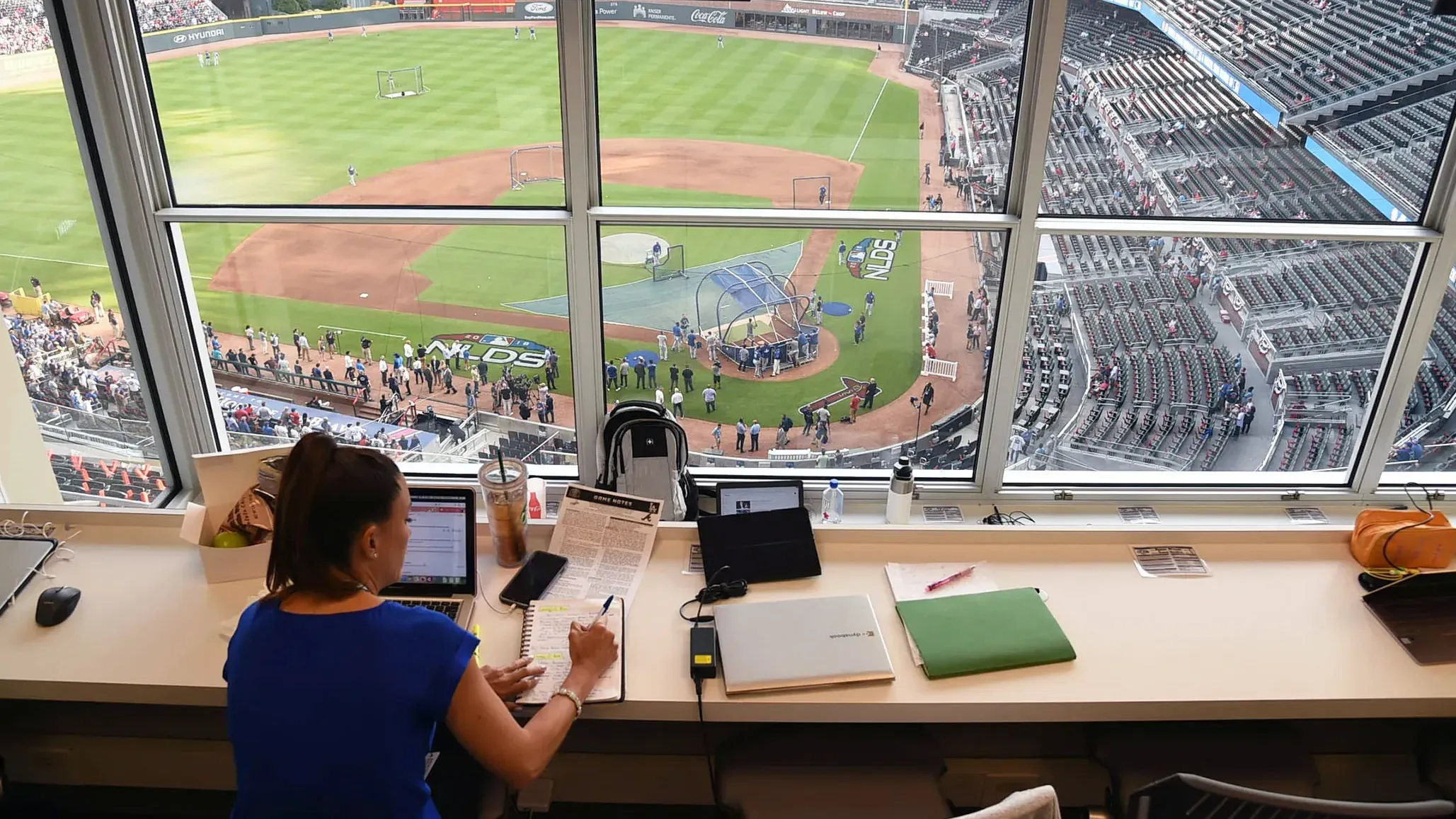
Major League Baseball’s top seasonal honors are decided through BBWAA award voting conducted by members of the Baseball Writers’ Association of America before the postseason begins. Two beat writers from each of the 15 cities in the American League and National League (30 voters per league for each trophy) rank their choices on a weighted points ballot. The BBWAA Secretary/Treasurer tabulates the points, announces the top three point-getters as finalists in early November, and reveals the winners alongside every writer’s individual ballot during MLB Awards Week.
According to the official BBWAA voting rules as of 2026, the association oversees five annual awards in each league: Most Valuable Player (MVP), the Cy Young Award, Jackie Robinson Rookie of the Year, Manager of the Year, and the Reliever of the Year Award. Long-tenured members also vote each winter on player elections for the National Baseball Hall of Fame in Cooperstown. Other prominent baseball honors, including the Hank Aaron Award, All-MLB teams, and the Heart & Hustle Award, are chosen by separate panels of fans, active players, or alumni rather than the writers’ association, as noted by Sports Illustrated’s awards guide in 2025.
Who gets a ballot in BBWAA award voting?
Every Major League Baseball market has a local BBWAA chapter made up of daily beat reporters and columnists who cover the team throughout the 162-game schedule. Before the regular season ends, the local chapter chair in each city recommends two writers for each of the five annual awards, and the BBWAA national secretary-treasurer reviews and approves the final panels (BBWAA, 2026).
Because both the American League and National League have 15 clubs, exactly 30 writers cast ballots for each award in each league. Across the 10 seasonal trophies (five in the AL and five in the NL), 300 individual ballots are submitted each autumn. Any active BBWAA member, along with select honorary members, is eligible to vote on seasonal awards regardless of how many years they have belonged to the organization, and national baseball writers are also included in the chapter pools (BBWAA, 2026).
When a local chapter does not have enough eligible writers to fill all 10 of its city slots, a local beat writer may vote on more than one award, or the secretary-treasurer assigns an eligible writer from another city to represent that chapter (BBWAA, 2026). Shortages in major media markets often happen because several news organizations enforce internal ethics rules that bar their journalists from voting on sports awards.
How does the weighted point system calculate each winner?
Rather than picking a single winner, BBWAA voters submit a ranked ballot where each slot carries a fixed point value. Voters are required to fill in every slot on their assigned ballot and are prohibited from splitting a single ranking spot between two candidates (BBWAA, 2026).
The number of ranked spots and the point spread depend on the specific trophy:
| Award | Players Ranked per Ballot | Points by Rank (1st to Last) | Maximum Unanimous Points (30 Ballots) |
|---|---|---|---|
| Most Valuable Player (MVP) | 10 | 14-9-8-7-6-5-4-3-2-1 | 420 |
| Cy Young Award | 5 | 7-4-3-2-1 | 210 |
| Reliever of the Year Award | 5 | 7-4-3-2-1 | 210 |
| Jackie Robinson Rookie of the Year | 3 | 5-3-1 | 150 |
| Manager of the Year | 3 | 5-3-1 | 150 |
The BBWAA has overseen the AL and NL MVP Awards since 1931 and adopted the 10-player weighted scoring system in 1938, according to MLB.com historical voting records published in 2025. Notice the five-point bonus built into the top of the MVP scale: a first-place vote is worth 14 points while second place drops to 9 points, followed by one-point steps down to 10th place. The five-pitcher Cy Young and Reliever of the Year scales give 7 points for first place and 4 points for second, while the three-slot Rookie and Manager ballots award 5, 3, and 1 (BBWAA, 2026).
The BBWAA expanded these ballots over time to reduce ties and capture broader consensus. Rookie of the Year moved from a single-vote system to the three-player 5-3-1 ballot in 1980 following a 1979 tie (BBWAA, 2024), while the Cy Young Award shifted from a single vote prior to 1970 to a 5-3-1 ballot from 1970 through 2009, before adopting the five-pitcher 7-4-3-2-1 format in 2010. When the BBWAA introduced its Reliever of the Year Award in 2026, its first new seasonal trophy since 1983, it applied the same five-pitcher 7-4-3-2-1 format used for the Cy Young Award (BBWAA, 2026).
Because total points determine the winner, down-ballot support and first-place bonuses can pull in opposite directions. In 1979, Pittsburgh Pirates first baseman Willie Stargell and St. Louis Cardinals first baseman Keith Hernandez finished in the only tie in MVP history at 216 points apiece (MLB.com, 2025). Stargell collected 10 first-place votes compared to just four for Hernandez, but four writers left Stargell off their 10-man ballots completely while Hernandez was named on all 24 NL ballots cast that year.
The reverse happened in the inaugural 2026 AL Reliever ballot tabulated by the BBWAA. Cleveland Guardians closer Cade Smith was the only pitcher named on all 30 ballots, collecting 7 first-place, 15 second-place, and 8 third-place votes for 133 points. Toronto Blue Jays reliever Louis Varland was left off three ballots entirely, yet Varland won the trophy with 146 points because his 16 first-place votes (112 points by themselves) outweighed Smith’s unanimous ballot presence (BBWAA, 2026).
When are ballots due and what criteria do writers use?
Every seasonal BBWAA ballot must be submitted before the first pitch of the postseason (BBWAA, 2026). That hard deadline keeps the awards strictly focused on the regular season, meaning a dominant October run or a Wild Card collapse has zero influence on who wins.
Once the World Series concludes, BBWAA Secretary/Treasurer Jack O’Connell tabulates the point totals. When Major League Baseball reveals three “finalists” for each award in early November, no second round of voting takes place; those three names are simply the top three point-earners from the ballots locked in before October, as confirmed in a 2026 NBC Sports finalist report.
For fans who wonder why one voter prioritizes Wins Above Replacement (WAR) while another leans toward runs batted in or late-inning situations, the official MVP ballot instructions have remained unchanged since 1931 and state that “there is no clear-cut definition of what Most Valuable means,” leaving the judgment entirely to the individual voter (BBWAA, 2026). The ballot asks each writer to weigh four specific guidelines (BBWAA, 2026):
- Actual value of a player to his team, defined as strength of offense and defense.
- Number of games played across the regular season.
- General character, disposition, loyalty, and effort.
- Eligibility of all players, including starting pitchers, relief pitchers, designated hitters, former winners, and multiple players from the same club.
To prevent voters from automatically disqualifying stars on losing clubs, the official ballot instructions also state directly that “The MVP need not come from a division winner or other playoff qualifier” (BBWAA, 2026).
How does Hall of Fame voting differ from seasonal awards?
While any active BBWAA beat writer can be tapped to vote on seasonal awards, voting for the National Baseball Hall of Fame requires at least 10 consecutive years of active BBWAA membership (National Baseball Hall of Fame, 2026). Under a rule change enacted in 2015, lifetime honorary members remain eligible to vote for up to 10 years after they cease active baseball coverage, provided they register annually with the secretary-treasurer (BBWAA, 2026).
Hall of Fame ballots are distributed in late November and must be returned by December 31 (BBWAA, 2026). Eligible candidates are retired players who played at least 10 Major League seasons, have been retired for five full seasons, and were active within 15 years prior to the election (National Baseball Hall of Fame, 2026). Instead of ranking candidates on a point scale, voters check the boxes for anywhere from 0 to 10 players, with write-in votes prohibited (National Baseball Hall of Fame, 2026).
The BBWAA Secretary/Treasurer tabulates the Hall of Fame envelopes in January alongside a representative from the accounting firm Ernst & Young (BBWAA, 2026). To be elected to Cooperstown, a player must be named on at least 75 percent of all ballots returned, including blank ballots submitted by voters who choose not to check any names (National Baseball Hall of Fame, 2026).
Frequently asked questions
What happens if two players tie in BBWAA award points?
There is no tiebreaker in BBWAA seasonal award voting; if two candidates finish with the exact same total points, both share the trophy, regardless of who earned more first-place votes. Across the history of the awards, four ties have occurred: the 1969 AL Cy Young Award, the 1979 AL Rookie of the Year Award, the 1979 NL MVP Award, and the 1996 AL Manager of the Year Award shared by Johnny Oates and Joe Torre (BBWAA, 2010, 2016, 2024; MLB.com, 2025).
Are individual BBWAA writers’ award ballots public?
Yes for all seasonal awards, and partially for the Hall of Fame. Beginning in 2012, the BBWAA started publishing every writer’s complete seasonal award ballot, listing the voter’s name, media outlet, and chapter, on its official website immediately after each winner is announced. For Hall of Fame elections, individual ballot disclosure remains optional for voters, though 81.4 percent of Hall of Fame voters chose to make their ballots public in 2025 (BBWAA, 2026).
Why don’t reporters from The New York Times or Los Angeles Times vote on MLB awards?
Several major news organizations, including The New York Times and the Los Angeles Times, enforce internal newsroom ethics policies that prohibit their reporters and columnists from voting on awards they cover in order to avoid a perceived conflict of interest (BBWAA, 2026). Those writers remain BBWAA members for press box access and association business but are skipped when chapter chairs assign award ballots.