
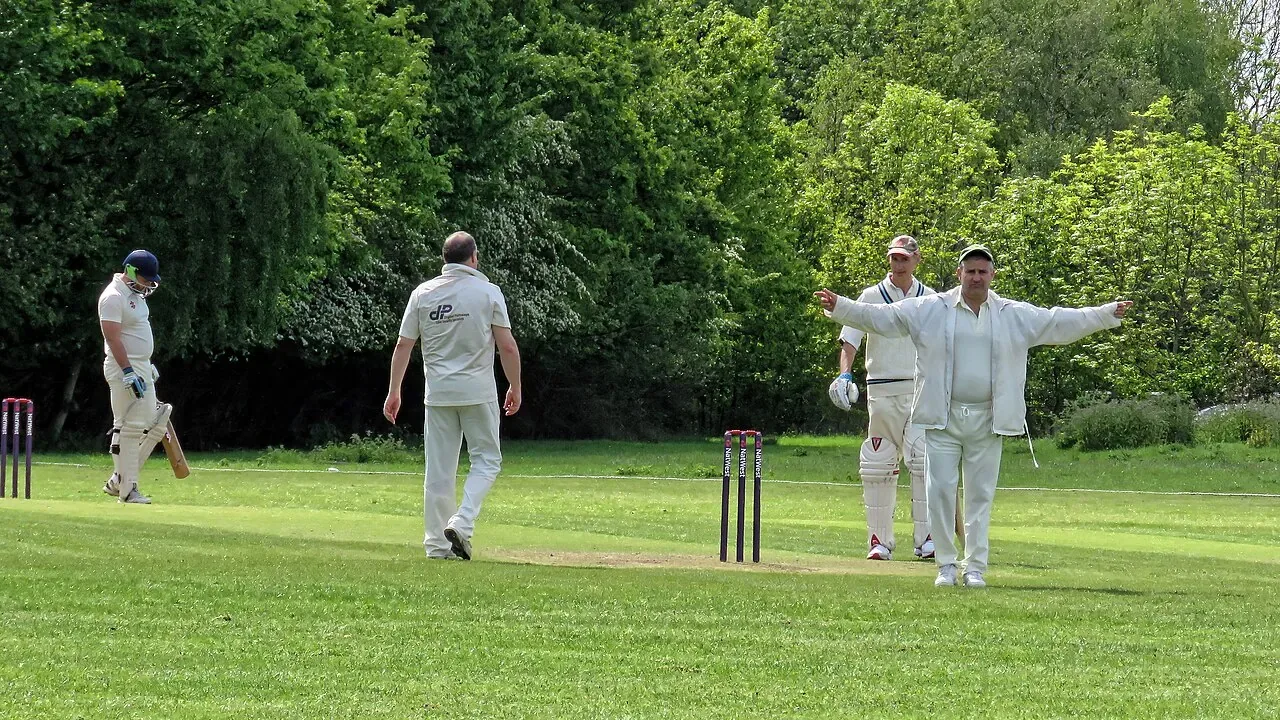
In limited-overs cricket, any no-ball bowled by the fielding side awards the batting team one penalty run plus a free hit on the very next delivery. Free hit rules protect the batter on that extra ball from standard dismissals like being bowled, caught, leg before wicket (LBW), stumped, or hit wicket. Unless the batters swapped ends on the original no-ball, the fielding captain must also keep the exact same field placement for the free hit.
Because the Marylebone Cricket Club (MCC) Laws of Cricket do not contain a free-hit provision in their base text, the rule operates as a competition playing condition layered onto Law 21 by the International Cricket Council (ICC) and domestic white-ball leagues. You will see it in every Men’s and Women’s One Day International (ODI), Twenty20 International (T20I), and domestic T20 tournament, while Test cricket and multi-day first-class matches do not use it.
What triggers a free hit in limited-overs cricket?
Under Clause 21.19.1 of the ICC Playing Conditions (2025), the delivery immediately following any mode of no-ball is a free hit for whichever batter is facing it. When the ICC first introduced the rule to ODI cricket in October 2007, only a front-foot or back-foot fault triggered a free hit. That changed on July 5, 2015, when the ICC expanded its ODI and T20I regulations so that every type of no-ball awards a free hit.
A bowler or fielding team triggers a free hit by committing any of these infractions:
- Overstepping the popping crease with the front foot when landing, or touching the side return crease with the back foot.
- Bowling a full toss that passes or would have passed above the striker’s waist while standing upright at the crease.
- Exceeding the permitted bouncer limit for the over, or bowling a delivery that bounces more than once before reaching the popping crease.
- Throwing the ball with an illegal bowling action rather than bowling it.
- Breaking fielding circle restrictions, such as having too many fielders outside the 30-yard circle or placing more than two fielders behind square leg.
After holding one arm out horizontally to call the no-ball, the bowler’s end umpire raises one arm straight overhead and rotates it in a circle. That overhead circular motion tells the batters, the scorers, and the crowd that the upcoming ball is a free hit.
If the bowler delivers another no-ball or a wide on the free hit itself, the penalty is not wasted. Because a wide or no-ball does not count as a legitimate delivery, the free hit carries forward to the next ball, and the umpire repeats the overhead circular signal.
How can a batter get out on a free hit?
A free hit gives the striker a nearly risk-free swing at the ball, though they are not completely immune from losing their wicket. As Clause 21.19.2 of the rulebook states, “For any free hit, the striker can be dismissed only under the circumstances that apply for a no ball,” and that protection holds even if the free-hit delivery is called a wide.
Five standard dismissals are turned off on a free hit: bowled, caught, LBW, stumped, and hit wicket. Even if a batter skies the ball straight into a fielder’s hands or steps back onto their own stumps while swinging, they remain not out and can keep running between the wickets.
According to Clause 21.18 of the ICC No Ball regulations (2017), only three modes of dismissal stay active on a no-ball and a free hit:
- Run out (Clause 38), if either batter is out of their ground when a fielder or the wicketkeeper breaks the stumps while they are attempting a run.
- Hitting the ball twice willfully (Clause 34), except when done solely to guard the wicket.
- Obstructing the field (Clause 37), which since 2017 also covers intentionally handling the ball without the fielding side’s consent.
Wait for a bowler to send down a wide on a free hit and you will often see casual fans wonder why the wicketkeeper cannot stump a batter who charges down the pitch. On a normal wide delivery, a stumping is legal. On a free hit, Clause 21.19.2 overrides that rule: if the batter leaves their crease to swing at a wide and misses, the keeper can only get them out via a run out if the batter is trying to take a run, not a stumping. Any wicket that falls on a free hit goes into the team scorebook as a dismissal, not into the bowler’s personal wicket tally.
When can the fielding captain change the field for a free hit?
Free hits punish bowling errors twice: first by taking away the bowler’s main dismissals, and second by locking the field in place. If a captain had an attacking field up inside the 30-yard circle when the bowler overstepped, they cannot push those fielders back to the boundary rope to defend against a big swing—unless a specific exception applies.
Under Clause 21.19.3 of the ICC ODI Playing Conditions (2017), the fielding side cannot alter the field placement or swap individual players from one position to another for a free hit, except in two situations:
- The batters ran an odd number of runs (one or three) on the original no-ball, putting the other batter on strike for the free hit. Because a different striker is facing, the captain can set a brand-new field.
- The original no-ball was called because the fielding side broke a fielding restriction. In that case, the captain may move only the fielder or fielders needed to fix the illegal setup.
Outside of those two exceptions, captains cannot even swap a slow fielder on the boundary for a faster teammate while keeping the geometric map of the field identical. Two minor adjustments are still permitted. A wicketkeeper who stood up at the stumps on the no-ball is allowed to step back for personal safety on the free hit, and Clause 21.19.4 allows the bowler to switch their delivery angle—such as moving from over the wicket to round the wicket—as long as they inform the umpire before running in.
What happens if the ball hits the stumps on a free hit?
One of the biggest misconceptions in white-ball cricket is that the ball becomes dead if it knocks the bails off the stumps on a free hit. Because a batter cannot be dismissed bowled on a free hit, the ball remains live in play after striking the wickets. The batting team collects one extra run for the original no-ball, plus whatever they score on that ball, plus any runs, byes, or leg byes they run on the free hit itself.
That exact scenario decided one of the most famous finishes in T20 World Cup history (2022) on October 23, 2022, when India played Pakistan at the Melbourne Cricket Ground. On the fourth ball of the final over, Pakistan spinner Mohammad Nawaz bowled a waist-high full toss no-ball that Virat Kohli hit for six. Nawaz then sent down a wide on the resulting free hit, which carried the free hit forward to the next ball.
When Nawaz bowled the re-taken free hit, the ball missed Kohli’s bat, crashed into the stumps, and deflected down to third man. As Cricket Australia’s rules breakdown (2022) notes, because Kohli could not be out bowled and the ball only becomes dead once it rests in the wicketkeeper’s or bowler’s hands or crosses the boundary, Kohli and non-striker Dinesh Karthik legally sprinted three byes while Pakistan’s fielders appealed, setting up India’s last-ball win.
Frequently asked questions
What happens if a DRS review changes a no-ball call?
If the Decision Review System (DRS) is used to check a dismissal or an on-field decision, the third umpire automatically checks the fairness of the delivery. If the third umpire spots an uncalled no-ball on replay, the batter is recalled and the next ball becomes a free hit; if replay proves an on-field no-ball call was mistaken, any pending free hit is canceled.
Do club and recreational cricket matches use free hits?
Only if the league’s local tournament rules adopt limited-overs playing conditions. Because the base MCC Laws of Cricket do not include free hits, a recreational match played strictly under standard MCC Laws awards one penalty run and an extra ball for a no-ball, with all normal dismissals active on the next delivery.
Does a free hit carry over to the next over?
A no-ball never counts as one of the six legal balls of an over. Because the bowler who bowled the no-ball must stay on to complete the over with a legal delivery, the free hit always takes place within that same over unless the bowler is incapacitated or suspended mid-over, in which case the replacement bowler finishes the over and bowls the free hit.