
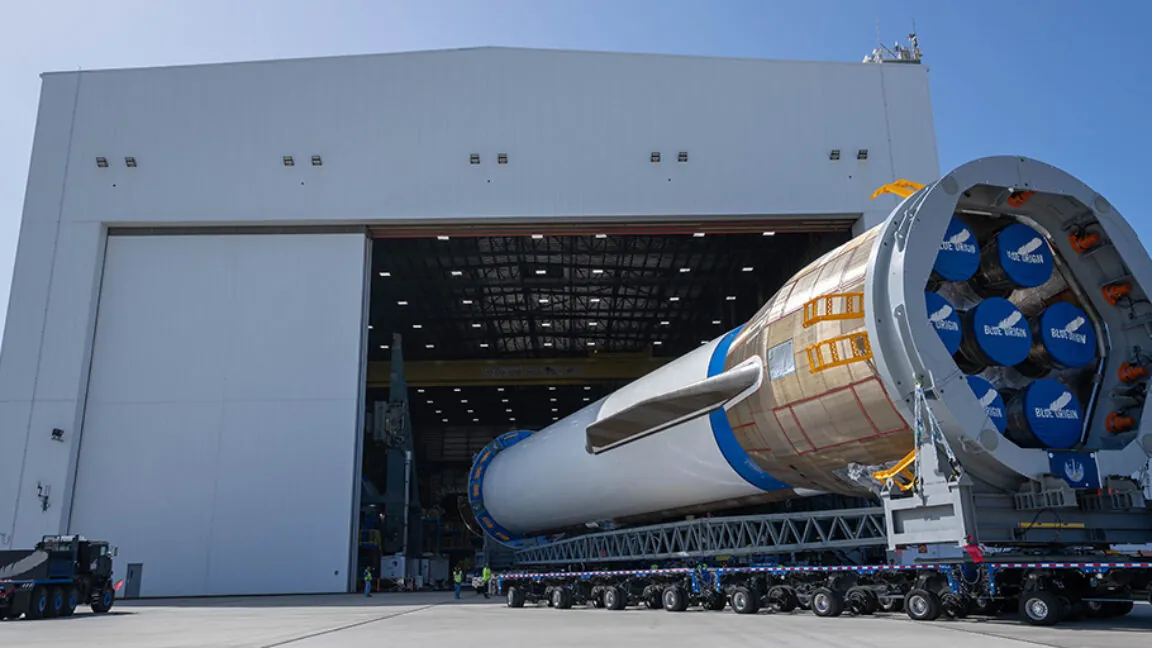
NASA and Blue Origin signed a testing agreement on Friday, July 24. They plan to use the Thad Cochran Test Stand at the John C. Stennis Space Center. To validate hardware performance, engineers will evaluate new modules there. And when you look at the logistics, Blue Origin to test New Glenn upper stages at Stennis makes strategic sense. Operations at the LC-36 facility require intense coordination. A Mississippi testbed relieves that pressure.
Two BE-3U engines provide power inside the second stage. Each unit generates 200,000 pounds of thrust in a vacuum environment. At this facility, testing begins this autumn. NASA is involved. Under the agreement, the agency will supply the engineers, equipment, and building services required to modify the B-2 stand. They also plan to share propulsion lessons learned from past decades. The shared work directly supports the Artemis III mission. After the successful Artemis II flight, four astronauts will evaluate commercial human landing systems in low Earth orbit.
During a recent statement, Blue Origin CEO Dave Limp noted the historical poetry of the arrangement. The B-Test Complex originally powered America’s journey to the Moon during the Apollo era. The new partnership will take them back. For NASA Administrator Jared Isaacman, that urgency is clear. To win the modern space race, he argued that the agency requires immense speed. The government must collaborate directly with a commercial industry.
From a legislative perspective, Representative Mike Ezell also highlighted the economic benefits. He expects the B-2 test stand capabilities to advance next-generation rocket propulsion. The project will also support local jobs. Honestly, it’s exactly the kind of setup they were looking for.
NASA Leases Public Test Stands to Commercial Launch Providers
As an annex to a July reimbursable Space Act Agreement, the Stennis arrangement changes the dynamic. Government agencies no longer hoard their best infrastructure. They’re sharing it. In the near future, both SpaceX and Blue Origin will participate in the Artemis III low Earth orbit rendezvous. To succeed, NASA needs multiple private contractors.
But testing stands take years to build, and companies don’t have that kind of time. Through the recent agreement, the dual vertical firing positions of the B-2 stand solve that problem immediately. Those structures tested the Apollo missions in the 1960s. Today, they accelerate the New Glenn rocket program. The rocket takes its name from John Glenn. He was the first American astronaut to orbit the Earth.
So the Apollo hardware will now test modern rockets. In May, NASA awarded Blue Origin a contract to launch a robotic mission near the lunar South Pole. The flight establishes sustained base operations. Upcoming tests will validate the rendezvous and docking capabilities of the Orion spacecraft.