
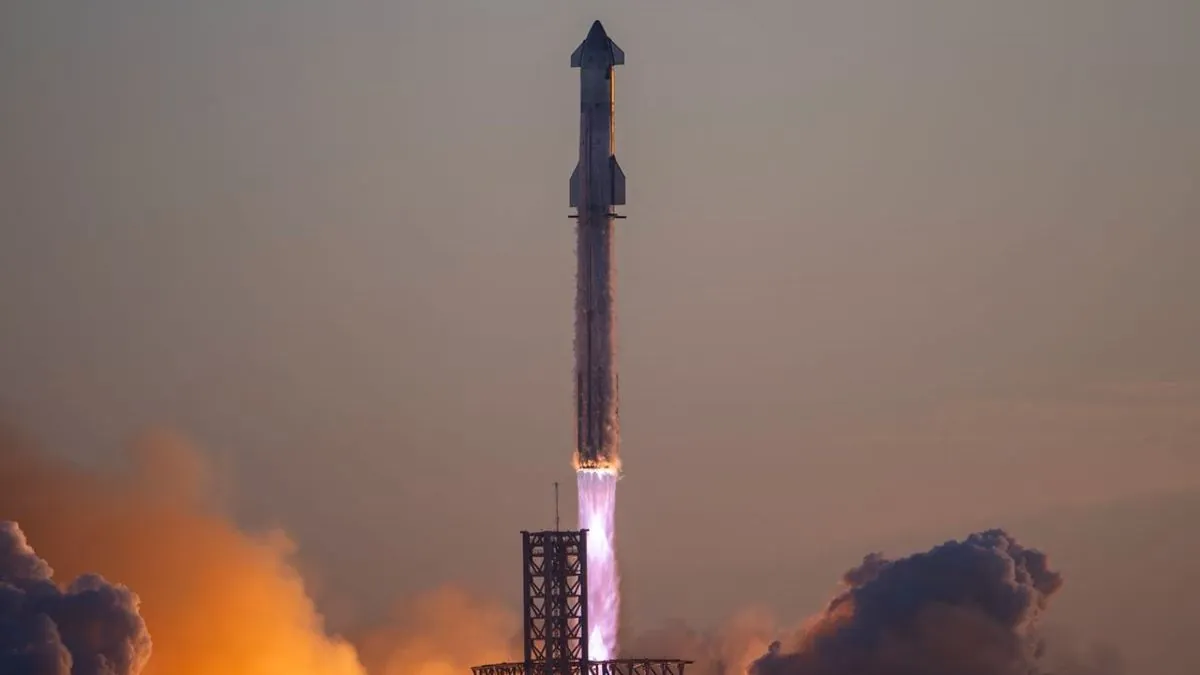
The upper stage of the SpaceX Starship rocket survived atmospheric reentry and executed an upright water landing in the Indian Ocean on Friday. The flight successfully deployed operational hardware into space, moving the vehicle’s testing phase past basic flight survival.
Liftoff occurred at 5:51 p.m. CDT from the Starbase facility in Boca Chica, Texas. This was the 13th integrated test flight of the Starship architecture and the second run for the 400-foot-tall Version 3 design. The upper stage reached its suborbital trajectory and relit a single Raptor engine in space before beginning its descent. During a live broadcast, commentators characterized the ocean arrival as the softest splashdown the company has achieved while deploying 20 Starlink V3 satellites.
The launch almost happened a week earlier.
A previous attempt on July 16 ended in a T-zero abort when four Raptor engines failed to ignite, which was immediately followed by a weather delay. The Federal Aviation Administration cleared the vehicle for flight just days prior on July 13. The agency issued that approval after concluding its mishap investigation into May’s Flight 12 and mandating hardware modifications. You can see how tightly regulatory timelines dictate schedules when testing experimental aerospace systems. NASA closely monitored Friday’s results because the agency relies heavily on a Starship variant to act as the crewed lunar lander for the upcoming Artemis moon missions.
While the upper stage performed well, the Super Heavy booster faced mechanical complications. After stage separation, the booster executed a boostback burn to target a soft offshore landing in the Gulf of Mexico. Early reports indicate the booster suffered a hard landing when some engines failed to reignite.
Six of the deployed Starlink satellites carried specialized cameras. These cameras actively scanned the Starship’s heat shield while in orbit to gather structural data before reentry. This test flight also carried immediate financial context. It arrived as the first launch since the company closed its $86 billion initial public offering in June 2026.
Moving from Dummy Weights to Operational Cargo
The deployment of functional Starlink V3 satellites alters the current profile of the Starship testing program. Previous test flights focused entirely on surviving ascent and reentry while carrying mass simulators. Opening the payload bay doors to release working hardware proves the vehicle can now execute commercial delivery tasks even while the booster systems still require refinement. This validates the rocket’s primary use case for satellite network expansion.