
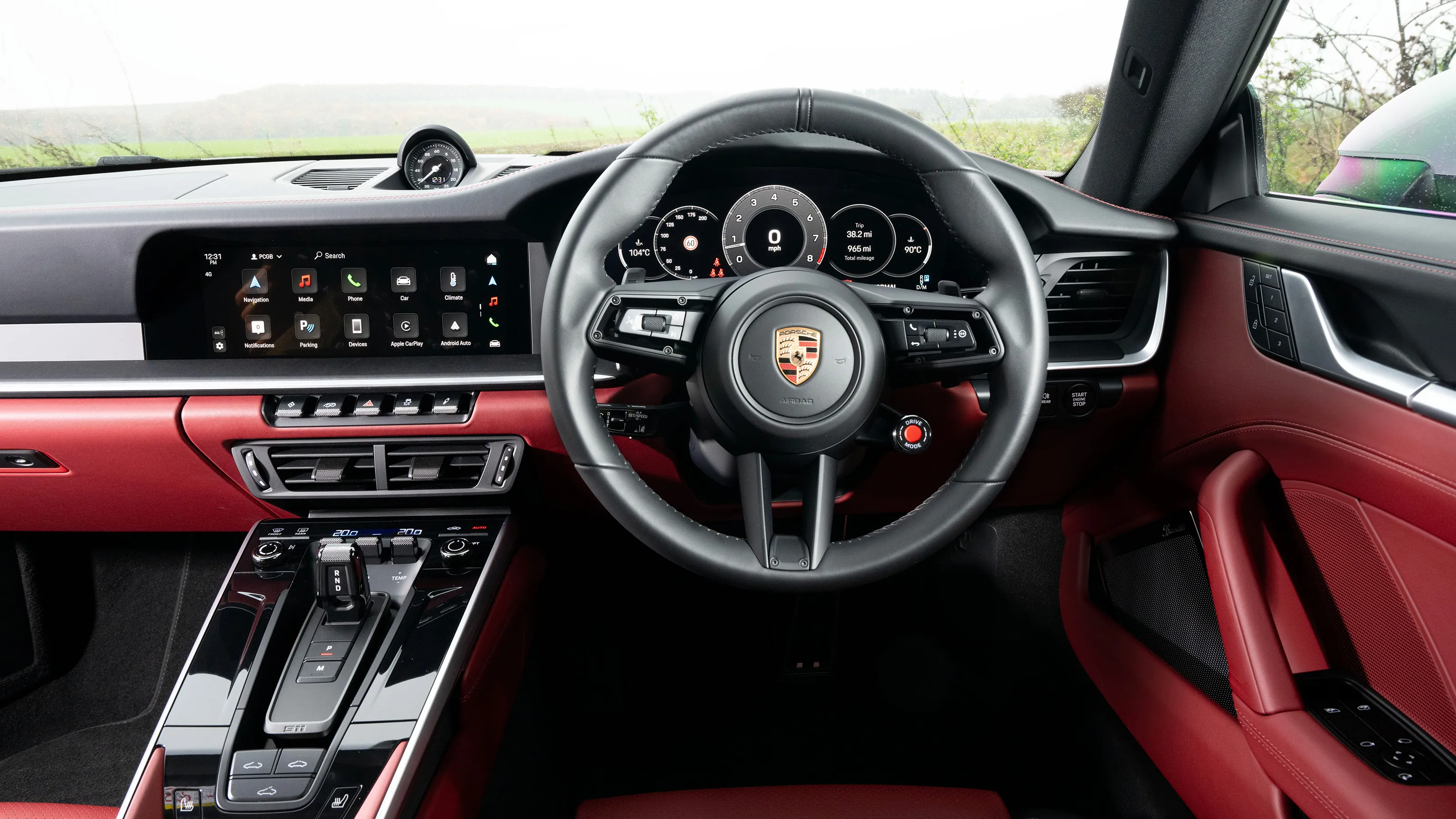
Paddle shifters are small levers or buttons mounted directly on or just behind a vehicle’s steering wheel that give a driver manual control over gear changes. In almost all modern setups, you pull the right paddle (marked with a “+”) to upshift into a higher gear, and you pull the left paddle (marked with a “-“) to downshift into a lower gear. It is that simple on the surface. But underneath the dashboard, a highly complex electronic conversation happens in milliseconds.
Unlike traditional stick shifts that rely on mechanical linkages and a physical clutch pedal on the floorboard, paddle shifters are entirely drive-by-wire. Pulling a paddle sends an instant electronic signal to the car’s Transmission Control Unit (TCU). The TCU acts as the gatekeeper. It instantly analyzes the current engine speed, your throttle position, and the road gradient before it executes the shift.
This electronic middleman introduces built-in safety parameters. If you accidentally tap the left paddle while traveling too fast, requesting a downshift that would cause the engine to over-rev and damage internal components, the computer will simply ignore the command. The TCU protects the engine from human error.
How Different Transmissions Process Paddle Inputs
Not all paddle-shifted cars operate the same way underneath. The mechanical hardware bolted to the engine dictates exactly how those electronic taps translate to physical speed.
Dual-Clutch Transmissions (DCT)
This is the preferred setup for modern high-performance sports cars. A dual-clutch transmission uses two separate clutch packs. One clutch handles the even gears, and the other handles the odd gears. When you accelerate in second gear, the computer already has third gear pre-selected on the other clutch. When you tap the right paddle, the transmission instantly swaps clutches. The result? Lightning-fast gear changes that outpace the most skilled professional drivers using a manual stick shift.
Traditional Automatic Transmissions
Standard commuter cars and luxury sedans often use a traditional automatic transmission built around a fluid-coupled torque converter. When you pull a paddle in one of these cars, you temporarily override the automatic computer’s programming. The mechanical response time is slightly slower than a track-ready DCT. However, you still gain complete manual gear operation without a physical clutch pedal, according to a guide by Autolist. This allows drivers to dictate the driving rhythm rather than waiting for the computer to react.
Continuously Variable Transmissions (CVT)
CVTs do not have traditional physical gears at all. Instead, they use a belt-and-pulley system that constantly changes size to keep the engine operating efficiently. To give drivers a familiar sense of control, manufacturers program their CVTs with simulated or “mimicked” gear steps. When you click the paddle, the transmission jumps to a pre-set point on the pulley system, creating the physical sensation of an upshift or downshift.
Engineering Extremes: From Hypercars to Hatchbacks
Automakers tune their paddle shift systems differently depending on the goal of the vehicle. Porsche famously utilizes its PDK dual-clutch system across its 911 lineup. The gear changes are so aggressive and precise that a PDK-equipped Porsche consistently records faster track lap times than the exact same car fitted with a manual transmission.
On the extreme end of the engineering spectrum sits the Bugatti Veyron. The Veyron produces an immense 1,250 N⋅m of engine torque. To prevent the transmission from tearing itself apart under that load, Bugatti engineered a highly specialized wet-clutch system where the internal plates are constantly bathed in oil. This fluid provides the vital cooling necessary to survive extreme performance runs.
Meanwhile, Acura took a hybrid approach with the TLX sedan. Acura engineers paired an 8-speed dual-clutch transmission with a traditional torque converter. They did this specifically to eliminate the low-speed shuddering that sometimes plagues aggressive dual-clutch gearboxes in stop-and-go traffic. It bridges the gap between low-speed comfort and high-speed paddle shifting.
You do not need a supercar to find this hardware today. Volkswagen brought rapid, high-performance paddle shifting to the mainstream commuter market years ago with its Direct-Shift Gearbox (DSG) in the GTI, proving that electronic manual overrides belong in everyday traffic just as much as on the racetrack.
Practical Uses Beyond the Racetrack
Most drivers ignore their paddle shifters during mundane commutes. But knowing when to use them gives you a distinct advantage in specific driving scenarios.
Overtaking slower traffic is the most common use case. When you need to pass a car on a two-lane road, waiting for a standard automatic transmission to downshift after you press the gas pedal wastes valuable seconds. By tapping the left paddle twice before you pull out into the opposing lane, you instantly raise the engine RPMs. This puts the car exactly in its peak powerband before you even touch the gas pedal, allowing for rapid, controlled acceleration.
Mountain driving changes the equation entirely. When driving down long, steep grades, riding the brake pedal causes the friction materials to overheat and eventually fail. Instead, tapping the left paddle helps utilize engine braking to naturally slow the car’s descent. The engine’s internal resistance controls the speed, saving your physical brake pads for when you actually need to stop.
Towing heavy loads also benefits from manual intervention. Standard automatics often “hunt” for the right gear when pulling a trailer up an incline, constantly shifting up and down. Engaging manual mode with the paddles forces the transmission to hold a lower gear, providing smooth, uninterrupted power delivery to the wheels.
Conversely, paddle shifters help conserve fuel on flat, open highways. A driver can manually force the transmission into its highest possible overdrive gear with the right paddle. This forces the engine RPMs to drop to their absolute minimum, sipping fuel during long cruising stretches.
The Tactile and Psychological Experience
Safety improves drastically when drivers use paddles during spirited driving. Because the levers sit right at your fingertips, you execute complex gear changes without ever taking your hands off the steering wheel. This maintains absolute stability and steering control during high-speed cornering.
Beyond the pure performance metrics and mechanical advantages, paddle shifters offer something intangible. Tapping a beautifully machined piece of aluminum behind the wheel creates a direct tactile connection between the driver and the machine. It forces you to pay attention to engine sounds and vehicle dynamics. It transforms a passive commute into an active, engaging driving experience, bringing a premium sports car feel directly into the hands of everyday drivers.
Frequently Asked Questions
What do the plus and minus symbols on paddle shifters mean?
The “+” symbol, which is typically located on the right paddle, signals the transmission to upshift into a higher gear. The “-” symbol on the left paddle signals the transmission to downshift into a lower gear for acceleration or engine braking.
Can you damage your engine by using paddle shifters wrong?
No. Modern vehicles use a Transmission Control Unit (TCU) that constantly monitors your inputs. The computer will automatically refuse a shift command—like trying to downshift at highway speeds—if it calculates the action would stall or over-rev the engine.
Do paddle shifters replace the physical clutch pedal?
Yes. In a car equipped with paddle shifters, the transmission relies entirely on computers and internal electronic actuators to engage and disengage the clutch mechanisms. There is no physical clutch pedal on the floorboard for the driver to press.
The Verdict
If you are shopping for a new vehicle, prioritizing one with a well-engineered dual-clutch transmission and paddle shifters is highly recommended. The technology completely bridges the gap between the mundane convenience of an automatic and the mechanical joy of a manual stick shift. You get superior track-level shift speeds, safer handling with both hands on the wheel, and built-in computer safeguards that make it impossible to destroy your engine via missed shifts. It is an automotive upgrade that fundamentally improves both daily commuting and high-performance driving.