
Radio waves are entirely invisible. But a new piece of hardware just fixed that.
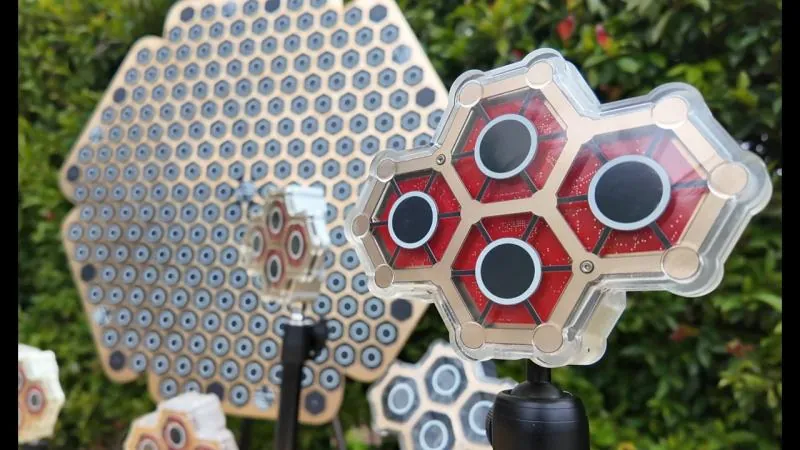
Scale RF has launched the QuadRF on Crowd Supply. It is a $499 kit powered natively by the Raspberry Pi 5 that functions as a radio frequency camera. Point it at a room, and the device overlays a live heatmap of wireless emissions directly onto your screen at 30 frames per second.
The system actively detects Wi-Fi routers, security cameras, and passing drones. It processes the 4.9 GHz to 6.0 GHz spectrum to figure out exactly where those broadcasts originate. According to recent live AR color visualization testing, the resulting heatmap shows exactly how data bounces around physical spaces.
Spatial RF visualization usually requires tens of thousands of dollars in bulky, proprietary lab equipment. Scale RF squeezed that capability into a plug-and-play 4×4 MIMO Software-Defined Radio (SDR) tile. And it scales.
Hardware hackers and researchers can pop these tiles out of their enclosures and chain them together. The architecture supports linking up to 240 antennas. That turns a desktop gadget into a system capable of advanced radio astronomy or Earth-Moon-Earth communication. The scalable phased-array support makes this an industrial-grade tool disguised as a maker kit.
The Crowd Supply campaign is already heavily overfunded. Initial kits and mobile expansion packs are scheduled to ship to backers on September 30, 2026.
How the Defensive Patent Covenant Protects Hardware Hackers
Legacy telecom equipment locks engineers into expensive, closed-source ecosystems. The QuadRF takes the opposite approach. Scale RF is releasing all antenna and mechanical design files under a Creative Commons (CC BY-SA 4.0) license.
They went a step further by enacting a royalty-free patent covenant. This legal shield specifically protects amateur radio operators, educators, and commercial users who want to modify the hardware. If an engineer decides to build a large custom mesh network using these tiles, they own their work.
This completely changes the barrier to entry for spatial RF development. By lowering the financial cost from five figures to under $500 and removing the threat of patent litigation, Scale RF just handed enterprise-level radio mapping to anyone with a Raspberry Pi.