
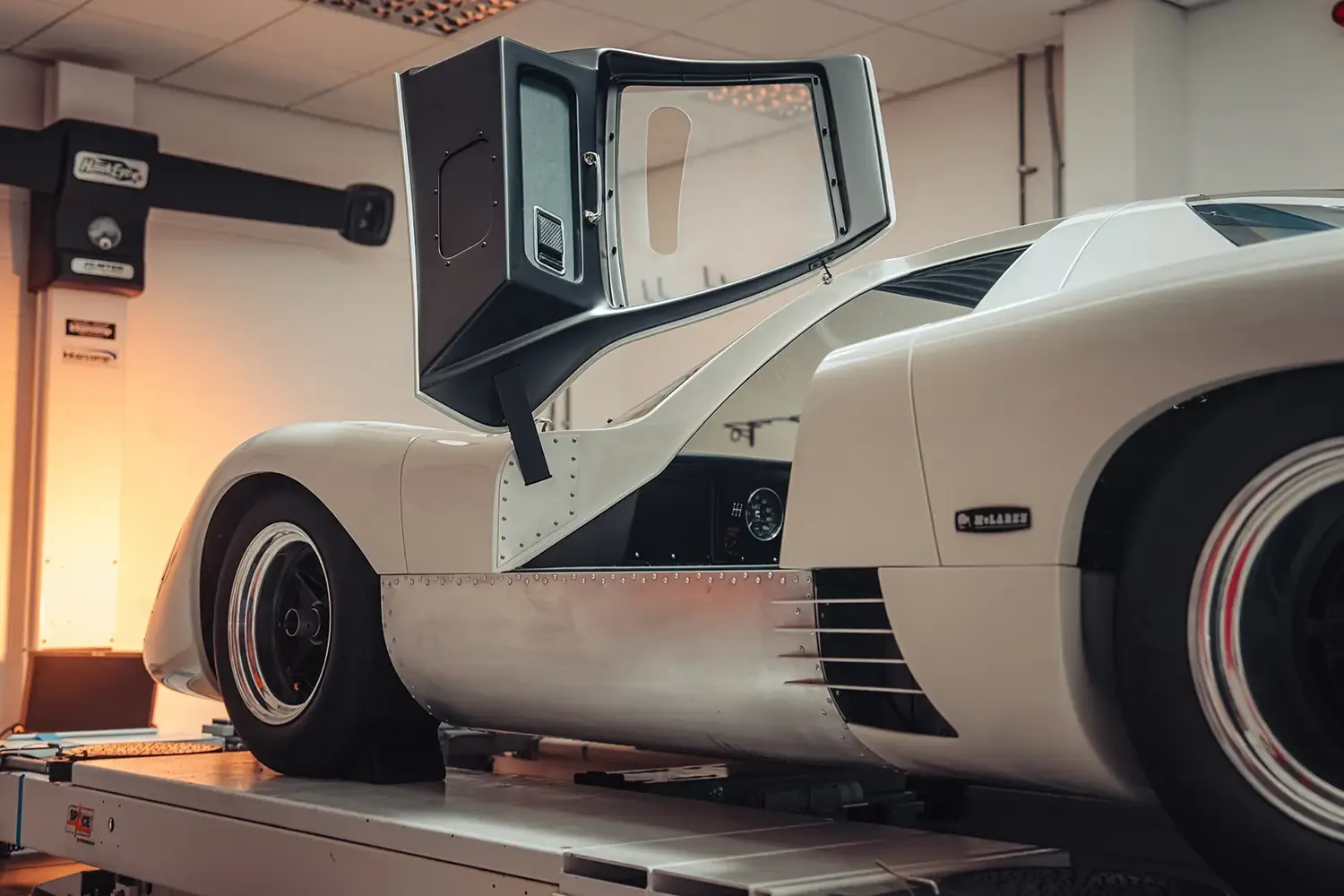
McLaren Special Operations (MSO) has meticulously constructed a one-off continuation of the M6GT. This is the exact model that served as Bruce McLaren’s very first attempt at building a road-going supercar in the late 1960s. The factory team essentially resurrected a ghost from the archives, building the car to absolute perfection to fulfill a dream that sat dormant for over five decades.
This is not a modern replica built from scratch on a computer. MSO built this specific car upon a historic open-cockpit M6A race chassis, using original 1960s body molds recently discovered in the UK. Engineers fitted a period-correct, mid-mounted 5.7-liter Chevrolet small-block V8 engine featuring camel hump cylinder heads and a five-speed manual gearbox. The team even tracked down rare imperial-era bearings to correctly install the original M6GT suspension hardware.
The rebuilt coupe is scheduled to make its public debut on July 9 at the Goodwood Festival of Speed. It will be displayed alongside McLaren’s new W1 halo car and the MCL-HY Le Mans racer. The heritage stage is going to be crowded with history this year. Audi is also bringing its newly recreated 1935 Auto Union V-16 speed-record car to the exact same event.
The backstory of the M6GT involves a brilliant plan derailed by tragedy. In 1969, Bruce McLaren intended to build 25 production models of the M6GT to satisfy FIA homologation rules for the 24 Hours of Le Mans. Sudden shifts in racing regulations complicated things. Then, Bruce died during a testing accident at Goodwood in 1970. The project was permanently cancelled, leaving only a few completed prototypes—including Bruce’s personal, registered daily driver.
This official factory continuation bridges that gap perfectly. The exterior is painted in a custom “Colnbrook White,” a specific shade chosen as a nod to McLaren’s original race workshop near Heathrow Airport. Inside, the coupe features custom green vinyl seats and a hand-turned solid walnut gear knob. You can even see subtle late-1960s development modifications preserved directly in the fiberglass of the recovered molds.
Why Automakers Are Resurrecting Their Shelved Masterpieces
This M6GT build points to a highly specific trend in the ultra-luxury automotive sector. Manufacturers are no longer just restoring old cars that have survived in private collections. They are digging through their archives to finish cancelled projects. Bringing a “lost” car to a showcase like Goodwood generates intense interest that standard restorations simply cannot match.
Audi’s parallel effort with the Auto Union V-16 shows this is an industry-wide strategy. By funding these complex, one-off historical recreations, legacy brands create physical links to their earliest analog ambitions. It gives them a tangible heritage piece to park directly next to their newest electric or hybrid hypercars, physically proving their historical engineering pedigree to prospective buyers.