
A fresh spool of PETG arrives at your door. You slice the thick vacuum bag, pull out the little packet of silica gel, load the plastic into your Bambu Lab AMS, and hit print. A few hours later, you are staring at a stringy, brittle mess. The problem isn’t your slicer settings. It isn’t a defective hotend. According to a July 5 guide from XDA Developers, that tight factory seal is giving you a false sense of security. Brand-new PETG is often wet the moment you open it.
Vacuum sealing is designed to protect filament from humidity during shipping and storage. But it fundamentally acts as a shield, not a sponge. A plastic bag cannot extract moisture that the polymer already absorbed prior to being packaged. Because PETG is inherently highly hygroscopic, skipping a dedicated drying phase almost guarantees poor layer adhesion and severe stringing.
Key Details
- Vacuum seals only protect filament from transit humidity; they cannot pull embedded water out of the plastic.
- PETG absorbs moisture aggressively during the factory extrusion process long before it hits the cardboard spool.
- Silica gel packets lack the desiccant capacity and heat required to dehydrate saturated plastics.
- Major manufacturers now consider active electronic drying a mandatory pre-flight step for PETG.
The root cause of this wet filament issue actually starts on the factory floor. Filament extrusion is an intense industrial process. Once the hot plastic pushes through the nozzle, it plunges straight into a series of water immersion baths. This rapid cooling locks in the dimensional accuracy so your spool stays perfectly round. But it introduces a massive variable. Understanding the specific moisture absorption rates of PETG reveals why that water bath is a double-edged sword. The plastic drinks in ambient moisture before the manufacturer ever wraps it in a protective bag.
Those tiny desiccant packets included in the final packaging are practically useless for fixing the problem. They only trap trace amounts of trapped air moisture. To actually fix a wet spool, you need to understand the functional differences between passive desiccant storage and active electronic heating hardware. You have to literally bake the water out of the polymer structure.
How Filament Makers Are Mandating Active Heat
Leading 3D printing brands are finally abandoning the illusion of print-ready packaging. They now treat active drying as a mandatory requirement for engineering-grade materials. Prusa Research explicitly instructs users to dry their PETG, officially publishing temperature and time parameters that demand 55°C for a full six hours before printing. Overture3D pushes it further, telling customers to bake its high-speed PETG at 60°C for five hours.
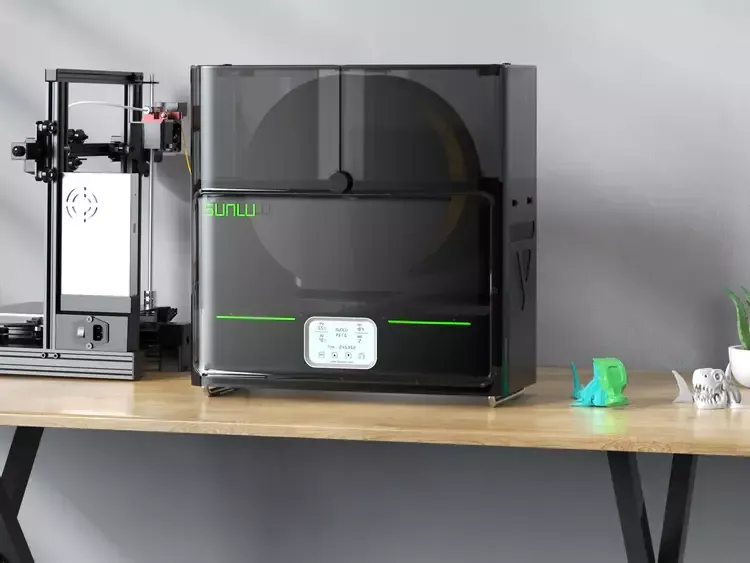
This industry shift has ignited an entirely new hardware category. Hardware manufacturers like Sunlu and JAYO have capitalized on the wet filament problem by releasing stacked, active-heating electronic filament dryers. These standalone devices are capable of reaching the 65°C to 70°C temperatures required to properly dehydrate PETG. The old method of throwing a spool into a sealed plastic cereal box with some color-changing beads is no longer sufficient for modern, high-speed 3D printing.