
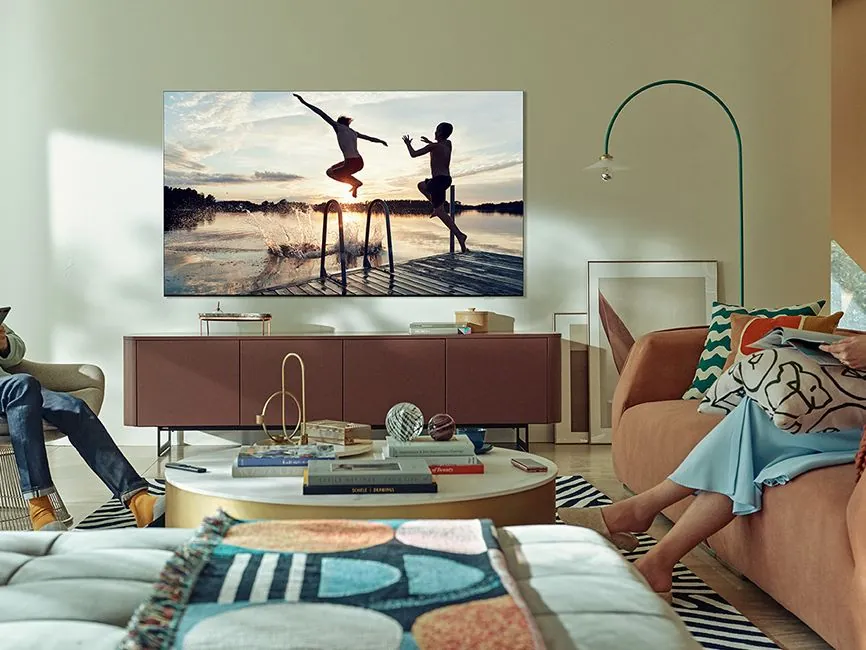
When you stand in the electronics aisle, the alphabet soup of acronyms gets overwhelming fast. But the fundamental difference between QLED and OLED display technology boils down to a single engineering concept: how they generate light. OLED screens produce light at the individual pixel level. QLED screens block and filter a giant, always-on backlight to create an image.
According to hardware testing conducted by Will Greenwald at PCMag, Steven Cohen at Business Insider, and reviewing teams at CNET, these distinct mechanical approaches dictate how each panel performs. A television that looks breathtaking in a dark basement theater might look completely washed out in a sunlit living room. Understanding the science inside the screen is the only way to pick the right hardware for your specific viewing environment.
Core Mechanics: Emissive vs Transmissive Engineering
To understand the visual differences, we have to look closely at the microscopic architecture of the panels. Both technologies try to achieve the same goal—producing vibrant colors and sharp contrast—but they take completely opposite paths to get there.
- The OLED Approach (Emissive): OLED stands for Organic Light-Emitting Diode. Reviewers at CNET confirm that this is an “emissive” display technology. It does not rely on a separate backlighting system. Instead, every single one of the millions of subpixels generates its own light and color independently. If a scene requires true, absolute black—like a shot of deep space in a sci-fi movie—the pixel simply shuts off completely. It stops drawing power. It emits zero light.
- The QLED Approach (Transmissive): QLED stands for Quantum Dot LED. This is a “transmissive” technology built upon the traditional LED and LCD framework that has existed for decades. As noted in testing by PCMag, these displays use a powerful LED backlight system (often utilizing thousands of mini-LEDs) that shines continuously. That white light pushes through an LCD layer and a specialized film packed with quantum dots. These microscopic semiconductor nanocrystals filter the raw light to produce highly accurate, vibrant colors, which aggressively expands the overall color gamut of the display.
Because OLED pixels act as their own light source, the panels can be manufactured incredibly thin. QLED displays require more physical depth to house the backlighting arrays and the various chemical filter layers.
Feature Performance in Real Rooms
The battle between these two panel types is largely a physical trade-off between absolute black levels and peak brightness capabilities. You usually cannot have both at the extreme ends of the spectrum.
Contrast Ratios and Black Levels
Because an OLED pixel can completely power down, Business Insider testing verifies that they achieve an infinite contrast ratio. The difference between the brightest white and the darkest black on the screen is mathematically infinite because the black level is literally zero light. This creates incredibly punchy, rich images in dark environments.
QLED displays struggle to match this specific feat. Even with advanced local dimming zones that turn off sections of the backlight, they cannot control light perfectly at the microscopic pixel level. The What Hi-Fi? testing team explains that this technical limitation often causes a blooming effect. This visual artifact occurs when a bright object sits on a dark background—like a white subtitle or a glowing candle. The intense backlight bleeds through the LCD layer, creating a faint, grayish halo around the bright object.
Peak Brightness and Glare
This is where the traditional LCD framework fights back. QLED models consistently overpower their emissive competitors when it comes to sheer light output. The dedicated LED backlights can push thousands of nits of brightness.
The technical difference becomes obvious in well-lit rooms. If you have an open-concept living room with large windows and heavy daytime sunlight, a QLED television will aggressively cut through the glare. While high-end OLED panels have improved their brightness output in recent years using advanced heatsinks and micro-lens arrays, they generally cannot match the brute-force illumination of a premium QLED model like the TCL QM8K or a Samsung QN90-series display.
Common Issues and Fixes
Choosing a television often comes down to mitigating the specific weaknesses of the technology. Both panel types have distinct physical limitations that affect long-term ownership, especially for power users and gamers.
The Burn-In Risk
OLED technology carries a persistent physical risk known as permanent image retention, commonly referred to as burn-in. CNET testing confirms that this degradation occurs when static visual elements stay on the screen continuously for long hours over many months. The organic compounds in those specific pixels degrade faster than the rest of the screen.
If you watch the exact same news channel all day, the ticker at the bottom of the screen might eventually leave a permanent, ghostly shadow. If you play a single video game for hundreds of hours, the health bar or heads-up display could burn into the panel. Modern OLEDs employ software tricks—like subtly shifting the entire image by a few pixels or running pixel-refresh cycles when the TV is off—to mitigate this problem. But the physical vulnerability remains.
Because QLED technology relies on standard LCD backlighting rather than degradable organic compounds, it is entirely immune to permanent image retention. If you need a display to act as a computer monitor, show airport arrival times, or run sports scores all day without breaking a sweat, QLED is the safer engineering choice.
Motion Clarity and Pixel Response Time
Gamers and sports fans care deeply about motion blur. The physical time it takes for a pixel to change from one color to another dictates how clear a fast-moving object looks. Because OLED pixels act independently and do not wait for an LCD shutter to open or close, their response times are near-instantaneous. This translates to incredibly smooth motion tracking for competitive gaming or fast-paced hockey broadcasts.
QLED screens have very fast response times, but the physical reality of twisting liquid crystals in the LCD layer means they are fractionally slower than their emissive counterparts. You might notice a slight blur behind a fast-moving object on a QLED that simply does not exist on an OLED.
Alternative Viewing Environments
The physical layout of your room dictates the final performance of the screen. How you arrange your furniture is just as important as the silicon inside the television.
According to BDI testing, OLED panels maintain strict color accuracy and contrast even at extreme off-center angles. You can sit far to the side of the screen, and the picture will look exactly the same as it does from dead center. This happens because the light emits uniformly from the pixel surface. If you have a wide, wrap-around sofa arrangement where many people sit at odd angles to the television, OLED provides wide viewing angles that keep everyone happy.
QLED displays naturally suffer from off-axis degradation. Because the backlight shines straight forward through a grid of physical filters, the light is highly directional. If you move too far to the left or right, you will notice a visible drop in color saturation. The deep blacks will suddenly look gray and washed out. Premium QLED models attempt to fix this with specialized light-scattering layers, but they rarely match the flawless viewing angles of an emissive display.
Finally, the sheer size of the panel changes the economics of the purchase. QLED technology is significantly cheaper to produce at scale. CNET and PCMag report that while flagship models of both technologies carry similar price tags at standard sizes, QLED offers far more budget-friendly options when you push into giant form factors. If your room requires a sprawling 85-inch or 98-inch display, manufacturing a flawless sheet of organic light-emitting diodes becomes incredibly expensive. Standard LED backlighting scales up to massive sizes far more efficiently, making giant QLED screens much more accessible to the average buyer.