
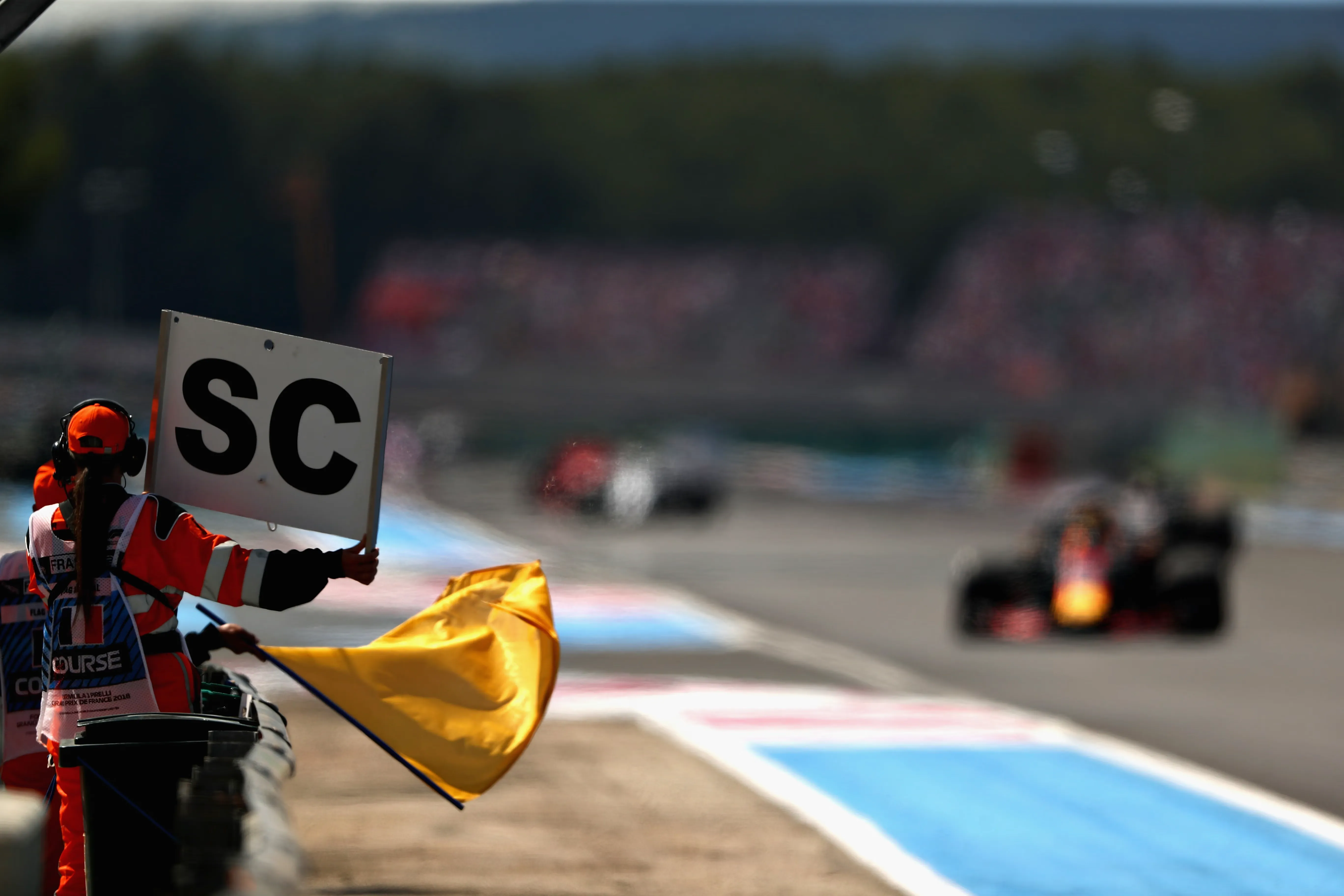
Think about the intense pressure of a Formula 1 qualifying session. The clock is ticking down, the track is rubbering in, and a driver is pushing their car to the absolute limit on a final flying lap. Suddenly, a marshal post lights up yellow. For casual fans, a yellow flag simply means danger on the track. But in the highly regulated world of F1 qualifying, the difference between a single yellow flag and a double yellow flag completely dictates a driver’s weekend.
The rules governing these flags are strictly enforced, and they directly impact who starts on pole position and who gets shuffled down the starting grid. The core difference is straightforward: passing a double waved yellow flag results in an automatic lap deletion, while passing a single waved yellow allows a driver to keep their lap time if they can prove they slowed down. Understanding the mechanics behind this system requires looking into the steward’s room and the telemetry data that governs modern racing.
How F1 Qualifying Yellow Flag Rules Work
To understand the current system, we have to define the two levels of hazard warnings used on the track. A single waved yellow flag indicates a localized danger ahead. The rule states that any driver passing through a single yellow marshalling sector must reduce their speed and be prepared to change direction. Drivers typically prove their compliance by braking earlier into a corner or clearly demonstrating a discernible reduction in speed compared to a normal racing lap.
A double waved yellow flag indicates a far greater hazard. This means the track is partially or completely blocked, or marshals are actively working on the tarmac. When drivers see double yellows, they must reduce their speed significantly and be fully prepared to change direction or stop the car completely. More importantly, they must abandon any attempt to set a meaningful lap time. The official sporting regulations give Race Control the authority to penalize anyone ignoring these safety signals.
The biggest regulatory mechanism in qualifying is the automatic lap deletion rule. During any qualifying or sprint qualifying session, if a driver passes through a double waved yellow flag sector, Race Control automatically deletes that specific lap time from the timing screens. This was not always an automatic process. Former Race Director Michael Masi first introduced the automatic lap deletion rule via event notes during the 2021 season. The FIA then formalized it as a permanent regulation the following season. You can look back at the original policy shift to see how the sport worked to remove the endless debates between team principals and stewards over whether a driver slowed down “enough.”
How Stewards Enforce the Rules With Telemetry
Formula 1 does not rely on the naked eye or trackside cameras to determine if a driver followed the yellow flag rules. The modern cars generate millions of data points per lap, and the stewards use this live telemetry to enforce the regulations with mathematical precision. Here is the exact sequence of how officials monitor and enforce speed reductions during a qualifying session:
- Hazard Detection and Flag Deployment: A car crashes or drops debris on the circuit. Trackside marshals immediately trigger a single waved yellow flag on their local electronic boards. Race Control then assesses the broader track situation to determine if the incident requires an upgrade to a double waved yellow flag or a full session stoppage.
- Driver Input Analysis: As soon as a car passes through the yellow flag sector, stewards pull the driver’s live telemetry trace. They isolate the exact moments before and during the incident zone, looking specifically at the driver’s throttle pedal usage, brake pedal application pressure, and steering wheel angle.
- The Mini-Sector Benchmark Check: To ensure a driver actually executed a “discernible reduction” in speed under a single yellow, stewards look at the time it took to travel through that specific mini-sector of the track. They look for a distinct mathematical percentage increase in time compared to the driver’s previous flying laps.
- Controlling for Environmental Variables: Raw lap times are useless without context. Stewards adjust their telemetry comparisons by factoring in variables that create similar track conditions. They verify the tyre compound the car is using, the age of those tyres, the estimated fuel load on board, and any shifting weather conditions before finalizing a ruling.
If a driver fails to produce the required telemetry inputs through a yellow zone, the stewards will invalidate the lap and apply sporting penalties. This data-driven approach removes driver excuses and forces teams to coach their drivers on exactly how much they need to lift off the throttle.
Famous Examples From Major Qualifying Sessions
Real-world incidents show how heavily these rules impact the championship. The 2026 Austrian Grand Prix provided a perfect case study in how single yellow flags influence a pole position shootout. During the final moments of qualifying, Max Verstappen crashed his car in Turn 9. Trackside marshals immediately deployed a single waved yellow flag in that sector.
George Russell was on a flying lap right behind the crash. He approached the incident under the single yellow flag, executed a brief lift of his throttle pedal, and finished his lap. Because the telemetry proved he met the minimum speed reduction criteria, the stewards allowed him to keep his lap time, which ultimately secured him pole position. Meanwhile, his teammate Kimi Antonelli encountered the exact same incident but chose to abandon his lap entirely. A review of the Austrian qualifying session highlights how two drivers on the same track handled the single yellow flag loophole differently.
Ignoring double yellow flags carries much harsher consequences, especially during a race. At the 2024 Qatar Grand Prix, Lando Norris failed to slow down sufficiently for double waved yellows deployed for debris on the main straight. The stewards handed him a severe stop-go penalty. Serving that penalty in the pit lane cost him dozens of seconds of overall race time, completely ruining his finishing position and demonstrating how strictly Race Control views double yellow infractions.
Common Misconceptions and the Safety Debate
A frequent misunderstanding among new viewers is the belief that any yellow flag instantly ruins a qualifying lap. The rules clearly show this is false. The single yellow flag exception specifically permits a driver to finish and keep a pole-setting lap time, provided they can prove a discernible speed reduction through the telemetry checks. However, this exact exception is the source of intense debate within the paddock.
Critics point out that the single yellow rule creates a highly dangerous loophole known as the “minimal lift” problem. Because drivers only need to show a slight percentage increase in their mini-sector time to satisfy the stewards, they often lose just tiny fractions of a second. This means drivers are still pushing their cars at extreme racing speeds right next to a disabled vehicle or track debris. Teams argue this incentivizes drivers to take massive physical risks just to keep a qualifying time alive.
Scrutiny also falls on the race directors who control the flag upgrades. Delays in changing a single yellow to a double yellow can leave drivers exposed. During the 2026 Austrian Grand Prix crash involving Verstappen, observers noted a prolonged delay of dozens of seconds before Race Control upgraded the initial single yellow to a double waved yellow. Safety advocates view these operational delays as critical failures in the system.
Team principals are increasingly vocal about the dangers of the current rulebook. Ferrari boss Fred Vasseur has publicly warned that validating pole laps set under single yellow flags sends the wrong message to the grid. His stance is that if drivers know they can keep their fastest times by executing a bare minimum lift off the throttle, it guarantees that everybody will push to the limit rather than prioritizing the safety of the track workers and crashed drivers ahead of them.