
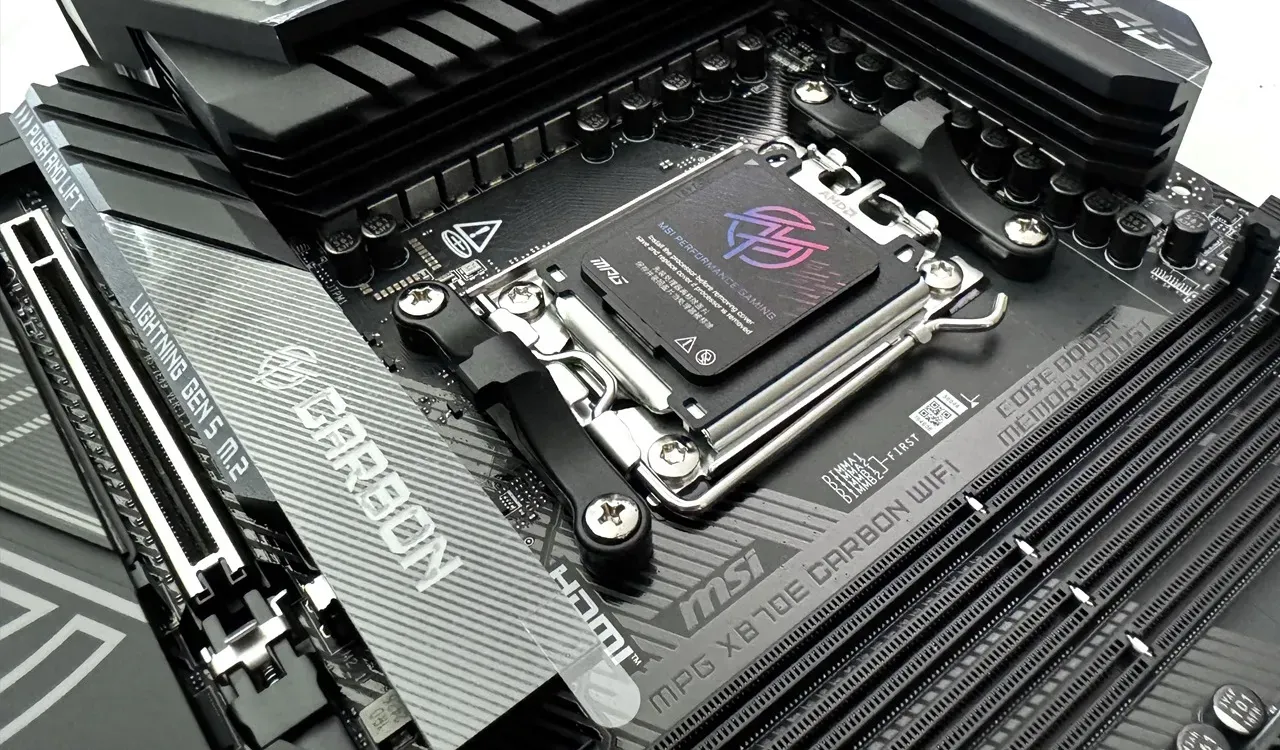
Upgrading your PC storage sounds like a straightforward win, but packing a modern motherboard with high-speed drives comes with a hidden hardware penalty. Builders adopting the AM5 platform are discovering that future-proofing their storage can secretly throttle their graphics card connections. Populating all the available M.2 slots on the MSI MPG X870E Carbon Wi-Fi motherboard forces a behind-the-scenes compromise due to severe PCIe lane sharing limitations.
The core issue revolves around the second PCIe 5.0 storage slot, designated as M2_2, which sits directly beneath the primary GPU slot. When a builder installs an SSD into this specific connection, the motherboard automatically strips resources away from the graphics card. The primary PCIe connection immediately drops from a full x16 bandwidth down to x8.
The Hidden Footnote in Hardware Specs
This technical trade-off cuts the maximum data transfer ceiling for premium graphics cards right in half. If you are running an NVIDIA GeForce RTX 4090, the card is suddenly restricted to PCIe 4.0 x8 bandwidth just because an extra storage drive was installed nearby. Crucially, this limitation is not heavily advertised on the box.
Manufacturers generally bury these specific lane-sharing rules deep within the small print. A recent hardware breakdown confirms that builders only spot the x8 bandwidth drop if they closely read the footnotes on the manufacturer’s specification page. Without checking the manual, users could be running their expensive components at a fraction of their theoretical capacity.
Fortunately, the real-world impact is surprisingly forgiving for gamers. Despite the RTX 4090 operating with half of its theoretical bandwidth, benchmark testing shows the card does not suffer a noticeable drop in frame rates during actual gameplay.
What PCIe Lane Sharing Means for Future Builds
The introduction of Gen 5 NVMe drives is pushing consumer motherboards to their absolute architectural limits. Desktop processors only supply a finite number of PCIe lanes to distribute between the graphics card, the storage drives, and the chipset. As storage drives demand faster connections, motherboard manufacturers are forced to reroute lanes away from the GPU to keep the SSDs running at peak speeds.
This creates a complex balancing act for 2026 system integrators. Builders can no longer just buy premium components and slot them in blindly. Understanding the specific motherboard topology is now a mandatory step in the PC building process. If a workstation requires maximum GPU data transfer for heavy rendering or local processing tasks, users must intentionally leave specific M.2 slots empty to protect that x16 connection.