
We all have that infamous drawer stuffed with tangled cables and leftover power bricks from old phones, tablets, and laptops. As manufacturers increasingly ship new electronics without included chargers, consumers naturally hoard these legacy accessories to power their modern lives. The hidden reality is that the USB-C standard is an unregulated frontier across different manufacturers, creating dangerous electrical mismatches when old charging protocols meet modern, high-capacity batteries.
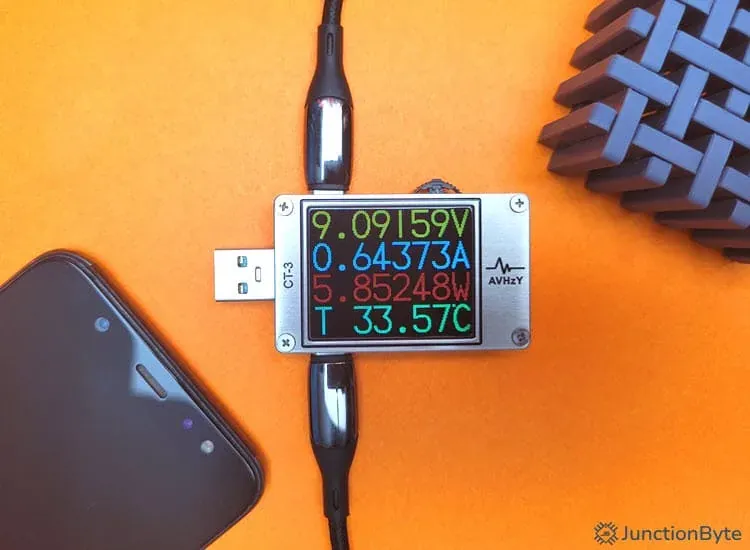
Hardware writer Joe Rice-Jones recently audited his entire household collection of chargers using an AVHzY CT-3 USB Power Meter, a device equipped with an oscilloscope and load simulator. An independent hardware test by XDA utilizing the AVHzY CT-3 equipment revealed the specific failure rates of everyday charging bricks, finding that nearly half failed to meet their advertised specifications or were completely unsafe to use.
Key Details
- The AVHzY CT-3 USB Power Meter, priced at $86, was used to actively simulate power loads and verify voltage consistency across the hardware.
- Several multi-port chargers failed to deliver their promised 100W Power Delivery (PD) output, automatically throttling to lower levels even when only a single cable was attached.
- High-power cables rated for 100W and above routinely failed to advertise the required 5A capability.
- Only a few recent, brand-name USB-C power bricks specifically designed for laptops functioned perfectly under load.
The issues extend far beyond slow charging speeds. In one specific instance during the testing, a high-power cable displayed a rigid 5.2V baseline without any load applied and subsequently failed to negotiate safe PD limits when triggered. Plugging a high-wattage device into a non-compliant cable like this risks pushing unregulated voltage directly into the battery cell, which can melt the charger housing or permanently ruin the wall socket.
This exact type of hardware mismatch previously caused the infamous 2018 Nintendo Switch hardware crisis. Third-party dock manufacturers failed to accommodate Nintendo’s slightly modified USB-C pin spacing and neglected to install dedicated PD controllers in their docks. As a result, those aftermarket docks blasted 9V of power directly over the console’s Configuration Channel, which was only rated for a maximum of 6V. Thousands of consoles were permanently destroyed by the voltage spike.
How Missing E-Marker Chips Threaten Your Devices
The USB-C standard strictly requires high-wattage cables—specifically those handling 100W or more—to possess an internal “e-marker” chip. This tiny component is responsible for digitally communicating with the connected device to negotiate the exact voltage and amperage required for a safe charge cycle.
If a consumer pairs a cheap or outdated cable lacking this e-marker with a fast-charging adapter, the necessary digital handshake fails to occur. Without that verification, the connection will either deliberately throttle the transfer speed to a crawl or incorrectly spike the connection, forcing excessive heat into the device’s internal components.