
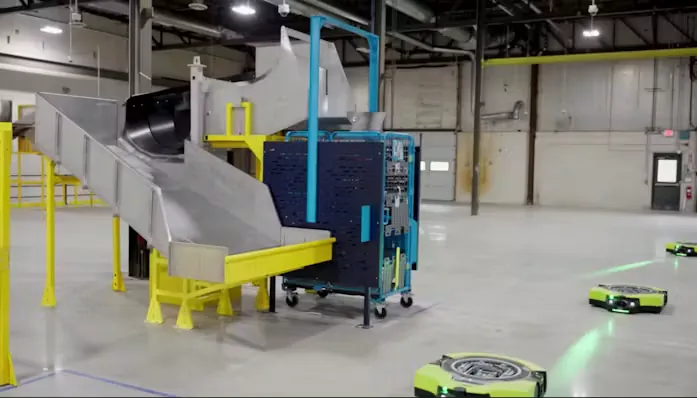
Amazon just showed off a fascinating upgrade to its warehouse robotics at the “Delivering the Future” event in Dartford, England. The company is spending over $200 billion this year on artificial intelligence infrastructure to accelerate sub-same-day grocery deliveries globally. The centerpiece of this hardware push is the next-generation Proteus robot. Workers can now give this machine plain-language conversational prompts. The AI autonomously figures out the task priority, timing, and routing across the warehouse floor.
The launch anchors a €10 billion investment into the European fulfillment network. Amazon is currently piloting the machines, and they are scheduled to hit warehouse floors in the first half of 2027. This is a big leap from the original 2022 Proteus model. That earlier version was restricted to dock areas at 25 United States sites, mostly moving 400kg carts. The new conversational model roams freely.
Scott Dresser, Vice President of Amazon Robotics, called the new bot a general assistant for material movement. He noted the machine can process conversational prompts alongside an entirely new hardware ecosystem. Amazon is rolling out Vulcan, the company’s first robot with a physical sense of touch, and a collaborative tote-handling system called STARK. The STARK system is expanding to 15 European sites by 2027.
Amazon’s robotic fleet now exceeds 1 million active warehouse bots globally, coordinated by a central deep learning system called DeepFleet AI. Labor experts continue to raise concerns about job displacement. To address the automation fears, Amazon announced a $1 billion global investment into its Career Choice program for employee upskilling. The company also pledged to create 25,000 new human jobs in its European fulfillment network as these robots deploy.
How Conversational AI Rewrites Logistics
This hardware upgrade changes the fundamental relationship between humans and warehouse automation. When Amazon bought Kiva Systems in 2012, its robots relied on rigid, pre-programmed tracks and barcodes on the floor. Now, the conversational Proteus shifts the operational burden away from software engineers and directly to the floor workers.
If an employee tells the robot to wait for a forklift to pass before moving a pallet to a specific bay, the onboard AI parses that dependency in real-time. It eliminates the need for complex control dashboards. This direct human-to-machine workflow creates a structural advantage over logistics competitors like Walmart and Target, who still largely rely on traditional, centralized automation grids. By removing the technical friction of programming the robots, Amazon can scale its automated sorting much faster during peak shopping seasons.