
Qualcomm’s exclusive hold on Windows ARM licenses is quietly expiring. That expiration opens a wide door for other silicon manufacturers to enter the personal computing space. On June 2, ASUS walked right through it. The company officially launched the ProArt P14 and P16 laptops at Computex in Taipei, becoming the launch partner for NVIDIA’s new RTX Spark superchip architecture.
These two computers take direct aim at the Apple MacBook Pro. They offer incredibly slim chassis profiles that rival the best hardware in the industry. The 16-inch P16 model weighs 3.9 pounds and measures just 0.51 inches thick. Its smaller sibling, the 14-inch P14, comes in at 3.2 pounds and 0.55 inches thick. Both machines feature ASUS Lumina Pro OLED displays, pushing a 120Hz refresh rate and a peak brightness of 1,600 nits. The P16 offers a 4K resolution, while the P14 sits at 3K. Both screens guarantee Delta E < 1 color accuracy alongside 100% DCI-P3 coverage, according to the initial hardware reveals comparing the laptops to Apple’s offerings.
NVIDIA CEO Jensen Huang showcased the internal components during his keynote. The RTX Spark processor is built on TSMC’s 3nm node. It fuses a 20-core Grace CPU with a Blackwell RTX GPU containing 6,144 CUDA cores. A high-speed NVLink-C2C interconnect bridges the two components. This setup gives the laptops up to 128GB of unified LPDDR5X memory and 1 petaflop of local AI computing power.
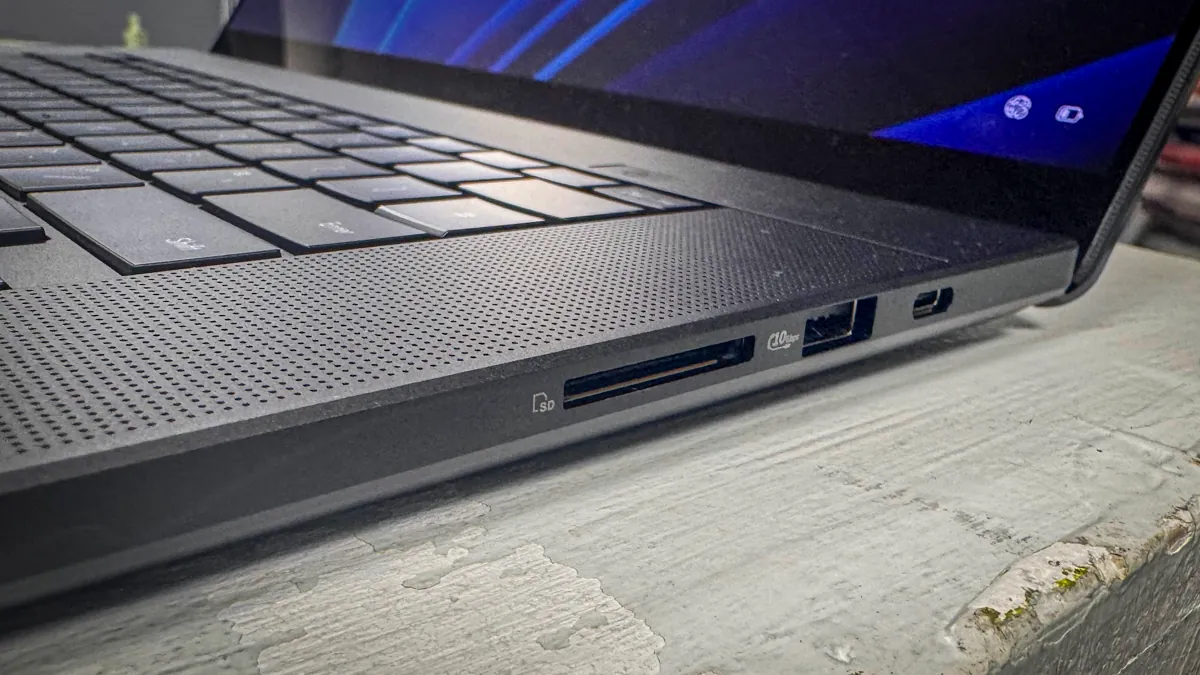
Users can run 120B-parameter Large Language Models entirely offline. The hardware handles native 12K 4:2:2 video editing and can render 90GB 3D scenes without stuttering. Gamers can hit 1440p resolution at 100 frames per second on current AAA titles. ASUS also included generous port selection. Users get standard USB-C, USB-A, HDMI 2.1, and an SD card reader right on the body. The official integration of the RTX Spark inside the ProArt chassis also includes Wi-Fi 7 compatibility out of the box.
Developers are already rewriting code to support the new platform. Adobe is entirely rearchitecting Photoshop and Premiere from the ground up for the RTX Spark to natively accelerate Firefly-powered tools. Windows 11 users will also find native ARM compatibility for DaVinci Resolve 21 and Blender on day one.
What the RTX Spark Means for Apple and Intel
This launch is NVIDIA’s first major attempt at building an integrated PC chip since the Microsoft Surface RT experiment back in 2012. Things are very different this time. Instead of relying on a restricted mobile operating system, the RTX Spark runs full Windows 11 with heavy backing from major software houses.
Apple has dominated the premium creator market since launching the M1 chip. Intel and AMD have struggled to match the battery efficiency of Apple’s ARM-based designs. NVIDIA brings a completely different advantage to the table. By fusing a desktop-class Blackwell GPU with an ARM processor, the RTX Spark offers raw graphics compute that Apple’s unified memory architecture struggles to match in high-end 3D rendering and gaming. Creators who need heavy GPU acceleration but want the portability of a thin MacBook now have a highly capable Windows alternative.