
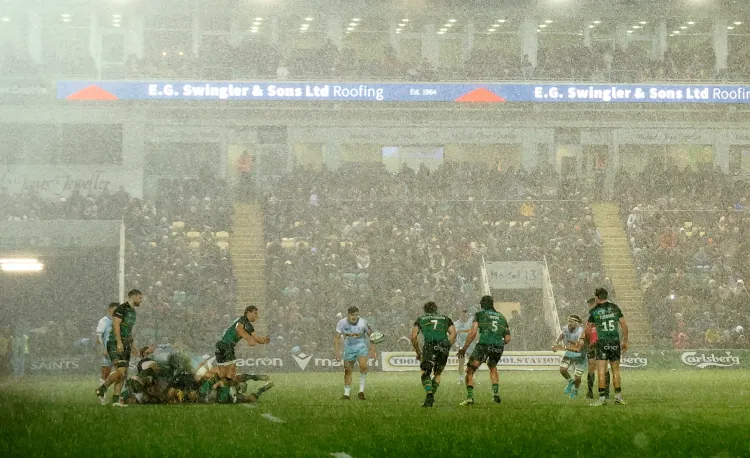
Weather affects ball handling in professional rugby by fundamentally altering the friction between a player’s skin and the ball’s surface, while simultaneously changing the physical properties of the ball itself. Rain, freezing temperatures, and heavy humidity routinely force teams to abandon wide passing strategies in favor of kicking for territory and engaging in tight, conservative forward play.
Rugby is a game built on continuous possession and rapid ball movement. But when the weather turns poor, the fundamental mechanics of catching, passing, and securing the ball break down. Casual fans often notice a sudden increase in dropped balls during a rainstorm, but the physical reasons behind these errors go far beyond things just being wet. Coaches and players must completely rewrite their game plans based on the moisture in the air, the temperature on the pitch, and the specific manufacturing of the ball.
Understanding how weather dictates play offers a totally different perspective on the sport. A sunny afternoon match looks entirely different from a freezing night game, and the reasons rely on biomechanics, friction science, and tactical survival.
How Skin-to-Ball Friction Works
The relationship between a player’s hands and the rugby ball operates on what researchers call a “bell-shape” moisture curve. Counterintuitively, a completely dry hand does not offer the absolute best grip. Initial moisture actually improves friction. If a player’s hands are exposed to light moisture for roughly thirty seconds, the skin absorbs the water. This absorption creates capillary adhesion, meaning the slight dampness helps the skin stick to the surface of the ball.
But this benefit disappears quickly as moisture increases. Once the skin becomes fully saturated by continuous rain, it can no longer absorb water. A fluid film forms across the surface of the hands. This film acts as a lubricant, drastically dropping the friction coefficient. When a player tries to catch a fast pass, the ball simply slides straight through their fingers.
The manufacturing of the ball plays a direct role in combating this fluid film. Professional rugby balls are manufactured differently based on the climate they will be used in. Balls designed specifically for wet conditions, often called “Traction Grip” variants, feature rubber pimples that are placed further apart. This wider spacing allows water to channel and drip off the surface, preventing the ball from aquaplaning across the player’s hand upon contact.
Conversely, balls built for dry, warm climates use a “Firm Grip” design. These balls feature a highly dense pimple pattern to maximize the friction coefficient in optimal conditions. But using a dry-weather ball in a rainstorm is a disaster. The dense pimples trap the water between them, creating a completely slick, uncatchable surface.
How Cold and Humidity Change the Game
Rain is not the only weather element that destroys ball handling. Freezing temperatures create a compounding physical problem for both the equipment and the athletes. When the temperature drops toward freezing, the physical rubber and synthetic materials of the ball harden. The ball becomes significantly less malleable, making it physically harder to squeeze and secure during a fast-moving play.
At the exact same time, the cold wreaks havoc on the human body. As a player gets cold, reduced blood flow to the hands leads to a severe loss of tactile sensation. The player quite literally cannot feel the ball properly. Furthermore, the cold slows down muscle contractions in the fingers and forearms, meaning the player cannot close their hands fast enough to catch a hard pass or complete a quick offload in a tackle.
Heat and humidity present an entirely different problem that produces the exact same result as rain. In extremely hot conditions with high humidity, a player’s sweat cannot efficiently evaporate into the air to cool the body down. Instead, the sweat pools heavily on the skin or drips continuously down the arms onto the hands. This sweat creates the exact same fluid film as a rainstorm. Players experience unexpected and frustrating handling drops even on days when the sky is completely clear.
Why Teams Change Tactics / When It Applies
Professional teams do not simply hope for the best when the weather turns bad. They alter their entire structural approach to the match. Statistical data from professional leagues shows exactly why this is necessary. Historical tracking reveals that matches played in the rain show a sharp increase in dropped balls compared to mild conditions. As handling errors spike, the game suffers a noticeable drop in overall points scored. The total distance covered by players drops significantly because the game pace slows down due to frequent stoppages from knock-ons (dropped balls that travel forward).
Because every dropped ball results in a scrum for the opposing team, wet weather turns a fast-paced running game into a grinding contest of set-pieces. Coaches mandate a “safety-first” contact style, often referred to as a “100% Contact Ball” protocol. Players are instructed to hold the ball firmly with two hands at all times in contact. They spread their fingers wide across the ball to soften the physical impact of the tackle. When they go to the ground, they delay placing the ball at the ruck until the very last moment, ensuring they maintain control in the slick mud.
The attacking shape of the team also changes. Wide, expansive passing attacks are abandoned. Shorter passes are preferred over long, lateral throws that are easily affected by wind and a slippery surface. To adjust for these shorter passes, teams compress their backlines. Instead of standing wide near the sidelines, receiving players like wingers stand closer to the action and execute arcing runs to find space on the outside, rather than relying on the ball traveling thirty meters through the wet air.
Territory kicking becomes the most reliable weapon on the pitch. Catching a wet, high ball while running at full speed is incredibly difficult. Teams exploit this by deliberately kicking the ball high into the opposition’s half, forcing the other team to attempt a dangerous catch. To set up these kicks, the forwards utilize a “pick-and-go” strategy. They keep the ball in very tight quarters, taking short runs straight into the defensive line to secure favorable field position simply to kick it away and pressure the opposing back three.
Famous Examples from Match Economics
The impact of weather on professional rugby is so reliable that it fundamentally alters the economics and betting markets surrounding the sport. Professional sports bettors and bookmakers actively adjust their predictive models based entirely on the weather forecast leading up to kickoff.
When heavy rain is predicted, betting models immediately push toward “Under” bets on total points. The probability of teams scoring tries through wide-passing moves decreases heavily. The odds shift toward a forward-dominated game that relies on penalty goals and tight territory play rather than expansive scoring.
Wind is just as influential as rain on match outcomes and market predictions. High winds directly impact proposition betting markets, specifically concerning goal-kicking accuracy and successful drop goals. In the large, open-air stadiums commonly found across Australia and New Zealand, crosswinds can alter the flight of the ball severely. The wind becomes so disruptive that teams frequently turn down kickable penalty goals to kick for the corner instead. This entirely shifts how a match is scored, forcing teams to rely on dominant lineouts and forward pushes rather than taking the guaranteed three points from the kicking tee.
Common Misconceptions
A dry day guarantees perfect handling conditions.
Many fans assume a lack of rain means the ball will stay dry. But heat and high humidity prevent sweat from evaporating. Sweat pools on the players’ arms and drips onto the hands and ball, creating a fluid film that causes handling errors similar to a wet weather game.
All professional rugby balls are identical.
Equipment varies drastically depending on the environment. Teams use “Traction Grip” balls in wet weather, which have widely spaced pimples to prevent aquaplaning. Using a “Firm Grip” ball with dense pimples during a rainstorm traps water on the surface and makes the ball virtually impossible to catch.
Cold weather only affects player comfort.
Freezing temperatures physically alter the equipment. The ball becomes much harder and less malleable. In addition, the cold reduces blood flow to the players’ hands, causing a loss of tactile sensation and slowing down the muscle contractions needed to securely grasp the ball.
Frequently Asked Questions
Do rugby players change the type of ball they use in the rain?
Yes, in professional environments, teams utilize specific wet-weather rugby balls. These “Traction Grip” variants have pimples spaced further apart. This design channels water away from the surface and prevents the ball from aquaplaning across the player’s hand.
Why do rugby players make more handling errors in the cold even if it isn’t raining?
Freezing temperatures cause the physical ball to become much harder and less malleable. Additionally, the cold reduces blood flow to the players’ hands. This decreases their tactile sensitivity and slows down the muscle contractions needed to securely catch and pass the ball.
Does sweat affect ball handling as much as rain?
Yes, especially in hot, humid conditions. When humidity is high, sweat cannot evaporate effectively to cool the body. Instead, it pools on the skin or drips onto the hands and ball, creating a lubricating fluid film that drastically reduces the skin’s friction coefficient, leading to dropped balls.
How do rugby tactics change when the ball is wet?
Teams shift to conservative, territory-based game plans. This includes utilizing shorter passes by compressing the backline, increasing the use of high kicks to force handling errors from the opposition, and employing tight “pick-and-go” forward phases to minimize the risk of dropping a slippery ball in wide channels.