
Europeans usually don’t rely much on air conditioning. Only about 20% of homes have it, according to the International Energy Agency (IEA). This is quite different from places like the United States, where roughly 90% of homes use AC. But things are changing quickly. Longer, hotter summers are making more people want to cool down.
This year is setting new heat records. Many parts of Europe are seeing temperatures above 40 degrees Celsius (104 degrees Fahrenheit). Portugal, for example, has been especially hot. This intense heat is a big reason why AC sales are spiking. But it’s not just the weather. People’s lifestyles are also shifting. More folks are working from home, and incomes are changing. These factors are all driving the demand for cooling devices, as a recent IEA report highlighted.
Paolo Spranzi, a partner at McKinsey, noted this “acceleration” in Europe’s cooling market. He specifically pointed to this year’s heatwaves. “Things are changing,” Spranzi told CNBC. “We are seeing more frequent and longer heatwaves. This is true even in northern Europe, where fewer people have AC.”
When it comes to AC, there are different trends. Fabian Voswinkel, an energy efficiency policy analyst at the IEA, explained that demand is growing for both portable units and built-in systems. But they are not growing at the same speed. Built-in AC takes longer to install. It’s often a one-time purchase, so its growth is slower. Portable units, however, are flying off the shelves. Stores are reporting “months-long queues well into the summer” for them. This shows a very specific and urgent demand.
The demand for cooling technology isn’t just for homes. Companies like Johnson Controls, which makes building technologies, are seeing more interest in HVAC (heating, ventilation, and air conditioning) systems for data centers. They also see increased demand in healthcare, industrial buildings, and commercial properties. Katie McGinty, Johnson Controls’ chief sustainability officer, pointed out the link to artificial intelligence. “As AI use grows, so does the need for smarter, more efficient cooling systems,” she said. This makes HVAC a vital part of digital transformation. She also mentioned rising interest in heat pumps, which can both heat and cool a space.
Cooling Demand: A Challenge for Energy and Climate
The IEA warns that energy needed for cooling could almost triple by 2050 if we don’t manage it better. Paolo Spranzi recalled that in Europe, “air conditioning was seen as a luxury, even a waste of money, given the high electricity costs.” Now, younger generations don’t think of AC as a luxury. Plus, more people working from home means more need to cool living spaces.
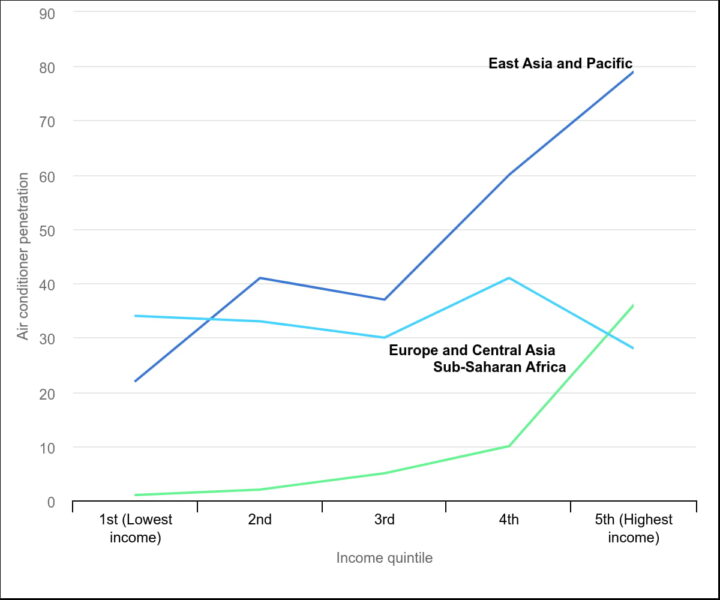
Heating and cooling buildings accounts for 20% of global carbon dioxide emissions. This makes AC a major contributor to global emissions. Spranzi believes thinking about sustainability is key when developing new AC units.
The future of Europe’s power grid is also a complex issue. Diego Hernandez Diaz from McKinsey notes that utility companies predict annual load growth of 1% to 8% in the next five years. This growth varies by country. Grids across Europe are expanding to handle extra demand. This extra demand comes from cooling, electric vehicle charging, heat pumps, and a more electrified industry. Still, there are limits. Fabian Voswinkel warned, “Right now, if all Germans suddenly said, ‘I’m going to buy a portable air conditioner to plug in at night,’ things could get tricky.”