
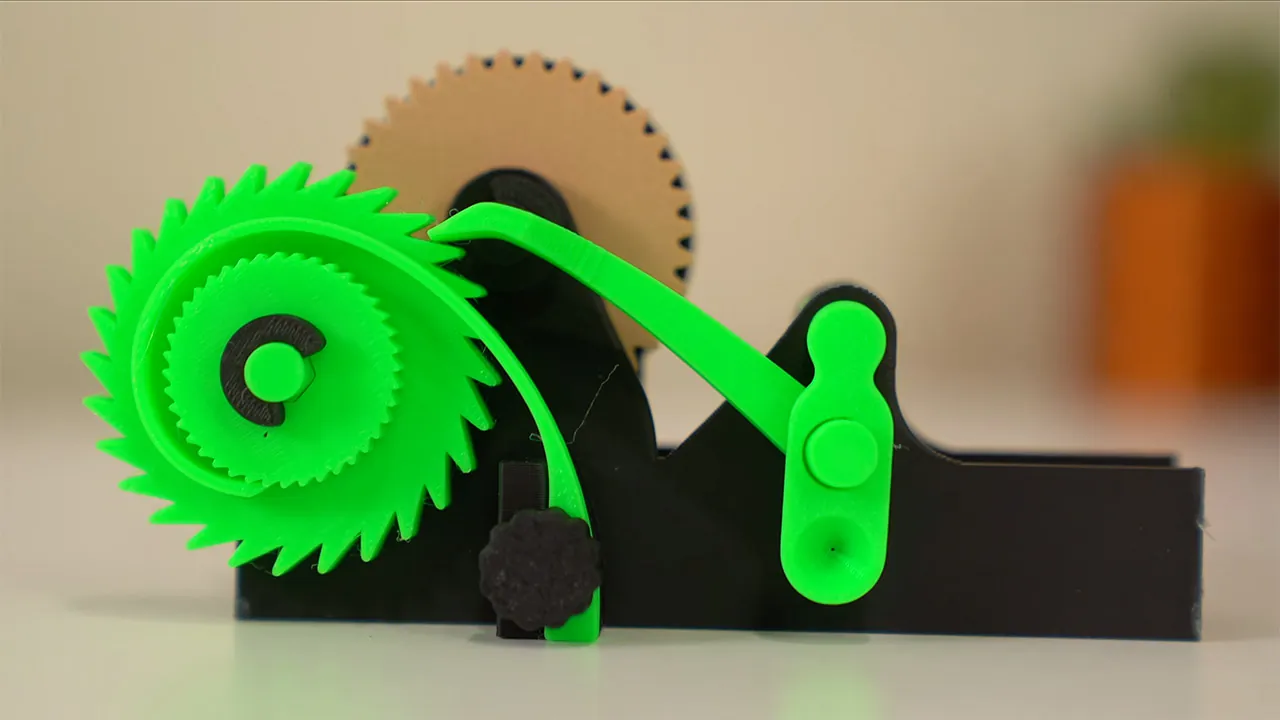
Imagine losing a game of Tic-Tac-Toe to a pile of plastic. That is exactly what happens when you challenge the XXO-Master. Printables user and YouTuber Alex Krasno (akrasno) has designed a purely mechanical computer that plays a perfect, unbeatable game of Tic-Tac-Toe.
It uses zero electronics. No software, no microchips, and absolutely no batteries. You turn a dial, push a handle, and the machine physically calculates its next move to guarantee you will either lose or draw.
How does it actually pull this off? The machine functions as a giant physical lookup table. When it is your turn, you input your move by turning a front dial to select a grid square and mark an ‘X’. Then, you pull and push a side release handle.
Inside the chassis, an intricate system of rods evaluates your move against a stacked deck of internal logic cards. It is an astonishing design, and according to a detailed breakdown of the hardware, dropping the correct card forces a reply rod to instantly output an ‘O’ in the optimal defensive or offensive position.
The real genius here is the math. A brute-force physical computer covering the entire game tree of reachable board states would require 301 distinct logic cards. That would make the machine over 30 centimeters long and incredibly annoying to operate.
Krasno wasn’t going to settle for that. He treated the optimization as an NP-hard “Set Cover” problem. By introducing clever physical wildcards into the design, he successfully compressed the entire logic engine down to just 65 printable cards.
You can actually build one right now. The STL files are free to download on Printables. The full assembly takes around 22 standard print runs. You just need to supply 20 M3 screws and 36 neodymium magnets to keep the internal gears perfectly centered.
How Edge-Notched Cards Inspired a Modern Plastic Brain
The XXO-Master is essentially a physical search engine. Its core mechanism directly borrows from vintage edge-notched cards.
Long before digital SQL databases existed, libraries and researchers used paper cards with holes punched along the edges to sort information. By running a long needle through a stack of these cards, the ones with specific notches cut out would physically drop from the deck. Krasno took that mid-century analog tech and repurposed it for game theory. The plastic logic cards in the XXO-Master drop in the exact same way when the internal rods match the current board state.
It is a brilliant reminder that computing does not actually require electricity. Sometimes, all you need is gravity, plastic, and some very clever math.