
Email along with social networks are some of the communication channels most used by marketers. Help to maintain the link with customers and increase conversion rates. Do you want to know how to use the email marketing to make the relationship with the client more solid and that this bond serves to reactivate your business? In this post we explain everything you need to know for your business to go from strength to strength. Are you going to miss it?
Email marketing, also known as emailing, is based on the mass sending of emails to a list of contacts. It is a mix between communication and direct marketing. You may ask, what is the purpose of this? The goal is to communicate discounts or promote a product or brand to your customers to get a better relationship with these.
Potential customers are easily and effectively reached. Not only to inboxes, but directly to the customer’s hand thanks to the mobile devices. Many users have personal and professional email configured on their smartphone or tablet. About half of the emails are opened from a mobile and this forces us to make their designs responsive. That is why many believe that email marketing will evolve into mobile email marketing.
It should be noted that the acceleration of digital transformation has led to the emergence of other marketing tools. Nevertheless, e-mail continues to be the medium with the greatest potential to capture the attention of the consumer.
What is email marketing for?
Emailing is not just for sending emails and that’s it. It has several goals which they intend to improve any ecommerce. Some of these purposes are as follows:
- Maintain contact with customers
- convert leads
- Send customers news, news, discounts, promotions, etc.
- Collect opinions and feedback
- Generate engagement
- Develop content marketing strategies
3 email marketing tips to keep in mind
- Establish SMART goals and a contact strategy. SMART goals are named after the initials of five words: Specific (specific), Measurable (measurable), Achievable (realizable), Realistic (realistic) and Timed (time). This will allow you to define clear KPIs, contact strategies for each campaign, scheduled emails, frequency with which emails are sent, etc.
- The three Vs to get registrations via email.
- Visibility. Everything must be located well so that the user has the clearest information.
- Worth. List the benefits in the email you send.
- Velocity. The registration of the email has to be fast, we do not want the client to get bored or provide difficulties in the process.
- Identify the correct metrics. There are two types of metrics. The important thing is to know which ones to use.
- Process metrics: they give trend indicators over time, but do not necessarily indicate that the campaign has been successful. Some examples are:
accepted rate. The percentage of emails delivered compared to the number sent.
bounce rate. The percentage of undelivered emails.
Openrate. The percentage of opened emails.
Click through rate (CTR). The percentage of recipients who have clicked on any of the links contained in the email.
Click-to-open rate (CTOR). It is the percentage of recipients who have clicked on one of the links contained in the email divided by the number of opened emails, and the result is multiplied by 100. This way, the quality of the content and the level of engagement can be evaluated.
- Results metrics: They measure the objectives of a company or brand and are a better indicator of the success of an email marketing campaign. Some examples are:
New subscribers or registration fee.
Conversion rate. The percentage of recipients who sign up based on the purpose of the email.
Value of an email address. Average lifespan of an email. You use this kpi to determine how much money you are willing to spend on getting a new customer.
Cost per acquisition. The average amount required to acquire a record or customer.
return by email. The amount of revenue earned during a campaign divided by the number of emails delivered, opened, or clicked.
return per customer. The average or median revenue generated across all members of the contact base or those who convert.
Average order value.
lifetime value. The money a subscriber gets to spend with you over their lifetime in your contact base.
Email marketing in figures
This tool is a ‘bargain’ and I’m not saying it, the figures say it. There are several companies that have conducted studies on the reliability of this. Such is the case of Digital Response, an agency specialized in email marketing and marketing automation services. It has published the 5th edition of the report known as “Research on the use and perception of email marketing in Spain in 2022”. To prepare it, they have had the participation of 54 companies of different profiles. Most of them have stated that the The objective pursued with email marketing is to generate salesbelow, with 53.7%, is generating traffic, with 51% engagement, and, finally, with 27.8% Inboud Marketing.
These companies report that they typically complement this tool with other channels that maximize the overall result. Most bet on combining it with the social mediawhile there are few that still do not coordinate them with another plan.
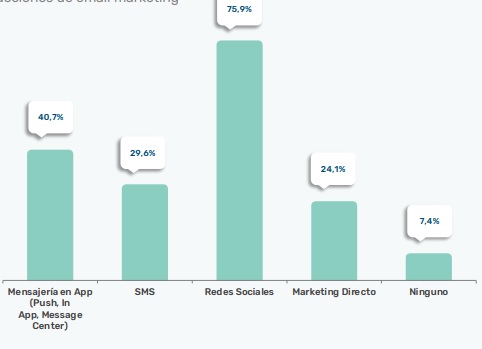
The report also makes it clear to us that it is necessary make a good segmentation of the database to make shipments much more effective and adapted to subscribers. The vast majority use behavioral and sociodemographic data. More and more companies are concerned with getting to know the users that make up their database well in order to address them in a much more personalized way, thus increasing the chances of having a positive impact on them.
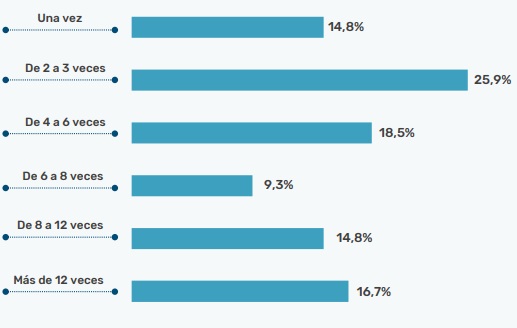
According to the email sending frequencyThey vary depending on the sector of the company or its needs. Most of the companies coincide in sending 2 to 3 emails a month. While only 9% usually send between 6 and 8.
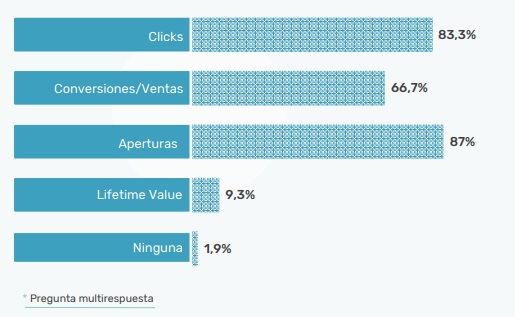
Best indicators to evaluate the performance of email markerting
Almost all the companies that have participated in the study, if not all, use the same metrics to measure email marketing success. Open rate and click rate are the most significant metrics when it comes to evaluating the results and performance of email marketing. Although the conversion rate also has a high percentage.
These three rates mentioned above have remained positive compared to the previous year. 42.6% of those surveyed affirm that the open rate has increased. The click rate has been maintained, according to almost half of the companies. As for the conversion rate, the “has decreased” answers have increased more than 20 points compared to the previous year.
Results and expectations of email marketing
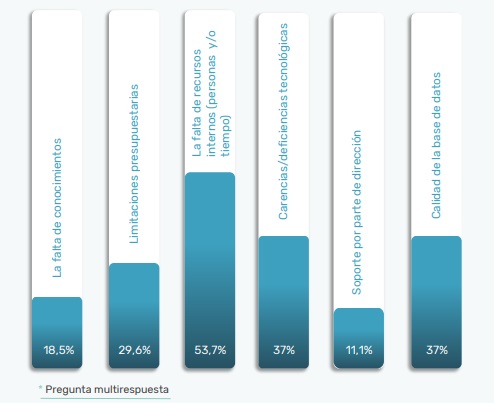
53.7% of the companies surveyed agree that the reason why they do not achieve the objectives related to email marketing is the lack of internal resources, either due to lack of staff or time. Last year it was also the most common reason with 58.6%.
Despite not having achieved their objectives, the companies declare that rate the use of email marketing with a high score. 33.3% rate it as a 7, followed by 29.6% who would rate it an 8. Therefore, more than 50% of the participants would move around notable. We also see reflected that the lowest percentages would be in the fail and excellent range.
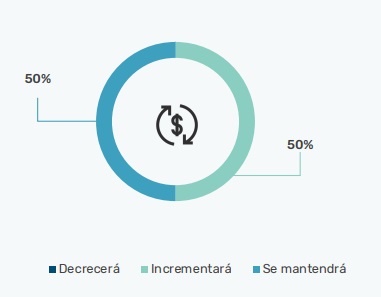
Investment
In it, they were asked the question of how they see the investment in email marketing in the medium term. According to the graph, it can be seen that the companies are divided, whether it will be maintained or increased. None opted for the option that it will decrease.
Top 4 best email marketing tools
Have you come this far? Great, don’t go, you have the best part left. In this last section we offer you the 5 best email marketing tools totally free. They are the following:
this tool serves more than 150 countries and seeks to be a global solution for all email marketing needs.
The free plan It allows you to have an unlimited number of contacts, which is a clear advantage over other free email marketing tools. What is limited is the number of emails you can send: 200 per day or 6,000 per month. To remove this limit and Mailjet branding and have 24/7 support, you can choose one of their paid plans starting at $9.65 per month.
Easymailing is a new email marketing tool born in 2020 that stands out for its ease of use, and the support it has in Spanish. Is Aimed above all at SMEs, communication agencies and the self-employed. It offers advanced segmentations and a very intuitive template editor with a wide variety of templates.
With the free version you can have up to 250 subscribers and send 2000 emails per month. Payment plans start at €12 per month, with unlimited shipments. They have support through different channels (email, chat and telephone) and a knowledge base in Spanish.
Mailify is a email marketing tool, mass SMS and marketing automation. It offers an intuitive editor, EmailBuilder, to design attractive newsletters as well as responsive templates and professional HD images for free download. It presents free intelligent functionalities such as: Predictive Sending, Heatmap, Sending by intervals, etc.
With the free version you can send up to 500 emails. What sets it apart from its competitors is that unlimited contacts can be imported, it is available in 6 languages (French, English, Spanish, Portuguese, German and Dutch), it can be connected with more than 30 applications (Google Analytics, WordPress, PrestaShop, etc) and offers free consultations in all languages.
This free email tool it is relatively newbut it has gotten a lot of positive feedback from users.
The free plan allows you to send up to 15,000 emails per month to a database of up to 2,500 users. Paid plans, starting at $9.85 per month, also allow you to send SMS and push notifications. It also has a very simple interface, so It is ideal to start in email marketing.