
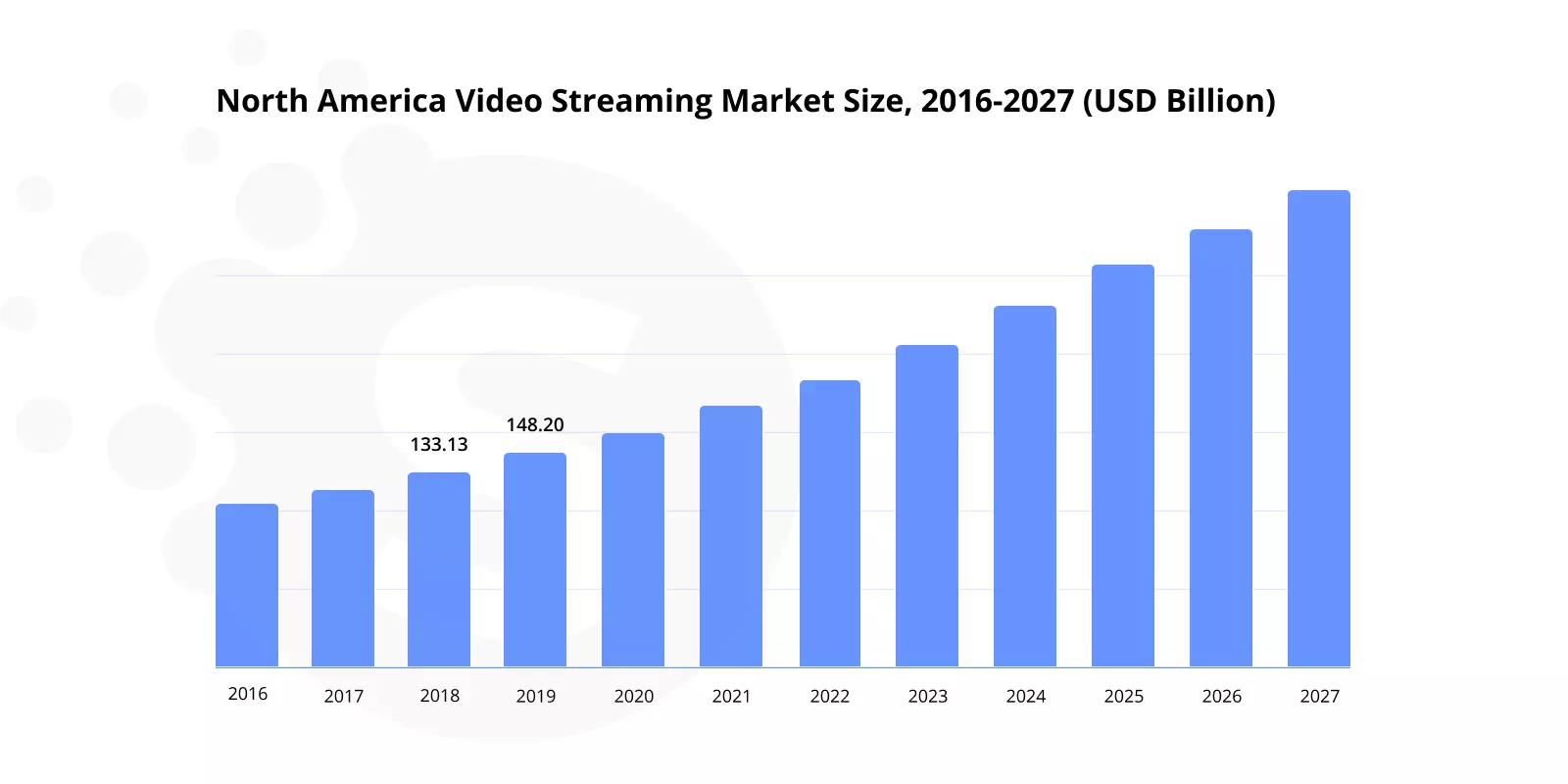
Live video streaming technologies have gained in popularity in recent years. According to App Annie’s State of Mobile 2021 report, global mobile users streamed 146 billion hours on mobile devices in Q1 2019. By Q4 2020, they had streamed over 240 billion hours, a 65 percent increase in only two years. According to the most recent predictions, the entire market size will be $842.93 billion by 2027. To put it mildly, a lot of individuals are interested in participating in this.
So, before we go into the details of how to build a streaming platform, let’s have a look at some of the many types of video streaming services accessible.
Video streaming application types:
– Apps for live video streaming.
– Apps for On-Demand Video Streaming.
– TV Providers’ or Networks’ Video Streaming Apps
When it comes to creating a video streaming app, there are a few apparent advantages.
– Reach the Right Audience – Increased Conversion Rate – Availability in a variety of formats – Content Variety
Application Architecture for Video Streaming
Fault-tolerant processing, storage, and geographical distribution are all required for data streams. Processing frameworks must thus depend on queuing systems such as Apache Kafka. If you’re building a streaming platform, this is a system to think about.
Samza, Storm, Flink, and Spark are processing frameworks that can be linked with a streaming platform to feed the data-processing pipeline and handle batch data. Netflix uses Kafka as a real-time monitoring tool and an event-processing pipeline. Microservice architecture is used, which is based on micro-batch processing.
Developing the backend infrastructure is perhaps the most difficult aspect of developing a VOD platform. The two most prevalent current options are HTTP Live Streaming (aka HLS) and Dynamic Adaptive Streaming over HTTP (called MPEG-DASH). Both function by breaking down any media material into little chunks and transmitting them via HTTP to the end user.
MPEG-DASH is an adaptive bitrate (ABR) protocol that detects changes in the internet connection and selects the best video quality based on those changes, hence eliminating buffering. MPEG-DASH also permits any video and audio codec to be used (WebM, H.264, AAC, MP3, etc.).
Apple invented HTTP Live Streaming (also known as HLS). It’s also a well-known ABR protocol that allows for several alternative streams at various bitrates, user authentication, and media encryption. H.264, H.265, AAC, and MP3 video and audio codecs are supported.
Video streaming app development company Trembit will help you figure everything out.
For video streaming app development, a popular tech stack is:
Netflix’s technology stack
Netflix delivers content using a custom CDN hosted on Amazon’s servers. MySQL, PostgreSQL, Cassandra, and Oracle are the databases they employ. Their front end is made up of Node.js and React, as well as Falcor, a proprietary JavaScript package that makes content delivery simple.
Hulu’s technology stack
Hulu’s core components were recently rebuilt, and the company detailed the process on its tech blog. Their front end now utilizes Node.js and React, with server-side rendering handled by next.js.
The Disney+ technology stack
Disney isn’t as open about its technologies as Hulu and Netflix are. Nonetheless, we may anticipate that Disney Plus will use comparable front-end technologies such as Node.js, React, and Java, with Amazon hosting.
The development of live video streaming software is a whole distinct process that will almost certainly use WebRTC.
The procedure for creating a video streaming app:
If your objective is to create a Netflix-style video streaming service, bear in mind that although each product’s development process is unique, it will have some similarities to other goods.
The wireframe is the foundation upon which the application will be built. That’s a very basic sketch of how the app might (but probably won’t) appear in the future. This essential step will guarantee that everyone involved in the development process is on the same page.
The creation of a functioning prototype is the next phase in the development of a streaming application. That isn’t the MVP, which is a ready-to-deploy version of the product, but rather a rudimentary version that can be utilized. This is an early version that is used to investigate the feasibility and collect critical early input.
After the first prototype is produced, UI and UX design begin simultaneously with development. This process has its own set of phases and stages that culminate in the app’s final, polished appearance and feel. While designers provide advice to video streaming software developers, they expand on the key functions and add all of the extras.
To decrease the number of versions and, as a consequence, total development expenses, testing should begin far before the final product is delivered – test for performance, security, usability, and compatibility throughout the development stage and after deployment.