
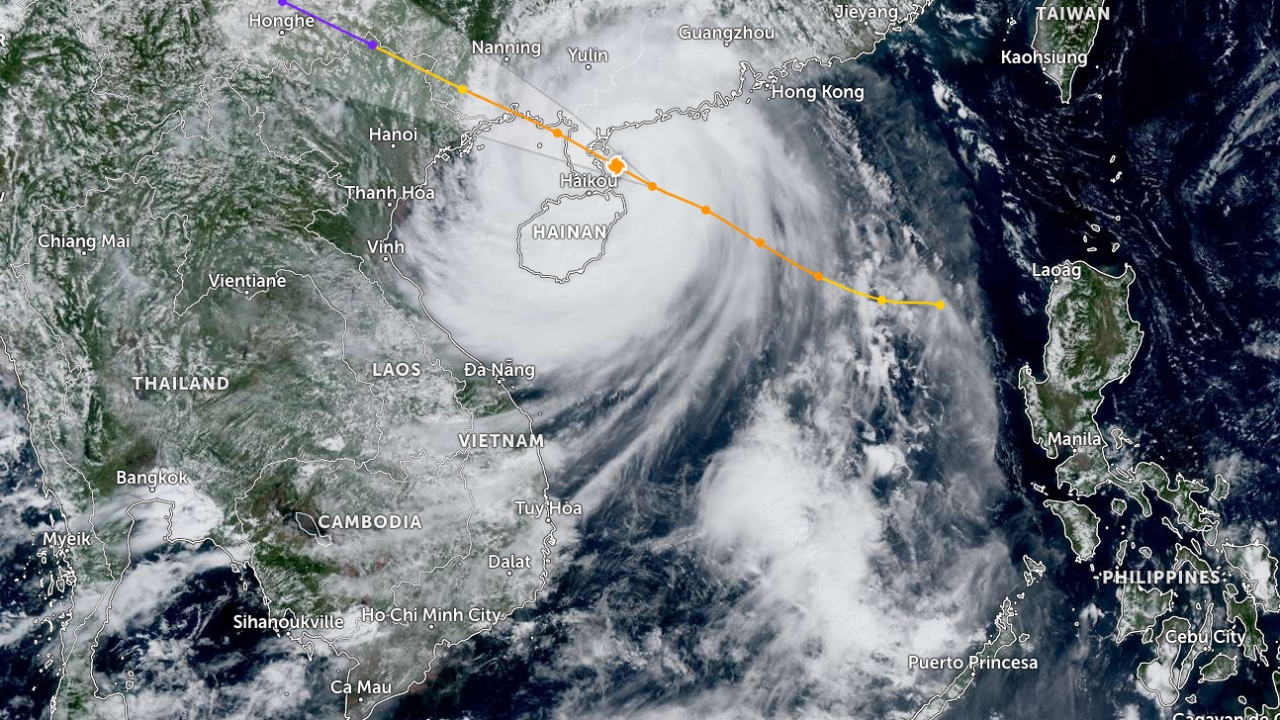
Coastal regions braced themselves as Typhoon Matmo grew into a powerful storm. It reached its strongest level before hitting southern China’s Guangdong province on Sunday, October 5th. Authorities issued a top-level red alert. They quickly moved more than 150,000 people to safety.
Officials in Guangdong took action, evacuating 151,000 residents from high-risk areas. The Chinese National Meteorological Center reported Matmo’s highest wind speeds hit 151 kilometers per hour early Sunday morning. The storm was expected to make landfall around noon that day.
Hainan province, directly in Matmo’s path, began preparing on Saturday. Flights were canceled, and public transportation services stopped. Businesses closed their doors to ensure safety for everyone. Meanwhile, the special administrative region of Macau also saw disruptions. Though not directly hit, Macau canceled classes and tutoring activities. Officials there warned of heavy rainfall, with some areas expecting up to 100 to 249 millimeters of water.
The Vietnam National Hydrometeorological Center tracked the typhoon closely. At 7:00 AM on Sunday, Matmo’s eye was about 70 kilometers northeast of Hainan Island. It was also around 420 kilometers from Quang Ninh province in Vietnam, which borders China and is home to Ha Long Bay. At that time, the storm had sustained winds of 149 kilometers per hour. Gusts were even stronger, reaching 167 to 183 kilometers per hour. Matmo was moving quickly, traveling at 25 kilometers per hour.
After its initial impact on China, Matmo was predicted to shift direction. It would head west and then north, moving towards northern Vietnam and China’s Yunnan province. Forecasters expected the typhoon to be west of China’s Leizhou Peninsula by 4:00 PM Sunday. It would be about 250 kilometers from Quang Ninh, with wind speeds dropping to 133 kilometers per hour. By 4:00 AM on Monday, the storm was expected to be near the coast between Quang Ninh and Haiphong, with winds further weakening to 75 to 88 kilometers per hour. Matmo would likely move inland through Quang Ninh, cross the Vietnam-China border, and eventually lose strength, becoming a tropical depression.