
A research team – led by the University of the Balearic Islands (UIB), the Mediterranean Institute for Advanced Studies (IMEDEA-CSIC) and involving the Center for Advanced Studies of Blanes (CEAB-CSIC) and the Italian Consiglio Nazionale Delle Ricerche has created a new one Polychaete species discovered an anchialine cave from the island of Mallorca.
These types of cavities appear to be far from the sea but are filled with water distributed in two layers: the top layer comes from the rain, the other comes from the surface. The lower part is brackish and generally enters the sea by slow filtration. The cave is very difficult to access, has no natural light and, due to its isolation, has few nutrients and dissolved oxygen in the water. For all these reasons, the entry and survival of organisms is very limited. TO eighteen feet deepThe polychaetes live under the sediments of the cave.
The first belongs to a previously unknown species. Its morphology differs from that of the species and genera already described. For this reason, a new genre had to be established. The annelid measures about two centimetersIt has no eyes and is almost transparent (the brain is visible, characteristically deep red pigmented). The back, like the other members of the taxonomic group to which it belongs, is covered with scales commonly known as “scale worms”. In addition, it features two pairs of parrot-shaped jaws.
Although it lives in sediment, with the advent of divers it was able to quickly surface and swim with sinusoidal movements. Surprisingly, this annelid related to bloodlines living in the depths of the Pacific and on the Antarctic continental shelf. This points to a possibly very old connection, when the configuration of the continents was still completely different.
The second genus is an already known genus, but the species is new and has never been described. HE
includes the taxonomic group commonly known as spaghetti worms, because they live in burrows built by themselves with the surrounding sediments, and under normal conditions one can only see their numerous long and thin tentacles, which they use to procure food. It measures about two inches, although its body is very soft and contracts and expands significantly. It is yellowish in color but is also quite transparent and may be bioluminescent (this fact will be verified on future expeditions to the cave).
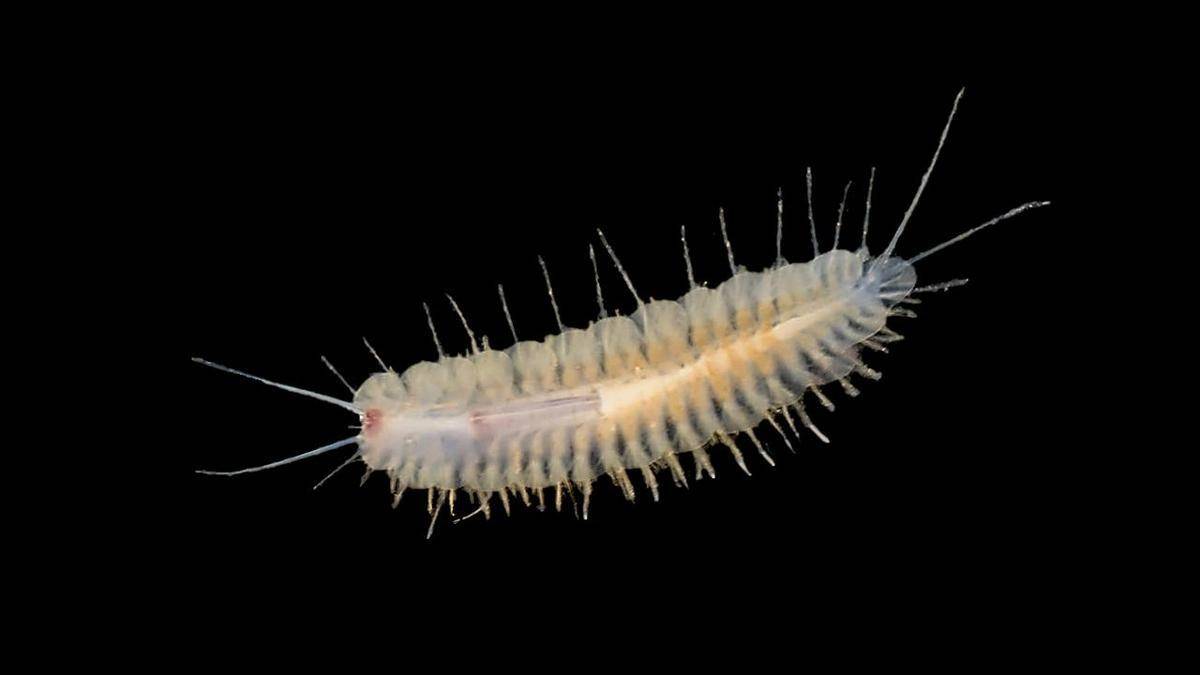
One of two new species described in the study. / Maria Capa
A third small finding
The same anchialin cavity was the site of a third finding, albeit less
taxonomic relevance. It is a polychet already catalogued, but always in caves directly connected to the sea and in semi-dark environments of the rocky coastal area.
This discovery increases Puzzle like the way the polycheet got into the cave; the possibility that this happened a long time ago, when the level of the Mediterranean Sea was higher; whether it can really be considered the same species as its marine relatives; or how the two new species could have remained isolated if there had ever been direct communication with open waters.
The story of the discovery began in 2019 with a first scientific expedition to the cave. A year later, the team returned to conducting dives. Research was then carried out that allowed us to confirm the discoveries and make progress in the characterization of polychaetes. This year 2022 was described first. The UIB team made it under the direction of Maria Capa.
Scientists are currently preparing the description and cataloging of the other new species, as well as the strategy to solve the questions raised by the three finds. This task will be carried out as part of the research project that the Spanish State has just awarded under the “Generation of Knowledge” program, which will allow further fieldwork to be carried out in the region Caves of the Balearic Islandsto study biodiversity.