
The smart contract platform Cardano, which was conceived to dethrone Ethereum, is immensely popular from the beginning of 2023. Whales in particular have the project in their sights this year and are quietly accumulating tokens from the project. Apparently they are waiting for a huge price explosion for the token or they are trying to create a hype in this way.
Good blockchain performance
Blockchain technology makes it possible to analyze in detail the status of the health of a project. For example, by monitoring the activity on the blockchain. In the case of Cardano, transaction volume is up 205 percent from the start of the year.
This seems to be mainly the result of the buying actions of whales. On a daily basis, more than 26 billion Cardano tokens or ADA move back and forth on the blockchain.
Cardano introduced quite recently Hydra, a scalability solution that provides a second layer on Cardano, so to speak. In principle, this means that these transactions do not end up on the blockchain, although IntoTheBlock expects that this will have little impact on the figures of the Cardano blockchain.
At least for now, they expect the impact of this upgrade for Cardano to be minimal in the short term. In the long run, it’s theoretically possible that this will shift a lot of activity to the second tier, which wouldn’t be a bad thing for Cardano at all. After all, that benefits scalability.
Buy whales
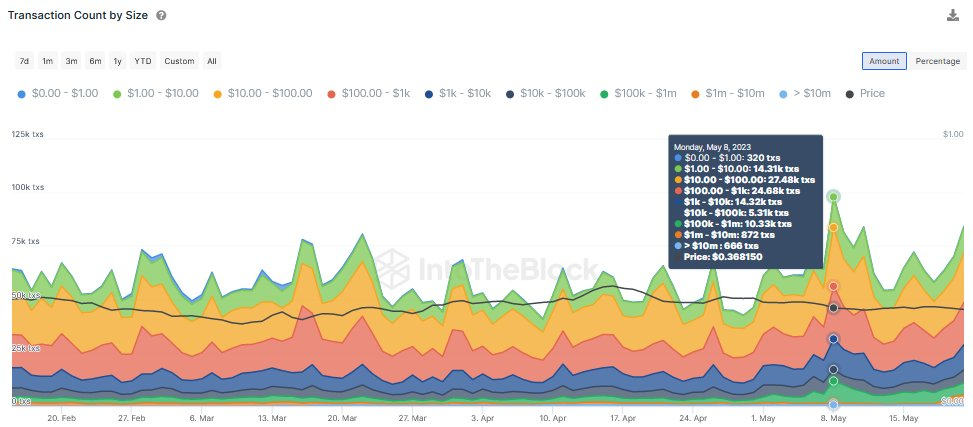
IntoTheBlock also reports that it is mainly the whales that are currently buying Cardano. Although the most active users in the network are people who trade with amounts from 10 to 200 dollars. Surely these will mainly be the smaller investors and not the whales.
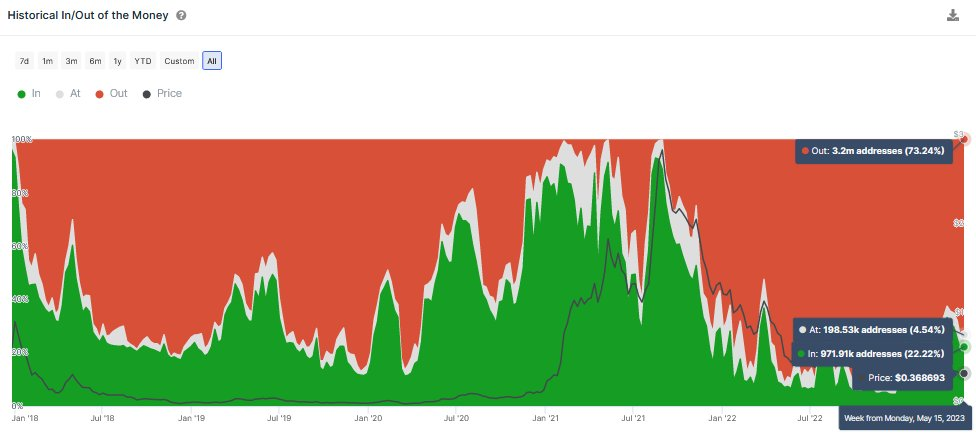
At the time of writing, 22.2 percent of all addresses on the blockchain are on a virtual profit. Just under 4.5 percent is breaking even and 73.2 percent is virtually in the red.
Particularly at the end of April, a group of whales seemed to wake up for a while. In the meantime, activity in that area has dropped again, or at least returned to a normal level.
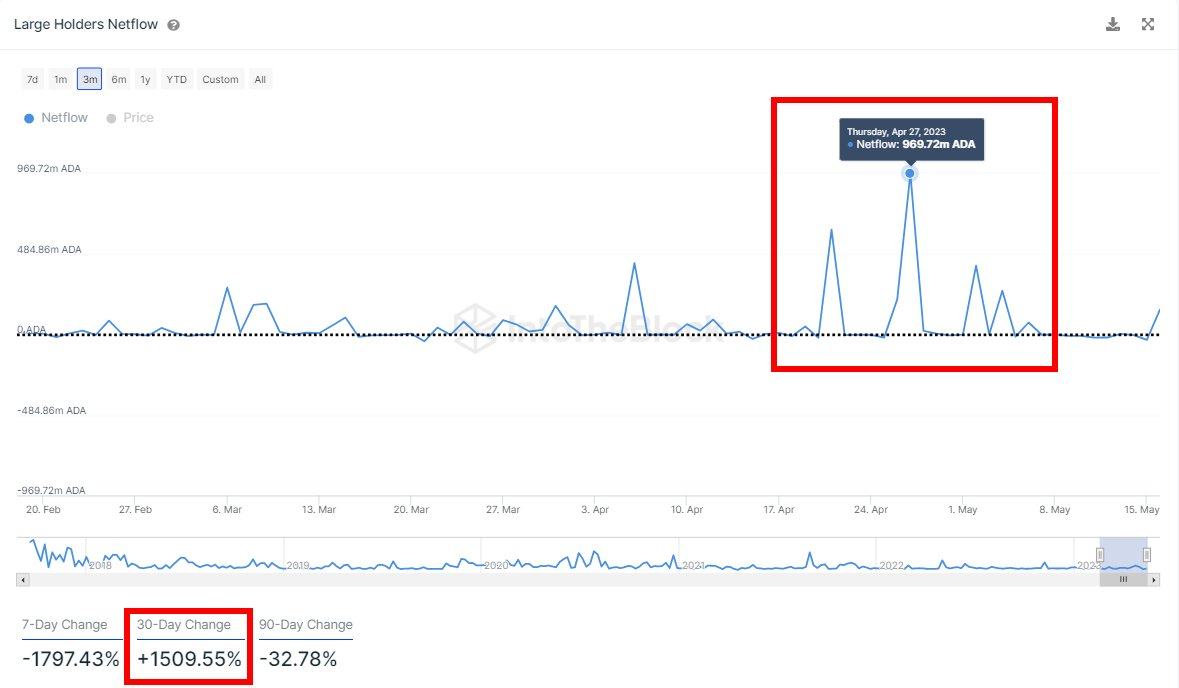
However, due to the gigantic peak at the end of April, the 30-day average has increased enormously by 1,500 percent.